The Zero Fee Is the Receipt: Finland's Battery Case Moves From Reserves to Energy
3 October 2026 · 8 min read · Auranova Ventures
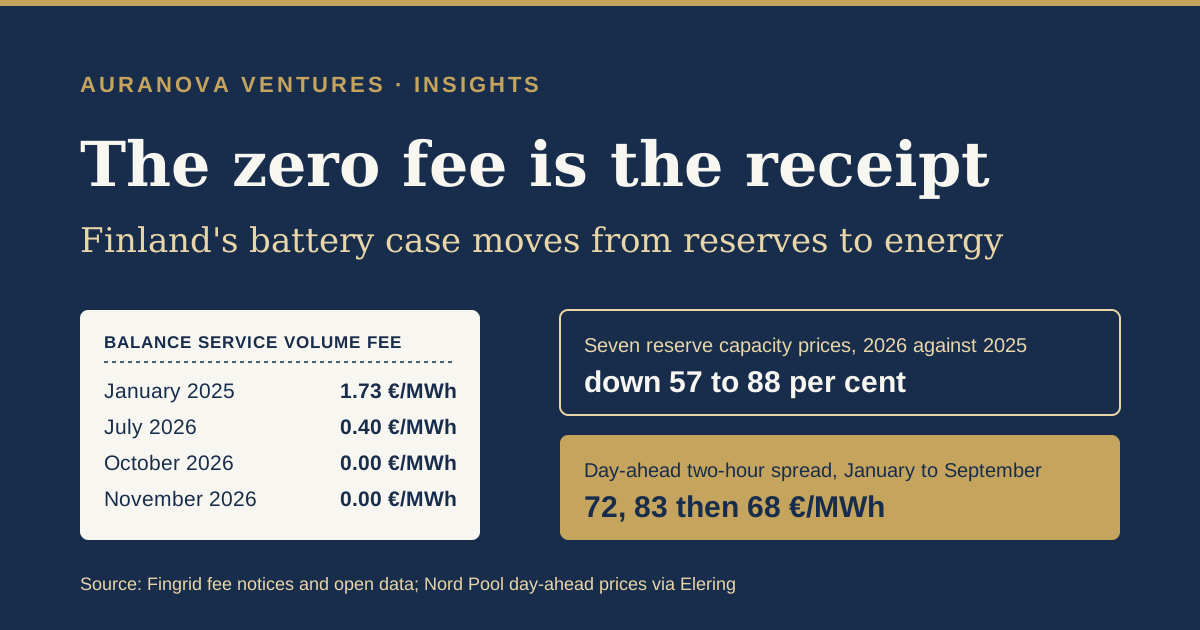
For October and November 2026 Fingrid, Finland's transmission system operator (TSO), will charge a balance service volume fee of 0.00 euro per megawatt hour of production and consumption. In January 2025 the same fee stood at 1.73 euro. Fingrid's stated reasons are lower reserve costs and a better electricity trade result. Most of what Fingrid saves on reserves is what reserve sellers no longer earn, so the zero is in large part a receipt for the battery owner's lost revenue. The useful question is what replaces it.
The development
On 31 August Fingrid announced that balance responsible parties, the companies financially answerable for the gap between what their portfolios promised and delivered, will pay no volume fee for October. On 23 September it extended the zero to November. Both notices give the same two reasons: reserve costs below forecast and an electricity trade result above it. On 28 September Fingrid set its 2027 main grid fees 4 per cent higher, after an 8 per cent rise for 2026.
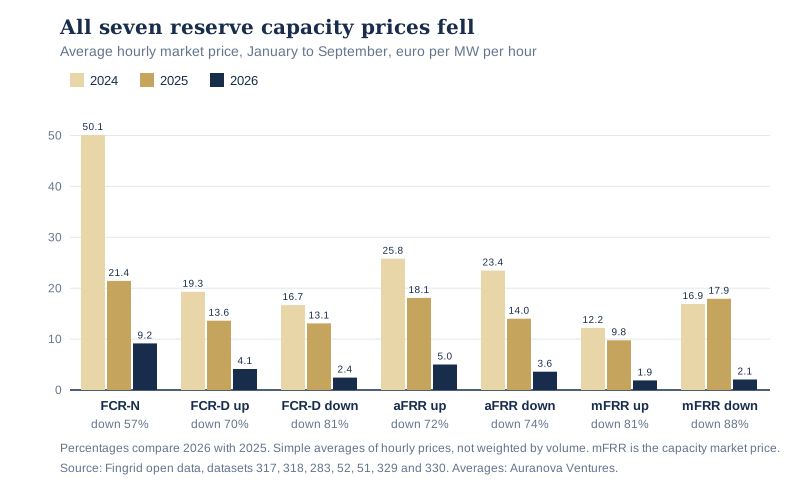
The tariff did not cut reserve revenue. Reserve prices fell and the tariff followed. Reserves are standby capacity the TSO pays for, sold on a ladder of speed. FCR-N, the frequency containment reserve for normal operation, corrects small everyday frequency swings. FCR-D, its disturbance sibling, acts when the frequency leaves the normal band, in separate up and down products. aFRR, the automatic frequency restoration reserve, pulls the frequency back within minutes. mFRR, the manual frequency restoration reserve, is the slowest rung. Each pays a capacity price, in euro per megawatt per hour, for being available.
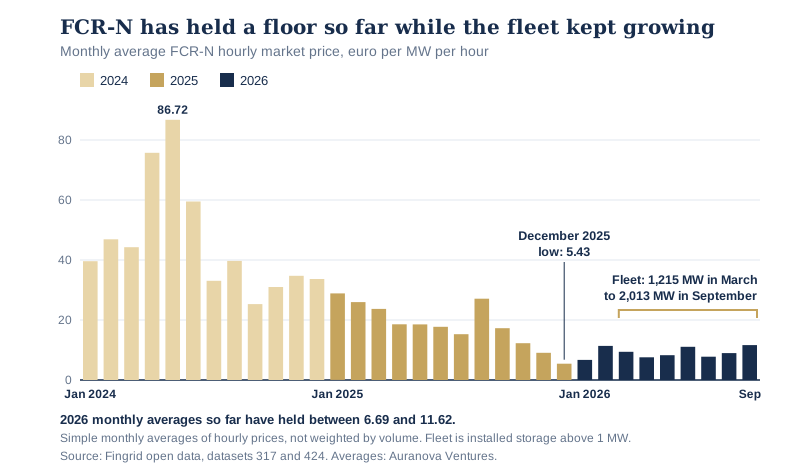
We took Fingrid's open hourly price data for all seven capacity products and averaged January to September of each year. Every product fell, by 57 to 88 per cent against 2025 and by 79 to 88 per cent against 2024. FCR-N, the highest priced of the seven in 2024, averaged 50.08 euro then, 21.44 euro in 2025 and 9.15 euro in 2026. The simple averages are ours.
What it actually means
Our read of the cause is supply, not policy. Fingrid does not publish which technologies clear its auctions, so the link is an inference. Fingrid's open data on installed battery storage shows the fleet growing from 1,215 MW on 11 March 2026 to 2,013 MW by the end of September. Fingrid's non-binding procurement forecast for 2026 adds up to about 1,700 MW across every reserve product and both directions together. The comparison is crude, nameplate against directional megawatts, but the fleet has outgrown the reserve markets.
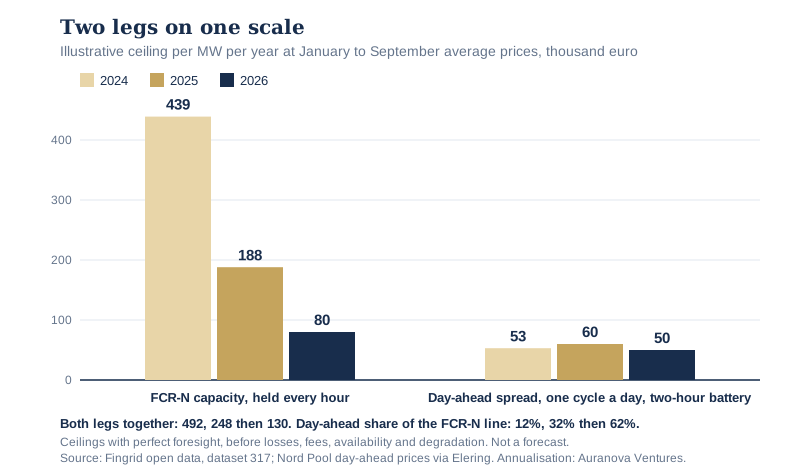
Now the other leg. The day-ahead market is the auction that sets tomorrow's power price for every delivery period. A battery earns the spread: it buys the cheapest hours and sells the dearest. We measured the Finnish spread the way a two-hour battery meets it, the mean of the two highest hours of each day minus the mean of the two lowest, using Nord Pool prices as published by Elering. It averaged 72 euro per megawatt hour in January to September 2024, 83 euro in 2025 and 68 euro in 2026. That is a stable range, not a collapse. The composition did change: negative-price hours in those months fell from 550 in 2024 to 52 in 2026 on the same series, a first sign of the fleet lifting the floor.
Put the two legs on one scale. A megawatt selling FCR-N every hour of a year at the January to September average price would have earned about 439,000 euro at 2024 prices and about 80,000 euro at 2026 prices. A one megawatt, two-hour battery cycling once a day at the day-ahead spread, with perfect foresight and before losses, would have earned about 53,000 euro and 50,000 euro. Both are illustrative ceilings, not forecasts. They are not alternatives either: a real asset stacks slices of both. Added together they fell from roughly 490,000 to 130,000 euro. Energy did not replace the reserve revenue. It became the larger share of a smaller total: day-ahead was worth 12 per cent of the FCR-N line in 2024 and 62 per cent in 2026.
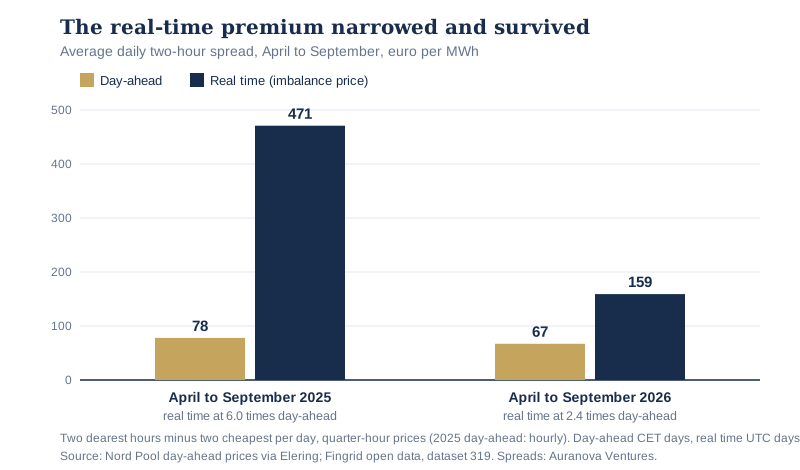
Our read is that energy carries more of the stack each year from here, for three reasons. First, depth. The day-ahead market prices the whole Finnish system, while the entire reserve forecast is about 1,700 MW. Second, granularity. Day-ahead has cleared in 15-minute periods since delivery day 1 October 2025, which gives a fast asset more edges to trade. Third, the real-time premium. Intraday trading, the market that runs after day-ahead closes, trades on our read toward the imbalance price, the price at which deviations are settled every quarter hour. On Fingrid's imbalance price data, the daily gap between the dearest two hours and the cheapest two hours of quarter-hour prices averaged 159 euro per megawatt hour in April to September 2026, against 67 euro day-ahead on the same quarter-hour measure. That spread is a reference, not a venue: a battery reaches it through intraday trades and balancing energy bids, with forecast error in between.
The caveat sits in the same series. That real-time gap averaged 471 euro in April to September 2025, so it has fallen by two thirds as the fleet grew. Energy markets are deeper than reserve markets, not immune to batteries.
What gets better from here
The data and Fingrid's own plans give three reasons for confidence. First, the highest priced reserve product looks to have found a floor. The monthly FCR-N average bottomed at 5.43 euro in December 2025 and has held between 6.69 and 11.62 euro in every month of 2026 so far, while the fleet grew by about 800 MW from March. September was the highest month since October 2025. Not every product has turned: aFRR down was still falling in September. Second, the day-ahead spread averaged 91 euro in September, the second highest month of 2026, against 99 euro in September 2025. Third, demand is coming. Fingrid says new consumption of over 8,000 MW is connecting under agreements already concluded, with no date attached. Our read is that more load against weather-driven supply widens spreads, provided the new load is not flexible enough to buy the same cheap hours a battery wants. On that read most of the repricing is behind Finnish batteries and the upside sits with demand growth.
Who is affected and how differently
Owners of batteries built on a reserve case have already taken the hit. Their upside now depends on trading capability.
Developers still have a case. For 2027 the tariff side barely moves: Fingrid's 2027 price list sets the storage capacity fee at 98.54 euro per MW per month in each direction with energy fees of 0.74 and 1.11 euro per megawatt hour. For a main grid battery cycling daily that is about 3,800 euro per megawatt a year, a small charge. The 2029 structure Fingrid intends to decide by year end is a different matter.
Investors and lenders should date-stamp every reserve assumption. A model calibrated on 2024 or 2025 capacity prices is arguing with the TSO's own data.
What to do about it
- Rebuild the stack with energy as the base case and reserves as the upside, on 2026 hourly prices.
- Compare one-hour and two-hour builds on spread capture, not reserve availability.
- Score the optimiser as carefully as the hardware. Energy value is earned by forecasting and execution.
- Stress the energy leg: run a case in which the real-time premium keeps narrowing.
Related insight
- What Fingrid's 77 percent fee cut actually tells Finnish battery owners, our August piece.
- The hedge sits out 2027, on the end of the fixed yearly FCR price.
Where the case stands now
This is the kind of question we at Auranova Ventures work through with developers and investors across the Nordics, Baltics and wider Europe. The prices, fees and fleet figures above are Fingrid's and Nord Pool's. The averages, the annualisations and the read that energy carries the Finnish stack from here are ours. When we model a Finnish battery today we start from the spread and add reserves as an option. If you hold a Finnish model built the old way round, reply and we will show you how we would re-cut it.
What share of your Finnish revenue case comes from energy today and what share will it need to be in 2028?
Sources
- Balance responsible parties will not be charged for the volume fee for production and consumption in October 2026, Fingrid, 31 August 2026
- Balance responsible parties will not be charged for the volume fee for production and consumption in November 2026, Fingrid, 23 September 2026
- Balance service fees, fee table from November 2023, Fingrid
- Growth in the power system increases costs, main grid service fees will rise by 4 per cent at the beginning of the year, Fingrid, 28 September 2026
- Main grid service fees 2027, Fingrid (PDF)
- Fingrid to raise grid service fees at the start of 2026, Fingrid
- Fingrid open data, hourly reserve capacity prices: FCR-N, dataset 317, FCR-D up, dataset 318, FCR-D down, dataset 283, aFRR up, dataset 52, aFRR down, dataset 51, mFRR capacity up, dataset 329, mFRR capacity down, dataset 330
- Fingrid open data, total installed battery energy storage system capacity, dataset 424
- Fingrid open data, imbalance price, dataset 319
- Power system reserves, national obligations and procurement forecasts, Fingrid
- Nord Pool day-ahead prices for the Finnish bidding zone, as published on Elering's open data dashboard
- 15 minute MTU implemented in SDAC, Nord Pool, 1 October 2025