The Hedge Sits Out 2027: Fingrid Skips Finland's FCR Yearly Market
8 September 2026 · 8 min read · Auranova Ventures
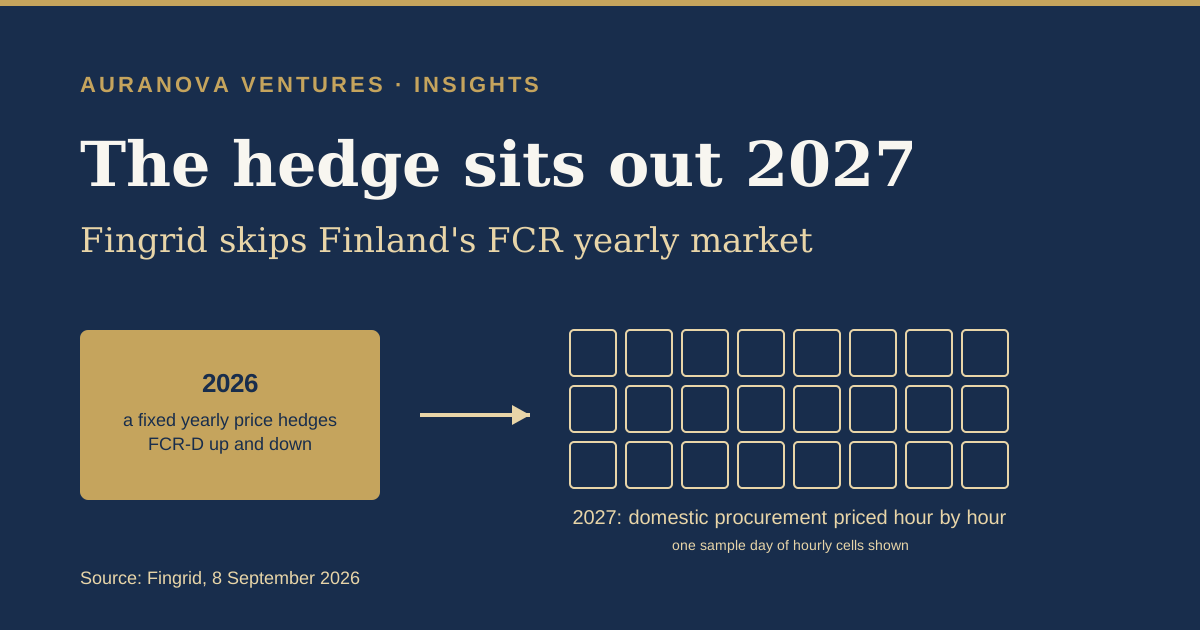
On 8 September the Finnish transmission system operator Fingrid announced that it will buy no frequency containment reserves (FCR, the reserves that catch grid frequency deviations automatically) from its yearly market for 2027. The current yearly market appendices, the contract annexes that carry the yearly commitments, expire on 31 December 2026. From 1 January, Fingrid's domestic FCR procurement runs through the hourly market alone. Every Finnish revenue model that leaned on the fixed yearly price needs a new anchor.
The development
FCR comes in three products. FCR-N (normal operation) is a symmetric product that holds the frequency inside the normal band of 49.9 to 50.1 Hz and responds on a timescale of minutes (roughly 63 per cent response in one minute in Fingrid's technical tests). FCR-D (disturbance) acts when the frequency leaves that band, in separate upward and downward products. It must deliver 86 per cent of its response within 7.5 seconds. A separate product, FFR (fast frequency reserve), covers hours when the system carries little inertia, the stored rotational energy that slows frequency swings. In the Finnish battery cases we see, FCR revenue is the anchor.
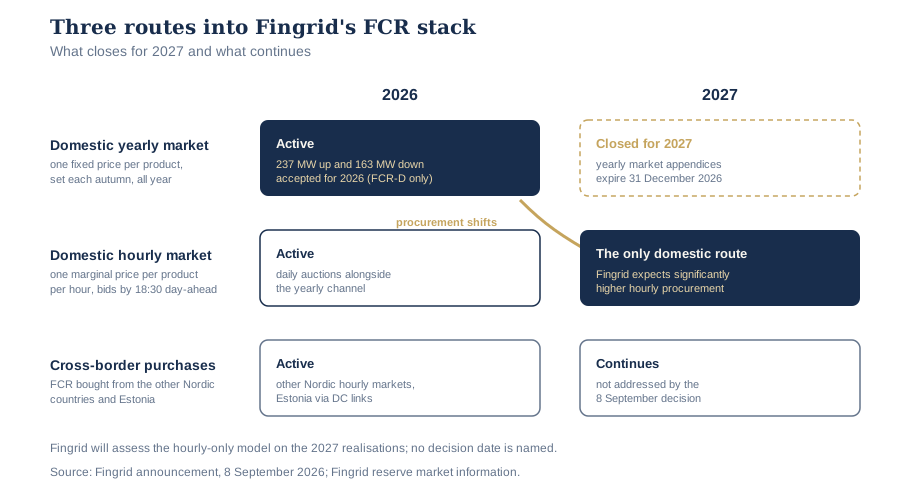
Fingrid buys FCR through three routes: a domestic yearly market, a domestic hourly market and cross-border purchases from the other Nordic countries and Estonia. In the yearly market, an autumn auction set one fixed price per product for every hour of the following year, paid to all accepted providers at the highest accepted bid. In the hourly market, providers bid by 18:30 the day before and each product clears at its own marginal price for each hour, the price of the last bid needed. Under the terms taking effect on 30 September 2026, hourly compensation in a product generally requires the yearly amount delivered in full that hour, with an exception for portfolio providers that split units between the markets.
The 8 September decision removes the yearly route for 2027. Fingrid cites customer feedback, a simpler market model, better reserve availability in the hourly market, more predictable hourly procurement volumes and the forecasted cost level. FCR-N costs sit in the fees paid by balance responsible parties (the companies financially accountable for their production and consumption imbalances) and FCR-D costs in the main grid service fees, so procurement cost flows straight to Fingrid's customers. Nothing here is permanent: Fingrid will assess the 2027 realisations and decide later whether the yearly model returns. Its one operational request: be ready to offer full available capacity through the turn of the year.
What it actually means
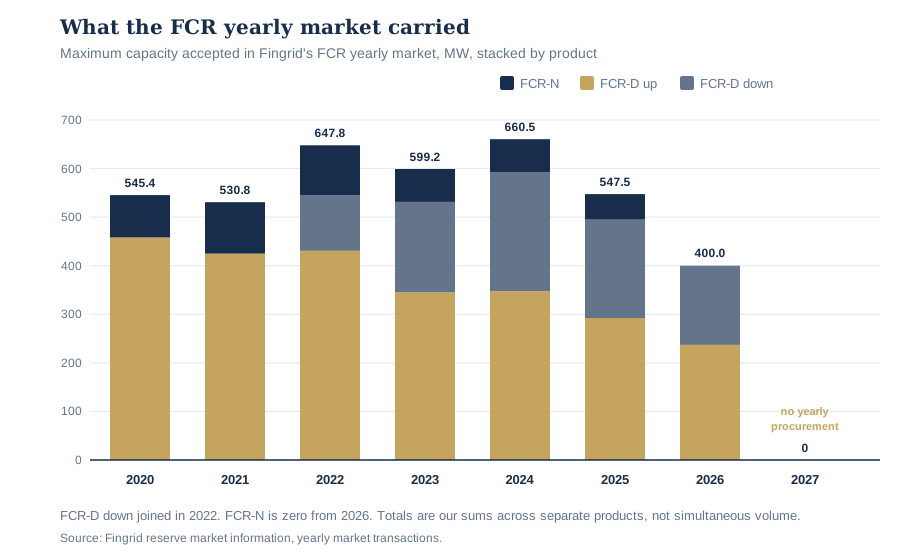
The yearly market was not in straight decline, but it was losing weight. The table Fingrid publishes lists the maximum capacity accepted in the yearly market, not the volume maintained in any given hour. FCR-N peaked at 105.8 MW in 2021 and stands at zero for 2026. FCR-D up fell from 458.3 MW in 2020 to 237.0 MW in 2026, roughly half. FCR-D down grew from 114.4 MW in 2022 to a 245.2 MW peak in 2024, then fell to 163.0 MW. Added up, 2026 is the smallest yearly-market footprint of the seven years, 400 MW against a 2024 peak of about 661 MW (sums are our arithmetic on Fingrid's table). The decision takes 2027 to zero.
What disappears is a hedge, not a subsidy. At its 2025 price of 25.30 euros per MW per hour, a megawatt of FCR-N in the yearly market earned about 222,000 euros if maintained every hour; that hedge already ended with the 2026 auction. What 2027 removes are the FCR-D versions: the 2026 yearly prices of 3.50 euros up and 6.00 euros down per MW per hour, printed in a published auction result before the delivery year began, annualise to about 31,000 and 53,000 euros per MW on the same full-delivery arithmetic (all annualisations ours; real assets rarely deliver every hour). The price was fixed; revenue still depended on delivered availability. From 2027 a megawatt earns the hourly clearing price on the capacity actually accepted and delivered, product by product, hour by hour.
The price effect is genuinely two-sided, because the decision mostly moves volume between venues rather than creating demand. Fingrid's published forecast of average reserve capacity procurement, a non-binding planning figure, barely changes between 2026 and 2027: 128 MW of FCR-N in both years, 307 rising to 309 MW of FCR-D up and 296 rising to 298 MW of FCR-D down. For FCR-N the switch already happened; what 2027 ends is the FCR-D hedge. Fingrid says its hourly procurement volume will rise significantly, while the capacity that held yearly appendices is freed to bid into the same auctions. Which side wins on price is not something anyone can read off the published data today. What is certain is the loss of certainty: none of that volume is priced in advance any more.
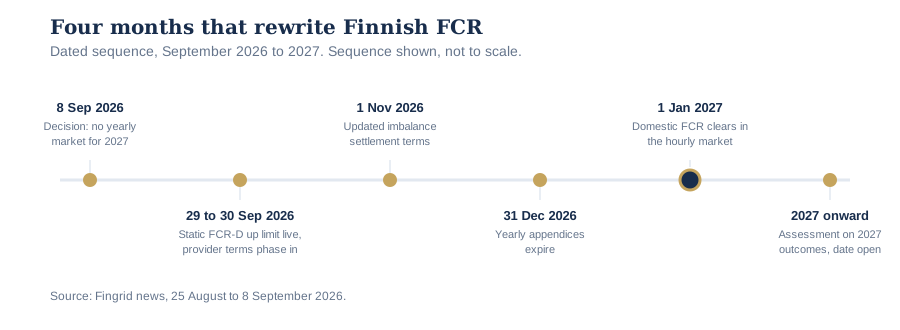
The move also lands in a crowded autumn. New terms for balancing service providers, the companies selling reserves to Fingrid, take effect on 30 September, including reliability requirements that bind new entrants at once and phase in for existing units at prequalification renewal or within five years. The Nordic limit on static FCR-D upward capacity (static FCR-D is a separately tested variant of the product with its own deactivation and repeat-activation rules under the Nordic technical requirements) goes live the same week. The initial maximum for Fingrid's control area, the slice of the Nordic grid Fingrid balances, is 308 MW, reviewed quarterly with a later inertia-linked tightening; Fingrid expects limited Finnish market impact at go-live. Balance responsible parties get updated imbalance settlement terms on 1 November. Then the yearly appendices expire on 31 December. Within four months, the reliability bar for sellers starts rising, a cap lands on static upward capacity and the last fixed price disappears.
Who is affected and how differently
Developers financing Finnish batteries lose their cleanest reference price. A yearly clearing price published before the delivery year was a fixed capacity price for the providers who won it and a defensible benchmark for everyone else. In our bankability work the question shifts from the auction result to the forecast and the distribution around it, a harder conversation with a credit committee.
Investors running diligence should date-stamp every FCR assumption they inherit. A model built earlier this year may still carry a yearly-market line for 2027 that can no longer exist. The 2026 auction results expire with the year.
Utilities and other portfolio providers that sold into the yearly channel face a repricing, not an exclusion. Fingrid sets the yearly-hourly split, so the shrinking yearly footprint says as much about the buyer as the sellers. Yearly providers already ran binding daily reserve plans; what is new is winning the price hour by hour, with acceptance never guaranteed, instead of reading it off a signed appendix.
Policymakers get a live experiment. Our read is that Fingrid is betting a single hourly marketplace serves total cost and availability better than a split one. The assessment will run on the 2027 realisations, with no decision date named; that data decides whether the yearly market returns.
What to do about it
First, rebuild the 2027 FCR line as a distribution over price and accepted volume, not a number. Inputs: Fingrid's published hourly history, the flat procurement forecast above and your view on supply growth and static-cap effects.
Second, take Fingrid's turn-of-year request seriously: from 1 January the hourly auctions carry all domestic procurement, hence its ask that suppliers offer full capacity through the transition.
Third, revisit product allocation. With no yearly commitments locking capacity, the split across the products your asset is prequalified for (the technical testing that admits a resource to a product) becomes an hour-by-hour choice.
Fourth, if you are financing, document the forecast method now. A model that shows its error bands and its assumptions on how much supply turns up in the hourly auctions will survive diligence better than one that quietly extends a retired fixed price. If part of the answer is a contracted floor from a trading partner, price it against that distribution, not against the old yearly number.
The forecast is the asset now
This is the kind of question we at Auranova Ventures work through with developers and investors across the Nordics, Baltics and wider Europe. The auction figures, forecasts and dates above are Fingrid's published data; the sums, the base-case reading and the risk framing are ours. When we rebuild an FCR revenue line, we work from the published hourly clearing prices per product, fit the distribution rather than the average and stress availability at the tails. If your 2027 case still carries a yearly price, reply and we will walk through how we would re-cut it against the hourly market.
When the last yearly FCR price expires on 31 December, will your 2027 model already know what replaces it?
Sources
- The procurement of frequency containment reserves will be focused to the hourly market in 2027, Fingrid, 8 September 2026
- Frequency containment reserves, transactions in the hourly and yearly markets, Fingrid reserve market information
- Frequency Containment Reserves (FCR) product terms and market mechanics, Fingrid
- Terms and conditions for providers of frequency containment reserves, effective 30 September 2026, Fingrid (PDF)
- Power system reserves, national obligations and procurement forecasts, Fingrid
- Procurement of frequency containment reserves from the yearly market 2026, Fingrid, 3 November 2025
- Technical requirements and prequalification process of frequency containment reserves, Fingrid, 1 September 2025 (PDF)
- Contract updates to balancing service providers and balance responsible parties in autumn 2026, Fingrid, 25 August 2026
- Updated implementation plan for the volume limitation on static FCR-D upward regulation, Fingrid, 26 August 2026