Sweden Rewired the Grid Fee. The Battery Line Is Still Being Written
15 September 2026 · 8 min read · Auranova Ventures
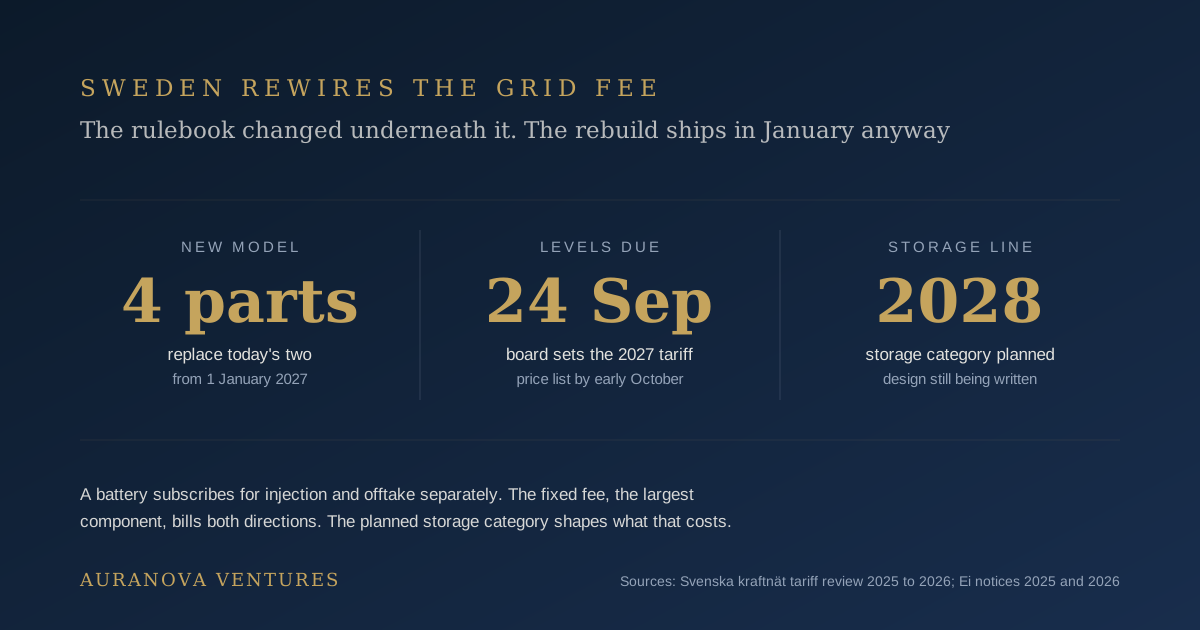
On 24 September Svenska kraftnät's board is scheduled to set the remaining 2027 levels of a transmission tariff it rebuilt from the ground up, in force from 1 January. The regulation that set its shape was repealed in June. The rebuild ships anyway. Only transmission-connected assets pay it directly, everyone else meets it through their own network company. The architecture is set. The storage piece is still being designed.
The development
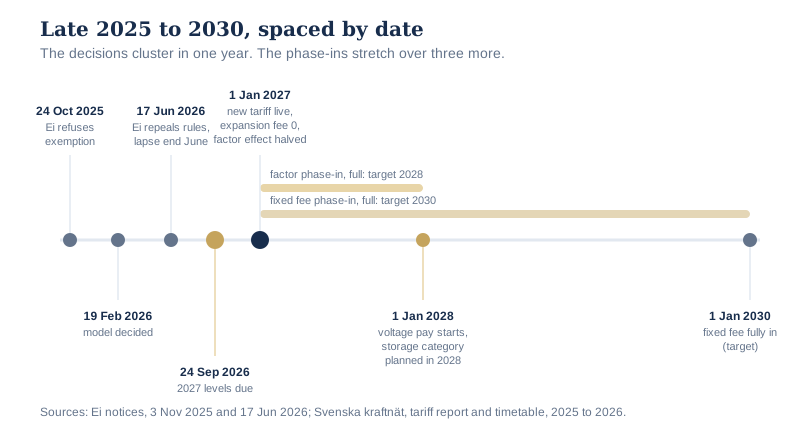
On 19 February 2026 Svenska kraftnät's board approved a new model for the transmission grid tariff, announced on 3 March, taking effect on 1 January 2027. A transmission tariff is the price list a grid customer pays the system operator for using the high-voltage network (in Sweden the 400 kV and 220 kV grid), separate from the price of the electricity itself. The final model report is the primary source for what follows.
Then the ground shifted. The model was designed to meet the regulator Energimarknadsinspektionen's tariff-design rules, EIFS 2022:1, which required four defined components by 2027. Ei refused Svenska kraftnät an exemption on 24 October 2025. On 12 March 2026 the government ordered Ei to repeal the rules and design a new power-fee model instead, due by 12 April 2027. On 17 June 2026 Ei decided to repeal EIFS 2022:1 and the rules lapsed at the end of June. Svenska kraftnät will implement the new model from 1 January 2027 regardless. Svenska kraftnät frames the model as serving flexibility and cost-reflective signals, not just compliance: a rebuild begun under one rulebook ships into another being written behind it.
The new tariff has four components in place of today's two (an energy fee for grid losses and a power fee on subscribed capacity). A customer-specific fee, fixed per connection point and month, covers metering and settlement. The energy fee stays loss-based per MWh, debited or credited by whether flows raise or lower total losses, with a new distribution factor for where the losses arise. The power fee splits in two: a network-expansion part charged only in winter high-load hours at points where more power would overload a line, plus a part for voltage regulation (holding grid voltage at its set level) from 2028, charged on average power exchange everywhere. A fixed fee per subscribed MW becomes what the report calls the largest single part of the tariff.
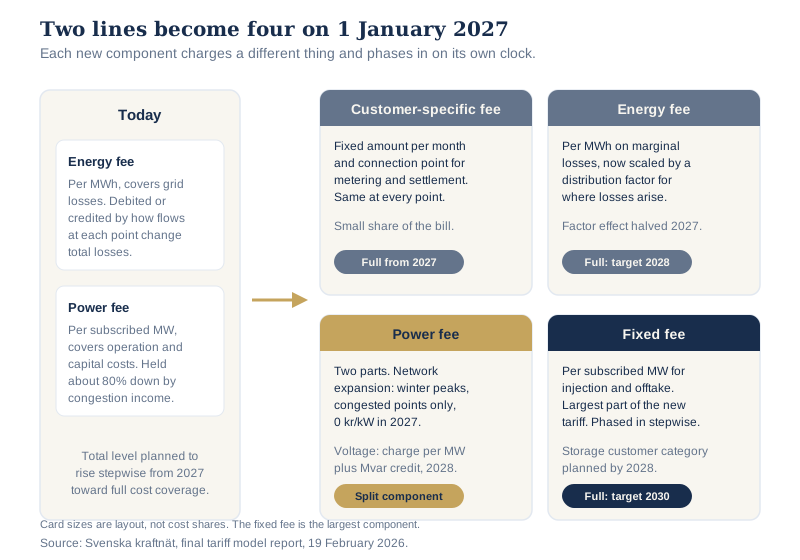
The rollout is staggered. The change the distribution factor causes to the energy fee is halved for 2027 and capped at ten percent, with full effect targeted from 2028. The network-expansion power fee is 0 kr/kW at every connection point for 2027. The fixed fee phases in from 2027, targeted to be fully implemented by 1 January 2030. Every existing group subscription (one subscription spanning several connection points) expires on 31 December 2026.
What it actually means
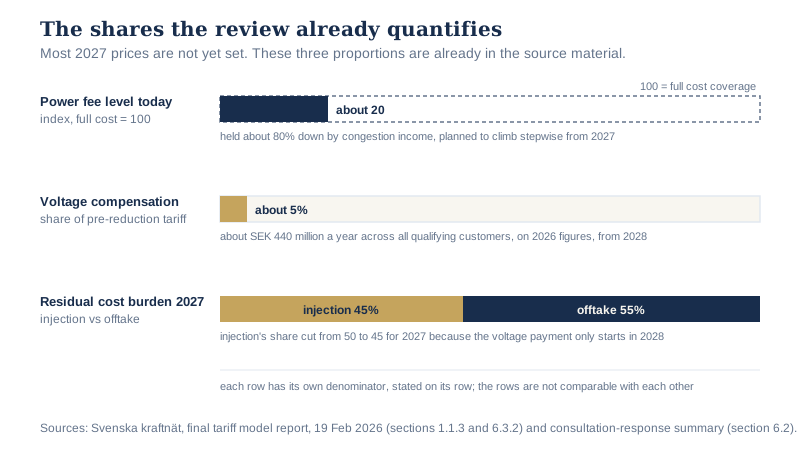
Today's power fee is held roughly 80 percent below its full-cost level by congestion income, the money the operator collects when prices differ between bidding zones (the price areas the market clears over). Svenska kraftnät plans to start raising the tariff in 2027 toward full cost coverage, stepwise over several years if Ei keeps approving congestion income to soften the path. When we model Swedish revenue stacks (the set of income streams a battery earns), the grid-fee line is usually a small constant. That is now wrong twice over: the level is on a rising multi-year path and the composition changes underneath.
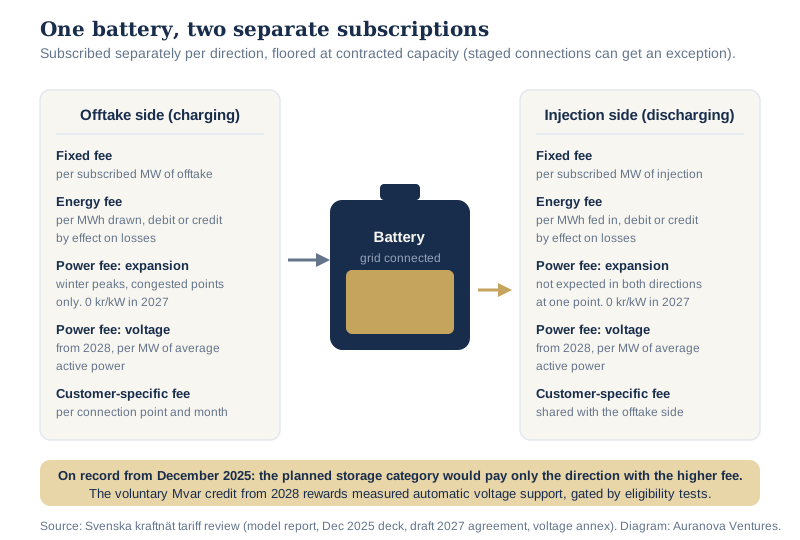
For a battery the mechanics run through both directions. A transmission customer subscribes separately for injection (feeding power in) and offtake (drawing power out), in MW amounts that need not be equal. The fixed fee is charged per subscribed MW in each direction. A new floor binds too: the annual subscription may not sit below the capacity contracted in the connection agreement, with an exception Svenska kraftnät can grant for projects connecting in stages. Consultation respondents asked for a storage category so batteries and pumped hydro do not pay on both sides. The design on record: Svenska kraftnät's December 2025 reference-group material says the storage category would pay only the subscription carrying the highest fee at the point, not both. The February report commits only to a category by 2028, design settled with the reference group. Billed both ways, a battery subscribed equally in each direction pays both directions' rates; under the higher-direction design only the more expensive one. Illustratively that is close to halving a symmetric battery's bill on the component the report calls the tariff's largest, which makes this category the biggest open variable in our read.
The genuinely new line is voltage. From 1 January 2028 the voltage-regulation component charges every customer per MW on the monthly mean of its quarter-hour active-power exchange (active power is the power that does work; a settlement period is the 15 minute window each exchange is measured over) and pays a voluntary compensation per Mvar (the unit of reactive power, the part of alternating-current flow that supports voltage rather than doing work). Payment follows measured behaviour, not capability on paper: the technical annex identifies automatic voltage regulation through regression analysis of high-resolution measurements and also credits reactive exchange otherwise favourable to the grid. Whether a battery qualifies depends on its inverter control mode (how the power electronics are set to behave), metering and its connection agreement. The pool is gross revenue funded by the new charge: on 2026 figures about SEK 440 million a year, roughly five percent of the pre-reduction tariff, across all qualifying customers. Enrolment is annual and voluntary, at least 15 percent of a month's settlement periods must classify as voltage-regulating, the payment is weighted at 0.85 against Svenska kraftnät's own equipment and unhelpful exchange draws deductions. Because it only starts in 2028, injection's share of the residual costs (the leftover grid costs no customer behaviour can change) is trimmed from 50 to 45 percent for 2027.
One caveat we hold ourselves to: a battery connected to a regional or local network pays none of this directly; the fees arrive second-hand through each network company's own tariff. The report notes most regional companies already pass the loss price through and the power fee is designed for passing on. Timing, shape and direction are each company's call.
Who is affected and how differently
Developers with transmission-connected projects get a location question. The energy fee credits flows that reduce losses and debits flows that increase them, point by point. The fixed fee's geographic part prices how much network each subscribed MW occupies. On 2026 figures the rebuild shifts cost from offtake customers toward injection customers. The distribution factor raises the energy fee in the north while lowering it in the south. Which direction dominates at a point is a modelling exercise.
Investors and lenders holding Swedish exposure have a dated uncertainty: 24 September is scheduled to set the remaining 2027 levels, with the price list due by early October, but the storage category stays open until 2028. A Swedish fee line now needs a phased series to 2030 plus scenarios for that category, from the higher-direction-only design on record to something narrower.
Utilities and regional networks inherit the plumbing: group subscriptions that expire on 31 December and need a fresh application for 2027, pass-through tariffs to redesign and a reduced-fee window at the start of a subscription overrun cut from eight quarter-hours to four. Policymakers watch a system operator implement a tariff design whose power-fee rules the regulator has just been told to redraw.
What to do about it
- Compare each direction's subscription with contracted capacity now. The floor binds from January unless a staged-connection exception applies. Unused contracted MW is a cost but also option value; weigh both before cutting.
- Re-run Swedish revenue stacks with the grid fee as a planned, phased series to 2030 and re-test debt sizing when the price list publishes in early October.
- If your inverters can run automatic voltage regulation, put the 2028 compensation on this quarter's design agenda: control mode, metering and the connection agreement decide whether months clear the 15 percent test.
- Get storage's case into the category design, which Svenska kraftnät is settling with its reference group ahead of the planned 2028 start. Definitions written without storage owners tend to fit someone else.
- In diligence, a Swedish battery model showing the same grid-fee line in 2027 and 2030 has not read the report.
The read that matters
The auctions get the attention. The wire has a price too and Sweden has just rewritten how it is built. The figures above are Svenska kraftnät's and Ei's. The judgment on what they do to a specific asset is ours. It is the kind of question we at Auranova Ventures work through with developers and investors across the Nordics, Baltics and wider Europe. If Swedish grid fees sit in your model as a footnote, reply and we will help you turn them into a line you can defend in credit committee.
When the 24 September decision lands, will your Swedish model absorb it as an update or discover it as a surprise?
Sources
- Svenska kraftnät, Ny modell för transmissionsnätstariffen, 3 March 2026: https://www.svk.se/press-och-nyheter/nyheter/allmanna-nyheter/2026/ny-modell-for-transmissionsnatstariffen/
- Svenska kraftnät, Översyn av transmissionsnätstariffen, final report Svk 2023/2237, 19 February 2026: https://www.svk.se/492b56/siteassets/2.utveckling-av-kraftsystemet/systemansvar-o-elmarknad/tariffoversyn/slutrapport_ny-tariffmodell_v0.pdf
- Svenska kraftnät, Sammanställning av synpunkter om tarifföversynen (consultation-response summary): https://www.svk.se/4af9a3/siteassets/2.utveckling-av-kraftsystemet/systemansvar-o-elmarknad/tariffoversyn/sammanstallning-synpunkter-om-tariffoversyn.pdf
- Svenska kraftnät, Tarifföversyn project page and reference-group timetable, 3 December 2025: https://www.svk.se/utveckling-av-kraftsystemet/systemansvar--elmarknad/tariffoversyn/ and https://www.svk.se/4ade84/siteassets/2.utveckling-av-kraftsystemet/systemansvar-o-elmarknad/tariffoversyn/2025-12-03-presentation-referensgruppsmote.pdf
- Svenska kraftnät, Nyttjandeavtalet 2027, bilaga 3, draft (price list available by early October): https://www.svk.se/4a46cf/siteassets/2.utveckling-av-kraftsystemet/systemansvar-o-elmarknad/tariffoversyn/bilaga-3---nyttjandeavtalet-2027.pdf
- Svenska kraftnät, Bilaga, effektkomponent för spänningsreglering (technical annex): https://www.svk.se/495a2f/siteassets/2.utveckling-av-kraftsystemet/systemansvar-o-elmarknad/tariffoversyn/bilaga---effektkomponent-for-spanningsreglering.pdf
- Regeringen, Uppdrag till Ei att upphäva föreskrifter och lämna förslag om ny utformning av effektavgifterna, 12 March 2026: https://www.regeringen.se/contentassets/353c232c163b4b15922706f7ee385747/uppdrag-till-energimarknadsinspektionen-att-upphava-foreskrifter-och-lamna-forslag-om-en-ny-utformning-av-effektavgifterna.pdf
- Energimarknadsinspektionen, Svenska kraftnät får inte dispens från Ei:s föreskrifter, decision 24 October 2025, published 3 November 2025: https://ei.se/om-oss/nyheter/2025/2025-11-03-svenska-kraftnat-far-inte-dispens-fran-eis-foreskrifter-om-utformning-av-nattariffen
- Energimarknadsinspektionen, Ei upphäver föreskrifterna om utformning av nättariffer, 17 June 2026: https://ei.se/om-oss/nyheter/2026/2026-06-17-ei-upphaver-foreskrifterna-om-utformning-av-nattariffer