Priced Not to Run, Activated Anyway. Estonia's Market Watchdog Issues Its First Manipulation Fine
27 October 2026 · 8 min read · Auranova Ventures
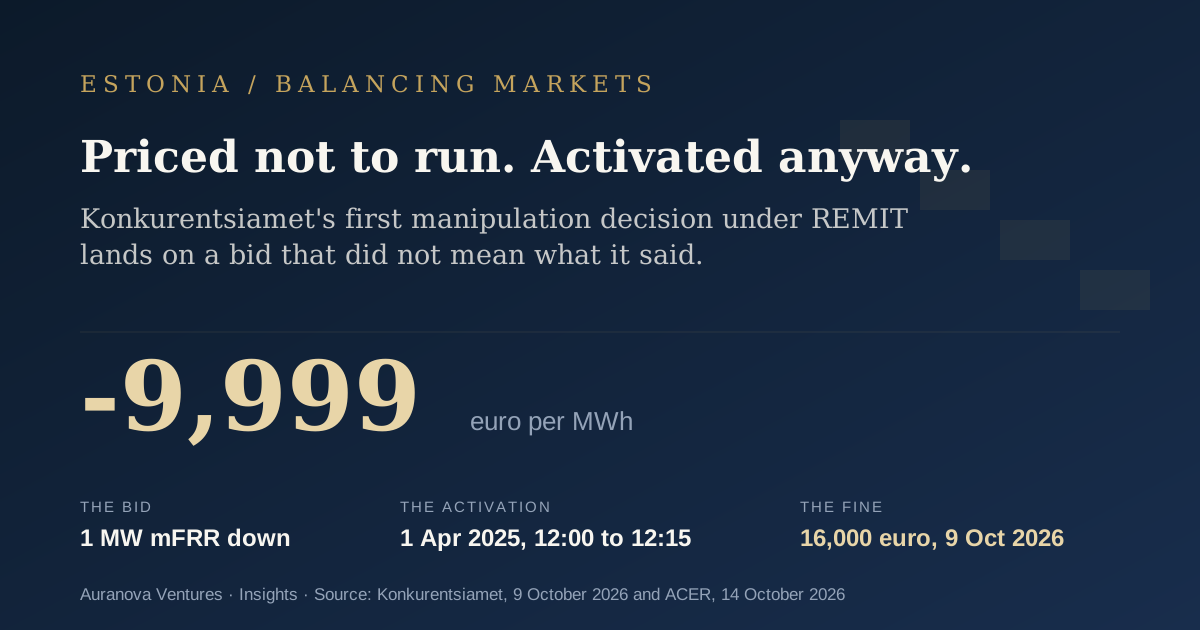
On 9 October 2026 Konkurentsiamet, the Estonian authority that polices energy markets, announced its first decision on market manipulation under REMIT, the EU regulation on wholesale energy market integrity and transparency. The fine: 16,000 euro. The collision behind it is ordinary: a maintenance window met a capacity award, so a 1 MW balancing energy bid went in at -9,999 euro per MWh to dodge activation. The system activated it anyway. The bid set the period's price. Any desk that has carried a reserve obligation through maintenance should read it twice.
The development
The fined company is Futugrid Technologies OÜ, a Tallinn firm that describes itself as a balance responsible party (answerable for its portfolio's imbalances), a balancing service provider (a BSP, the seller of reserves to the grid operator) and an aggregator connecting solar plants and batteries to the spot market and to the frequency reserves that hold the grid at 50 hertz: FCR (frequency containment reserve, the fast first response), aFRR (automatic frequency restoration reserve, following automatically over minutes) and mFRR (manual frequency restoration reserve, the slower product ordered by the operator). Neither announcement says what kind of resource sat behind this bid.
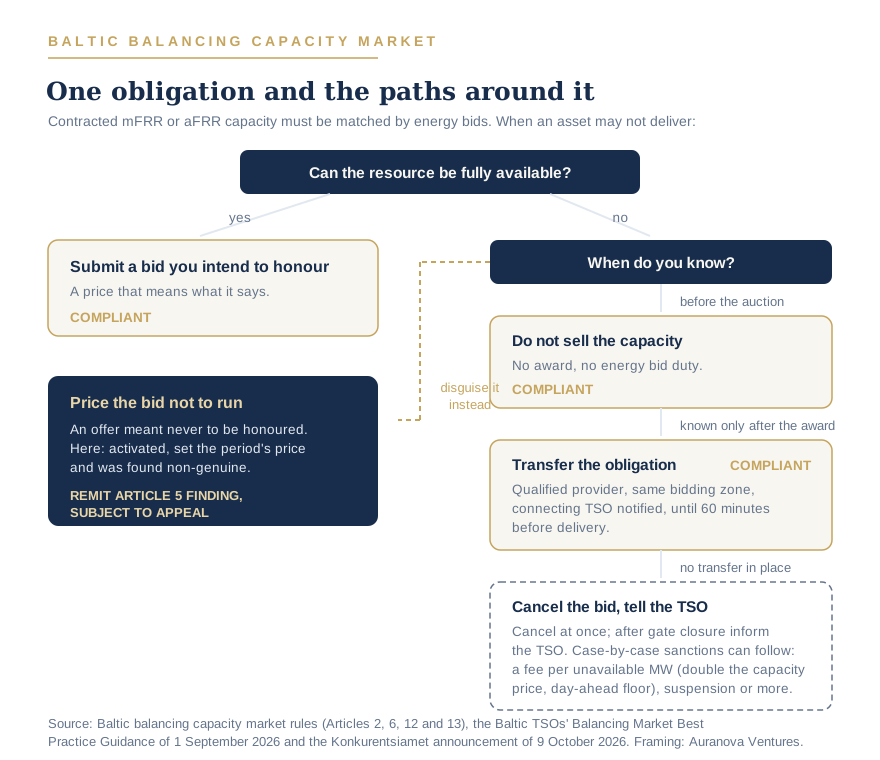
The facts come from the authority's announcement and ACER's summary of 14 October. Futugrid had sold capacity into the Baltic balancing capacity market, the joint Estonian, Latvian and Lithuanian auction in which providers are paid to stand ready. For the two restoration reserves that promise is enforced in the next market along: under the Baltic market rules every contracted mFRR or aFRR capacity bid must be matched by corresponding balancing energy bids. Balancing energy is the second leg, settled only when the transmission system operator (the TSO, here Elering) activates the resource, in either direction, at prices that can be negative.
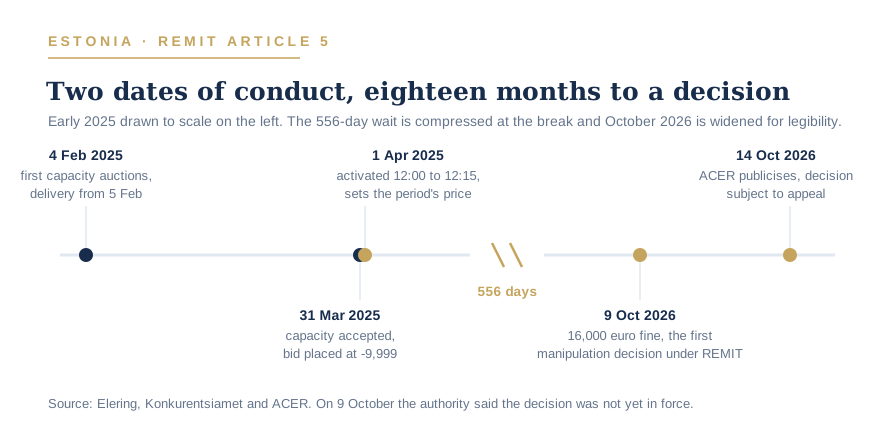
On 31 March 2025 Futugrid's capacity offer was accepted for delivery on 1 April. The company wanted to pause service that day to complete a software upgrade, so it submitted the obligatory energy bid at a price chosen not to clear: 1 MW of downward mFRR at -9,999 euro per MWh. On 1 April, between 12:00 and 12:15, the system reached it. The bid was activated and its price became the marginal balancing energy price for that trading period. The settlement here is marginal and directional: under the EU pricing methodology (as amended in 2024), the lowest-priced selected bid sets the price for downward energy. Park a bid at -9,999 and it is the price setter the moment the system needs everything above it.
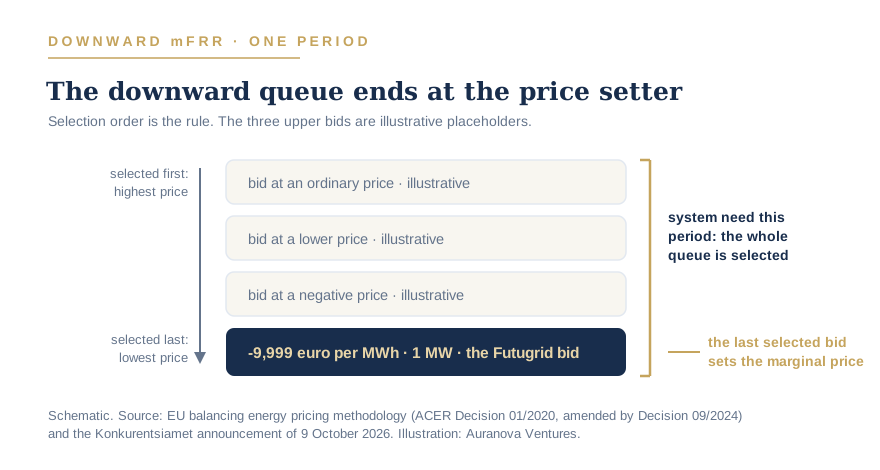
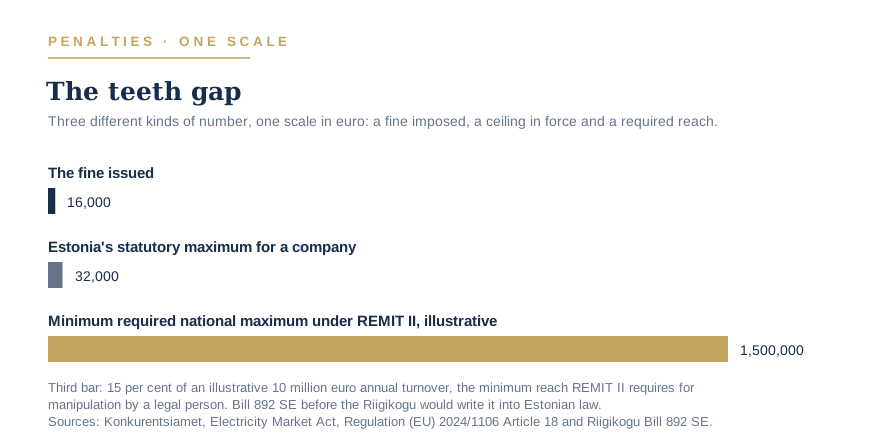
Konkurentsiamet found the bid was not genuine: its purpose was to satisfy the capacity obligation while avoiding delivery, which sent a misleading signal to the market and directly shaped price formation. That is market manipulation under Article 5 of REMIT. The fine, issued under section 101⁴ of Estonia's Electricity Market Act, is half the 32,000 euro statutory maximum for a legal person, a ceiling in force since 2014. On 9 October the authority said the decision was not yet in force and could be challenged in court.
What it actually means
Capacity markets pay for a promise, enforced for mFRR and aFRR by forcing an energy bid whose main lever is its price. So when an asset cannot deliver, the temptation is to park the bid at the far end of the price queue and assume the queue never gets that long. On 1 April 2025 the Baltic queue got that long.
The decision does not outlaw extreme prices, but the space for them is narrower than many desks assume. The Baltic TSOs' Balancing Market Best Practice Guidance, updated on 1 September 2026, says bids should reflect forward-looking opportunity cost, the value genuinely foregone in other markets, explicitly including batteries. The price a battery charged at in the past is sunk cost and "not a legitimate reason for pricing it artificially". The guidance is blunter still: under REMIT, intention is not even required for manipulation, so an erroneous bid can breach it too. "An offer that did not mean what it said" is our shorthand; the legal test is false or misleading signals or artificial price levels.
The rulebook and the guidance both anticipate the situation. The market rules let a provider transfer its obligation to another qualified provider in the same bidding zone (the geographic price area) up to 60 minutes before the delivery quarter-hour, with the connecting TSO notified. The guidance sets the error drill: correct freely until gate closure, cancel immediately when obligations cannot be met and tell the TSO after gate closure. A provider that cannot deliver faces case-by-case sanctions, which can include a fee of double the capacity price per unavailable megawatt (day-ahead floor) and suspension. The list is not exhaustive. All of those paths existed here; a bid that fakes availability carries REMIT manipulation exposure on top.
Then there is the fine, half the ceiling Estonian law sets today. REMIT II, the 2024 revision, requires maximum administrative fines of at least 15 per cent of a legal person's total annual turnover in the preceding business year for manipulation and at least 5 million euro for a natural person, with the imposed fine capped at 20 per cent of turnover. Estonia is mid-implementation: Bill 892 SE repeals section 101⁴ and sets manipulation fines for a legal person at up to 15 per cent of annual turnover. It is not law yet: in the second-reading materials of 26 October the lead committee proposes suspending the second reading and the bill keeps the old regime for proceedings started before 1 February 2027. Futugrid was decided under the old ceiling. The direction is set; the date is not.
Who is affected and how differently
Operators carry the direct exposure, most of all automated desks. The guidance says REMIT applies to algorithmic bidding exactly as to a human trader: a sentinel price (a fixed extreme value the software falls back to when an asset flags unavailable) is not laundered by automation. Where a route-to-market provider (the firm contracted to bid an asset into markets) acts for an owner, the guidance is explicit: aggregators are responsible for the pricing of the volumes they bid and remain responsible for REMIT compliance. Contracts can move money afterwards; they do not move the regulatory duty.
Investors get a cheap and revealing diligence question: how does the bidding desk handle a maintenance window that collides with a capacity award? A good answer names the transfer route, the cancellation drill and the sanction arithmetic. A bad answer mentions a price.
Balance responsible parties and utilities read the case from the other side: a settlement price formed by a bid later found non-genuine. Nothing in the announcements says settlement was corrected. What changed: such a price is now an enforcement matter, not weather.
Policymakers and desks elsewhere should note the sequencing: first auctions on 4 February 2025, the fined conduct inside the market's first two months, the decision eighteen months later. Sweden, Finland and Denmark procure reserves through capacity markets of their own. The mechanics differ, but REMIT applies across the EU and the control lesson travels.
What to do about it
Audit the bidding stack for sentinel prices. If configurations or bid histories show extreme values tied to availability states, remove them. Bid forward-looking opportunity cost or do not bid.
Rehearse the error drill. The Baltic guidance expects an incorrect bid cancelled immediately before gate closure and reported to the TSO after it. Put that sequence in the desk manual and the optimiser.
Move maintenance into the bidding calendar. Where an outage is known before the capacity auction clears, the cheapest answer is not selling that capacity.
Reprice the downside. In the diligence we run on reserve revenues and route-to-market agreements, we now ask who sets the bid price when an asset is unavailable, who is notified and what the contract says about recourse. Then we size the exposure twice: at today's cap and at the proposed 15 per cent of turnover, labelled as pending.
The quarter-hour that will outlast its price
A 16,000 euro fine will not move anyone's revenue model. The reasoning behind it should. Reserve revenues are underwritten by obligations: be genuinely available, hand the obligation to someone who is or cancel and tell the TSO, never hide behind a price. When we at Auranova Ventures model reserve portfolios or run diligence across the Nordics, Baltics and wider Europe, bidding conduct now sits on the checklist beside prequalification (the TSO's entry test for providers) and settlement. If your capacity revenue depends on a bidding setup you have not audited for this pattern, reply and we will compare notes.
When the system calls the bid you never meant to run, what does your desk do in the next quarter-hour?
Sources
- Konkurentsiamet: fine to Futugrid Technologies OÜ for market rule breach, 9 October 2026
- ACER: REMIT breach, Estonian Competition Authority fines Futugrid, 14 October 2026
- Baltic TSOs: Baltic balancing capacity market rules under Articles 33(1) and 38(1) of the EB Regulation, approved version
- Baltic TSOs: Balancing Market Best Practice Guidance, version 1.2 of 1 September 2026
- Elering: Baltic TSOs launch the Baltic balancing capacity market, 5 February 2025
- Electricity Market Act, section 101⁴ (English translation, Riigi Teataja)
- Regulation (EU) 2024/1106 (REMIT II), Article 18 on penalties
- Riigikogu: Bill 892 SE file, Act amending the Electricity Market Act, the Natural Gas Act and the Industrial Emissions Act and second-reading text of 26 October 2026
- ACER: methodology for pricing balancing energy, Decision 01/2020 and Decision 09/2024 amending it
- Svenska kraftnät: procurement and pricing of ancillary services
- Fingrid: reserve markets
- Energinet: ancillary services to be delivered in Denmark, tender conditions
- Futugrid Technologies, company site