One Hour, One Direction: The New Flow Lock on Fenno-Skan
20 October 2026 · 8 min read · Auranova Ventures
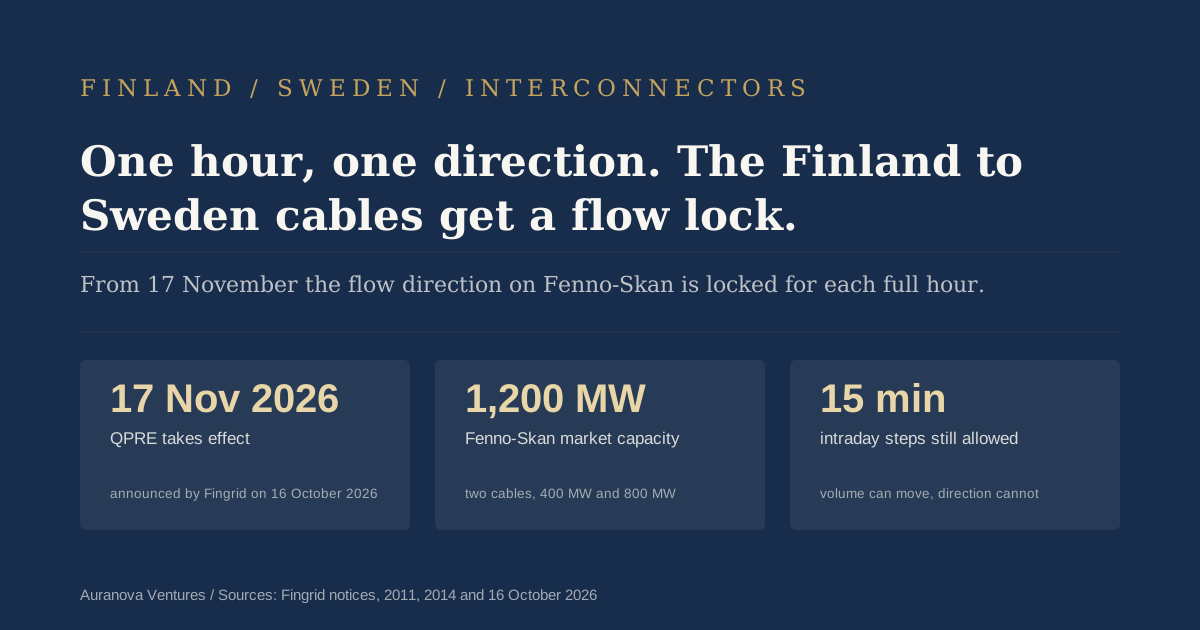
On 16 October Fingrid announced that from 17 November 2026 the Fenno-Skan links between Finland and central Sweden, about 1,200 MW of nominal market capacity on that corridor, may no longer reverse their flow direction within an hour. The rule is called QPRE (Quarterly Polarity Reversal Elimination) and it exists because the market design of the last two years has been flipping the cables more often than is good for their lifetime. Flexibility the 15-minute market handed traders is being taken back.
The development
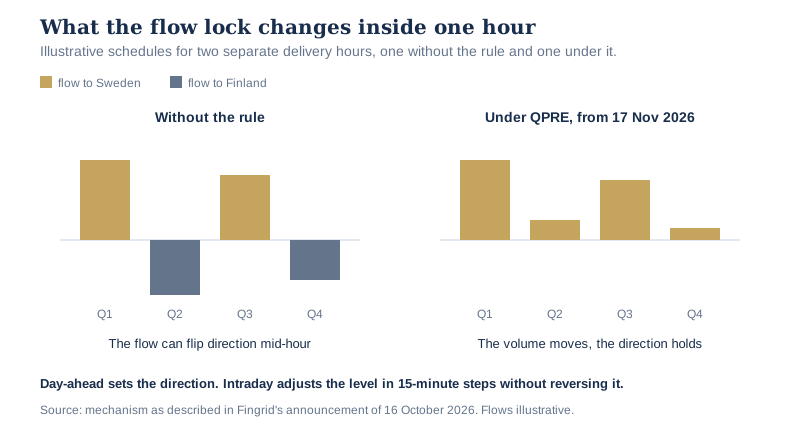
Fingrid's announcement of 16 October sets out the mechanism it has agreed with Svenska kraftnät, the Swedish system operator. From 17 November the day-ahead market, where power for each hour of the next day is traded, sets the transfer level on Fenno-Skan one hour at a time. Intraday trading, the adjustment market that runs up to delivery, can still move the level in 15-minute steps, but the direction of flow cannot reverse within the hour. According to Fingrid, a similar arrangement has been used to protect the submarine cables between Sweden and Denmark.
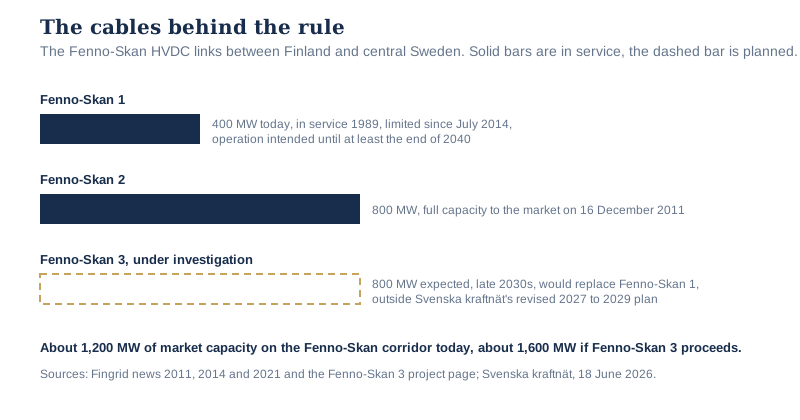
Two terms carry the story. Fenno-Skan is a pair of high-voltage direct current (HVDC) links, connections with submarine cables that move power point to point between the Finnish and Swedish grids. A polarity reversal is the moment the flow flips direction. Fingrid says frequent reversals stress the cables and could otherwise force outright restrictions on transmission capacity to keep them operational. The older link entered service in 1989 and has been limited to 400 MW since July 2014 on account of cable condition. The operators intend to keep it running until at least the end of 2040. Fenno-Skan 2 brought its full 800 MW to the market on 16 December 2011. Finland and Sweden also trade over the alternating current (AC) lines in the north, a separate interface of up to 2,100 MW under normal conditions. Fingrid's announcement concerns only Fenno-Skan.
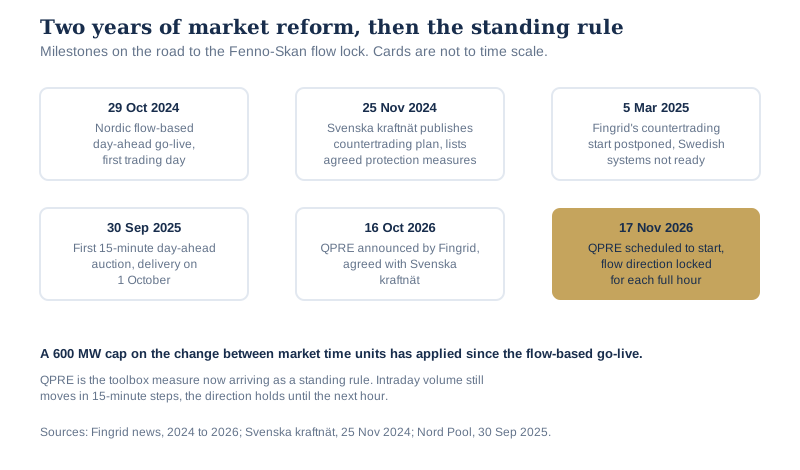
What changed is the market around them. The Nordic region switched to flow-based capacity calculation on 29 October 2024, the first trading day under a method that models the physics of the grid in more detail when allocating cross-border capacity. Then the day-ahead market moved to a 15-minute market time unit, the length of one traded delivery period, trading on 30 September 2025 for delivery on 1 October. Both reforms did their job. Both also, in Fingrid's words, significantly increased the number of flow reversals on Fenno-Skan.
The response has been a toolbox assembled in stages. In November 2024 Svenska kraftnät listed the measures the operators had agreed to protect the older HVDC links: countertrading (the operator trading against the market flow to undo reversals), changed ramping, extended monitoring and, already on that list, the elimination of quarterly reversals. Fingrid's side of the countertrading was due to start on 18 March 2025 and was postponed that March pending Swedish system development. A cap of 600 MW on how much the flow may change from one market time unit to the next has applied since the flow-based go-live. QPRE is the toolbox item now arriving as a standing rule rather than a daily trading operation. The joint operating agreement for the links already carries stress-based tripwires: once a cable passes set counts of reversals per running year its capacity is cut and at a higher count the link is locked to a single direction until the count falls. QPRE acts before those tripwires, in normal operation.
What it actually means
Think of each hour on Fenno-Skan as a one-way street. Day-ahead decides which way it runs, intraday decides how much traffic moves in each quarter and nobody turns the street around until the next hour.
Fingrid's modelling suggests no significant effect on overall market functioning and we have no basis to dispute that on averages. The question we care about sits below the averages, at quarter-hour resolution. When intraday traders would previously have flipped the link mid-hour to chase a surplus or a shortage, that trade no longer exists. The adjustment has to clear through something else: other borders, generation, demand or the flexible assets inside each bidding zone, the price areas the market settles on.
Our read, stated as a hypothesis: Batteries are among the fastest sources of the within-hour flexibility the link is giving up. A rule that removes one cross-border escape route for mid-hour surprises should, at the margin, add to the quarter-hour price movement a battery can trade. A battery that is on line and holds charge can change direction every quarter-hour, with wear that is priced into its cycle life rather than carried by a cable from 1989. Ex-post evidence cannot exist before the rule goes live on 17 November. The market facts here are Fingrid's and Nord Pool's, the hypothesis is ours and we would test it rather than underwrite it.
There is also a defensive point. Fingrid's stated alternative was restricting transmission capacity to protect the cables, which would remove megawatts whenever applied. QPRE is designed to keep the megawatts available. For anyone holding Finnish exposure, the rule reads less as a constraint than as an insurance premium paid in optionality.
Who feels it and how differently
Cross-border traders feel the most direct effect. The coupled day-ahead outcome fixes the corridor's direction for each hour, so the within-hour flexibility that intraday trading offered across Fenno-Skan narrows to one sign. Strategies built on flipping with the quarter-hour spread lose a venue.
Battery operators in Finland and in SE3, the central Swedish price zone, are the natural counterparties. Which side gains in which hour depends on the locked direction and where the surprise lands, so we would read the first winter of data before pricing it.
Investors holding Finnish merchant exposure should care most about a quieter question: whether their price-curve provider models interconnector operating rules at all or treats border capacity as a single number. The Fenno-Skan fleet already has a step cap and a life-extension programme and takes on an hourly direction lock from 17 November. Fenno-Skan 3, the planned 800 MW replacement for the 1989 cable, is pencilled for the late 2030s. Svenska kraftnät left it out of its revised 2027 to 2029 investment plan in June while a socioeconomic analysis runs. Until something is built, the rules on the existing cables are the border.
Policymakers should read QPRE as a pattern, not a one-off. The operators have already restricted ramping on SwePol Link and flagged the same step for Konti-Skan if cable stress becomes unacceptable. Where an aging link meets a market design that wants ever faster changes in flow, operators protect the asset and flexibility inside the price zones has to fill the gap. Our read is that this is a slow-burn demand signal for storage in the bidding zones around the region's older HVDC links.
What to do about it
Re-run Finnish revenue forecasts with Fenno-Skan direction-locked from 17 November. If your model or your curve vendor cannot represent an interconnector operating rule, that gap is now quantifiable and we do not expect this to be the last such rule.
Treat the effect as a hypothesis with a measurement plan, not a number. Model quarter-hour spread distributions for hours where the day-ahead flow sits near zero and compare matched hours before and after 17 November, controlling for wind, outages and season.
For diligence on Finnish and Swedish assets, add interconnector operating rules to the checklist beside reserve saturation. Ask how the revenue model treats the 600 MW step cap, the QPRE lock and outage risk on a link whose oldest pole entered service in 1989.
Watch the Fenno-Skan 3 file. Fingrid expects its grid study to finish by the end of 2026 while the Swedish socioeconomic analysis runs. Whether the corridor gets new capacity in the 2030s or keeps living under protective rules is a real fork for Finnish merchant cases.
The rules on the cables are the border now
QPRE is one rule on one corridor, but it shows where aging links and fast markets collide. Sizing what it is worth to a specific project, on a specific node, under a specific dispatch strategy is the kind of question we at Auranova Ventures work through with developers and investors across the Nordics, Baltics and wider Europe. We are extending our revenue forecasting to carry interconnector operating rules as first-class inputs. If you want to compare notes on the Finnish winter ahead, reply and we will walk through it.
How is your model treating Fenno-Skan after 17 November, as 1,200 MW or as 1,200 MW that can no longer change its mind mid-hour?
Sources
- Fingrid: Fingrid secures the transmission capacity of the Fenno-Skan interconnectors between Finland and Sweden with a new mechanism, 16 October 2026
- Svenska kraftnät: Svenska kraftnät to start trading on the intraday market for electricity, 25 November 2024
- Fingrid: Fingrid to trade on the intraday markets to reduce polarity reversals of interconnectors, 9 December 2024
- Fingrid: Fingrid to postpone planned trading on the intraday markets related to polarity reversals of interconnectors, 5 March 2025
- Fingrid: Fingrid and Svenska Kraftnät have agreed to implement 600 MW ramping limit on Fennoskan at the Nordic flow-based go-live, 22 March 2024
- Svenska kraftnät: Changes in ramping on HVDC links at go-live of flow-based capacity calculation methodology, 22 March 2024
- Fingrid: Fenno-Skan 2 cable link completed for use by the electricity market, December 2011
- Fingrid: Interim report January to September 2014, Fenno-Skan 1 limited to 400 MW from 1 July 2014
- Fingrid: Fenno-Skan 1 lifetime will be extended until 2040, 2021
- Fingrid: Fenno-Skan 3 project page
- Svenska kraftnät: Svenska kraftnät har skickat in en reviderad investeringsplan, 18 June 2026
- Svenska kraftnät: Successful go-live of the Nordic flow-based market coupling project, 2024
- Nord Pool: MCSC confirms go-live of 15-minute MTU in SDAC on trading day 30 September 2025 for delivery day 1 October 2025
- Fingrid and Svenska kraftnät: Joint operation between the Finnish and Swedish subsystems on the AC links and Fenno-Skan, Appendix 2 to SOA Annex OS, v3
- Nordic RCC: Coordinated capacity calculation