Nothing Comes Free in Romania's First Grid Auction. Storage Applied Anyway
15 October 2026 · 8 min read · Auranova Ventures
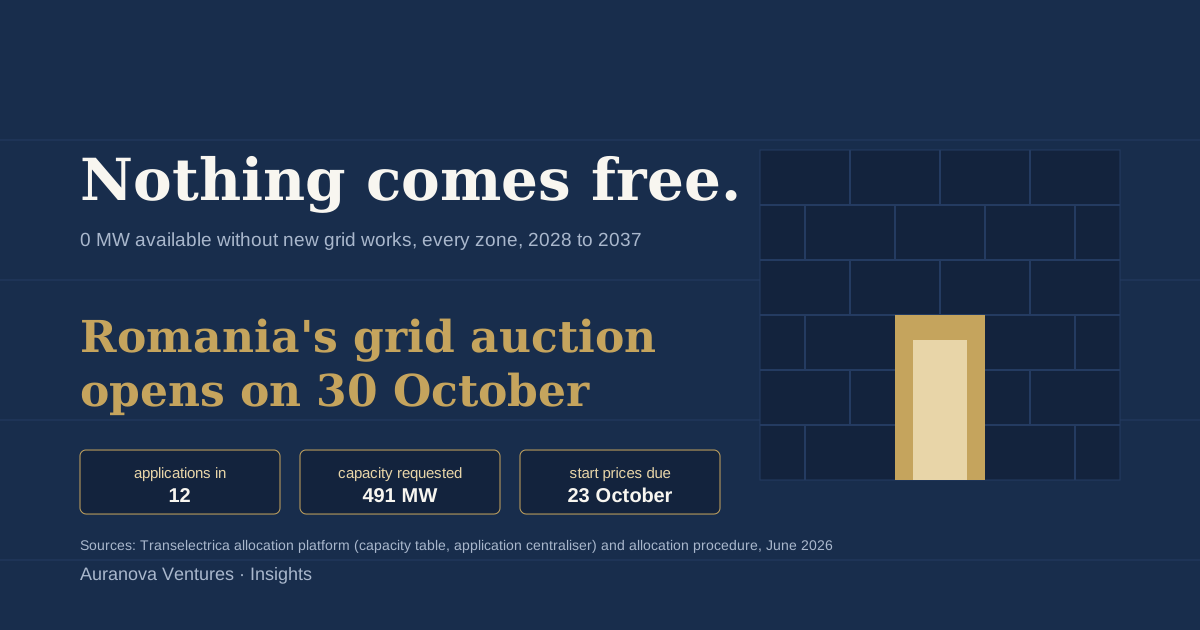
Romania's first grid capacity auction opens daily bidding on 30 October. There is nothing free to win: Transelectrica's published capacity without new grid works stands at zero megawatts in every zone and every allocation year from 2028 to 2037. Twelve applications, 491 MW, are in the ring anyway. Standalone batteries carry 212 MW. The floor under what they will pay, each session's start price, arrives by 23 October with the published reinforcement costs. Bidding from 30 October settles the rest.
The development
The rules were set in the spring by ANRE, Romania's national energy regulator, on 21 May 2026. Order 15/2026 armed the auction regime created by Order 53/2024 with a participation guarantee of 20,000 euro per MW of requested capacity for 2026 and lifted the connection guarantee for new generation and storage connections above 1 MW from 5 to 20 per cent of the connection tariff excluding VAT. Order 16/2026 added an establishment authorisation guarantee of 30 euro per kW of installed power. Transelectrica's implementing procedure fixed the 2026 calendar: applications closed 14 July, the updated grid study with reinforcement works is due by 23 October, the participant list at least two working days before bidding and daily sessions from 30 October, one per delivery year from 2028. The design is in our July piece.
The ATR is Romania's technical connection approval, the document that fixes a project's connection conditions and approved power. The participation guarantee is the refundable deposit behind an auction application; the establishment authorisation guarantee stands behind the permit to build. Co-located storage is a battery at an existing generation or consumption site; standalone storage connects on its own.
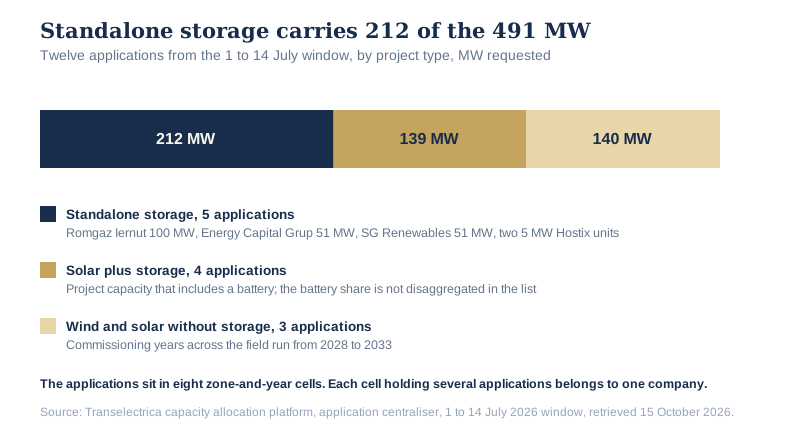
Transelectrica's application centraliser lists the twelve applications, 491 MW, from the 1 to 14 July window. Five are standalone storage installations totalling 212 MW, led by Romgaz's 100 MW battery at Iernut and Energy Capital Grup's 51 MW, both for 2028. Four more, 139 MW, are solar-plus-storage projects whose battery share is not disaggregated. The remaining three, 140 MW, are wind and solar without storage.
The guarantee wall is already being renegotiated. On 24 August ANRE put a draft procedure out for consultation that would leave storage added to existing generation capacity at the same site out of the authorisation guarantee base; Order 16 already exempts projects backed by a contract for difference (a state contract fixing a strike price for output) and retrofits that add no installed power. The 30-day comment window closed in late September; the decision is pending. On 5 October the wind and solar industry associations RWEA and RPIA asked ANRE to cut the standalone battery rate too, to a reported 5 euro per kW (Economica.net, picked up by Balkan Green Energy News); we found no primary document, so we treat that figure as reported, not confirmed. As of 15 October nothing had changed in law.
What it actually means
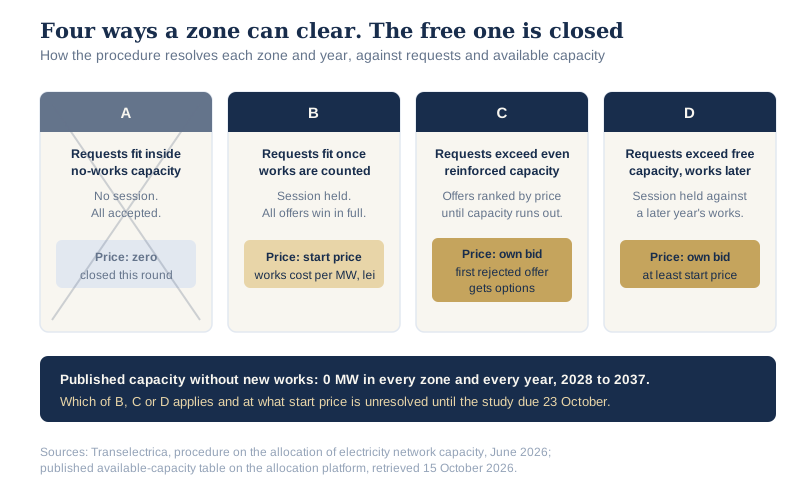
The zero decides the auction's shape. The procedure resolves each cell, one network zone in one delivery year, into one of four scenarios. Where requests fit inside the capacity needing no works, no session is held and applicants contract at a price of zero. Where they fit only once reinforcement works are counted, everyone wins and pays the start price, the cost of those works divided by the megawatts they make available, in lei excluding VAT. Where requests exceed even the reinforced capacity or the works land only in a later allocation year, bidding is real and winners pay their own bids. With the no-works capacity at zero in every cell, the zero-price outcome is off the table and every active cell waits on reinforcement costs that do not yet exist in public. 23 October therefore matters more than 30 October: it is the day Romanian grid capacity gets its first visible price tag.
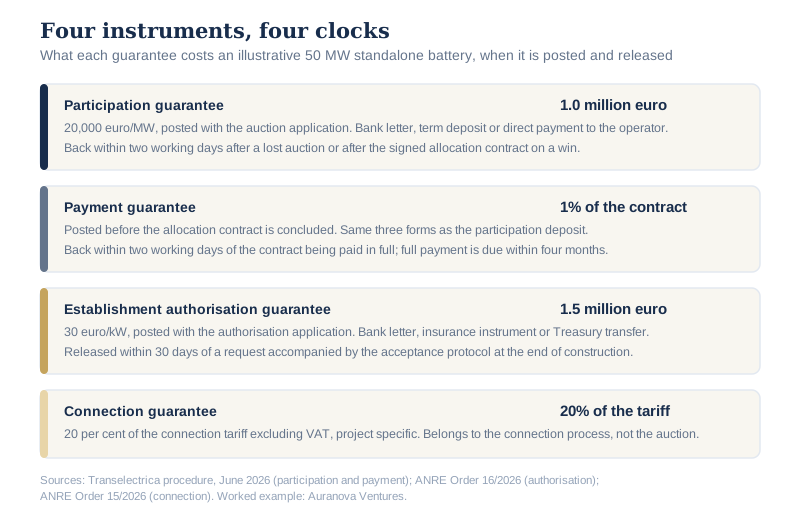
The guarantees are staged, though stages can overlap in a fast build. For an illustrative 50 MW standalone battery: 1.0 million euro of participation guarantee went in with the July application, back within two working days of a lost auction or after the signed contract on a win. A payment guarantee of 1 per cent of the contract value is posted before that contract and held until full payment. The 1.5 million euro authorisation guarantee belongs to a later stage, filed with the establishment authorisation application and held until construction is formally accepted. The connection guarantee, 20 per cent of the connection tariff excluding VAT, belongs to the connection process rather than the auction. The forms differ too: bank letters, term deposits or direct payments on the auction side; a bank letter, an insurance instrument or a Treasury transfer for the authorisation layer. Lining them up against a project calendar to find the peak collateral month is arithmetic we run with clients.
The 2027 economics are partly written by this round. From 2027 the deposit becomes the lower of 20,000 euro per MW and the weighted average contract price from the prior year's completed auctions, so a cheap 2026 round pulls the 2027 deposit down by formula. For scale, from a differently counted population: ANRE's 1 March 2026 report counts 1,431 renewable projects of 1 MW or more holding valid ATRs, 81,322 MW of approved export power, 46,136 MW with connection contracts signed. That stock already holds its approvals; the auction allocates new connections and export increases of 5 MW or more. The twelve applications are the first cohort priced under it.
Who is affected and how differently
The twelve applicants hold a one-week option: start prices by 23 October, offers from 30 October (subject to the final participant list, due before bidding) and the right to withdraw during a session. The competitive map is already public: the applications sit in eight zone-and-year cells; three hold several applications, each set filed by a single company, so no two companies compete in the same cell on paper. How much capacity each cell offers stays unknown until the study.
Standalone developers outside the round get a cleaner decision. By the 28 February 2027 application deadline, start prices will be public, first clearing results known and the guarantee question possibly settled. Model the collateral load at the current 30 euro per kW and at the materially lower levels under discussion before shelving anything.
Owners of operating generation sites gain most from the pending draft. At an existing production site the procedure pulls added storage of 5 MW or more into the auction when the site seeks an increase in export power; a battery within the site's existing export rights sits outside that trigger, though its approvals still need amending. If the draft passes, the authorisation guarantee on that added storage goes too.
Investors should weight the two pending changes differently: the co-located relief is a formal draft past consultation, the standalone cut so far only a reported request.
What to do about it
Watch 23 October, when the updated study prices reinforcement per zone and year. Five of the eight active cells hold a single application, so across most of the map the start price, not a rival bid, will decide.
If you are in the round, rehearse the post-win chain: the signed contract goes back within five working days of receiving it with the 1 per cent payment guarantee attached, the first tranche of at least 20 per cent falls due within 30 days and full payment within four months. Missing the contract step forfeits the participation deposit and the capacity; missing a payment later forfeits the capacity and the payment guarantee.
If you are not, build the February 2027 file now. Price the guarantees as financing cost and execution risk, not as a fee, at today's rates and at the relief under discussion.
Screen your portfolio for existing production sites that can host storage within their current export rights. That configuration avoids the capacity auction today and sheds the authorisation guarantee if the pending draft passes.
The date that resolves it
Romania built an entry gate with heavy collateral and no price tag, drew a storage-heavy twelve-application field and will publish the missing floor a week before bidding. Working out what to bid on 30 October, what to hold for the better-informed 2027 window and what to put behind an existing site is the kind of question we at Auranova Ventures work through with developers and investors across the Nordics, Baltics and wider Europe. We are building a market-entry model that prices these regulatory inflection points; reply to talk through a Romanian position.
When the start prices land on 23 October, will your zones look like a bargain or a bill?
Sources
- Transelectrica capacity allocation platform, published available capacity by zone and year
- Transelectrica capacity allocation platform, application centraliser for the 1 to 14 July 2026 window
- Transelectrica, Procedure on the allocation of electricity network capacity, updated June 2026 (PDF)
- ANRE Order 15/2026 on connection guarantees and capacity allocation (PDF, Monitorul Oficial reprint)
- ANRE Order 16/2026 introducing the establishment authorisation guarantee (Monitorul Oficial 439 of 25 May 2026)
- ANRE, Regulatory Committee press release of 21 May 2026
- ANRE, draft procedure on the financial guarantee under art. 19¹, public consultation of 24 August 2026
- ANRE, status report on renewable projects with valid ATRs as of 1 March 2026 (PDF)
- Economica.net, RWEA and RPIA request to cut the battery guarantee to 5,000 euro per MW, 5 October 2026
- Balkan Green Energy News, English coverage of the same request, 6 October 2026
- Further reading: our July piece on the auction's design