Romania Just Made Grid Access an Auction. Batteries Have to Win It
9 July 2026 · 8 min read · Auranova Ventures
Romania is about to run the first grid capacity auction in its history. The clock is short. Applications for the first round close on 14 July 2026. Daily bidding starts on 30 October. To sit at the table a developer posts a participation guarantee of about 20,000 euro per megawatt. The connection guarantee behind it just rose from 5 percent to 20 percent of the connection fee. This is a different market from the one that existed six months ago. Grid access used to be a queue. Now it is a contest you pay to enter and have to win.
The development
On 1 January 2026 Romania switched the way it hands out grid capacity. Under ANRE Order 53/2024, issued by the national energy regulator and built on Article 25 of Law 123/2012, capacity for any generation or storage site of 5 MW or more is allocated through annual competitive auctions run by the transmission operator Transelectrica, not by first-come administrative queuing. The rules name storage directly. Standalone batteries and batteries added at existing generation or consumption sites all fall inside the scope.
A word on the jargon, because it decides everything here. In Romania the document that reserves your place on the grid is the ATR, the technical connection approval. Hold a valid ATR and you have a right to a defined slice of grid capacity at a defined point. The reform does not touch what an ATR is. It changes how you get one. Instead of applying and waiting, you now bid for the capacity in an auction. Only the winners walk away with the reservation.
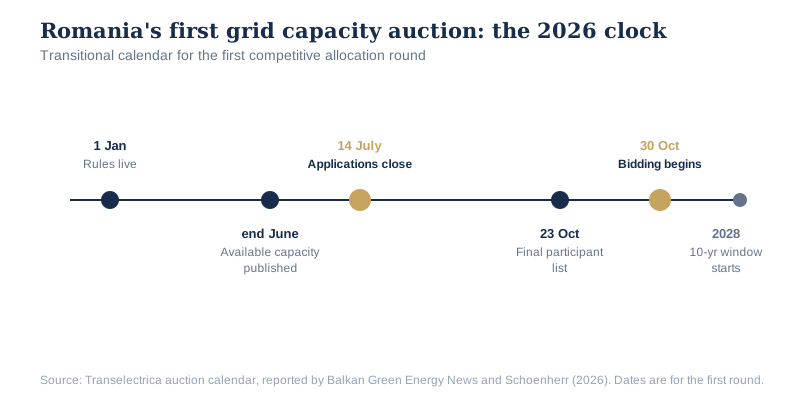
The first round runs on a transitional calendar. Transelectrica published the available capacity by grid zone at the end of June, applications close on 14 July 2026, the final list of qualified participants is due on 23 October and daily bidding sessions begin on 30 October, for capacity that is allocated across a ten-year window opening in 2028. The timeline is compressed because the first auction was already deferred once, from January to autumn 2026. These dates come from Transelectrica's own auction calendar as reported by Balkan Green Energy News and Schoenherr.
Running alongside it is the money. In March 2026 the European Commission approved a 150 million euro Romanian scheme to support standalone electricity storage, Romania's first measure cleared under the Clean Industrial Deal State Aid Framework and financed through the EU Modernisation Fund. It targets at least 2,174 MWh of new capacity, awarded by competitive tender as direct grants that must be paid out before the end of 2030.
What it actually means
Put the two together and the picture is clear. Romania has built two gates in front of a battery. They are not the same size.
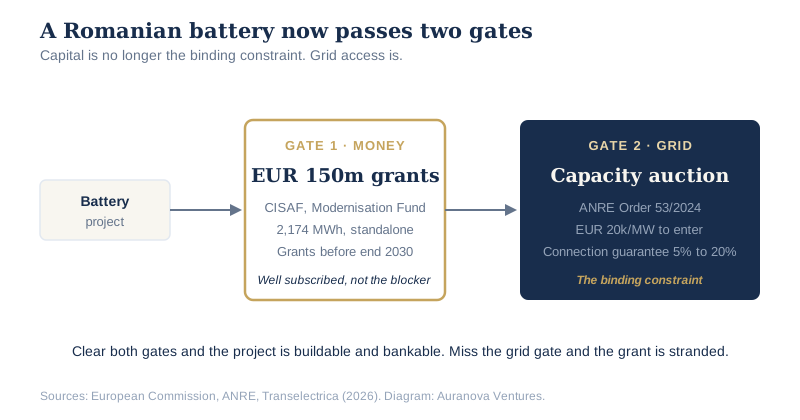
The grant gate is real money and it matters, but it is not the binding constraint. Capital has been chasing Romanian storage for two years. The grid gate is the one that decides which projects exist. That is a structural change in where a Romanian project can die. When we model a market entry, the question moves from "can this project be financed" to "can this project win and hold a capacity slot at a price that still leaves an equity return." Grid access has become a priced, contested, dated input rather than a form you file.
That reprices risk in two concrete ways. First, the auction clearing price is a new line in the capital stack. Whatever a developer pays to secure capacity is money spent before a single cell is installed. It competes directly with the grant on the other side of the ledger. Second, the guarantees raise the cost of being wrong. At roughly 20,000 euro per megawatt to participate, a 50 MW battery is putting up around one million euro just to bid, with the connection guarantee stacked behind it at 20 percent of the connection fee rather than the old 5 percent. Our read is that this is the point of the design, not a side effect. It is meant to clear out the speculators.
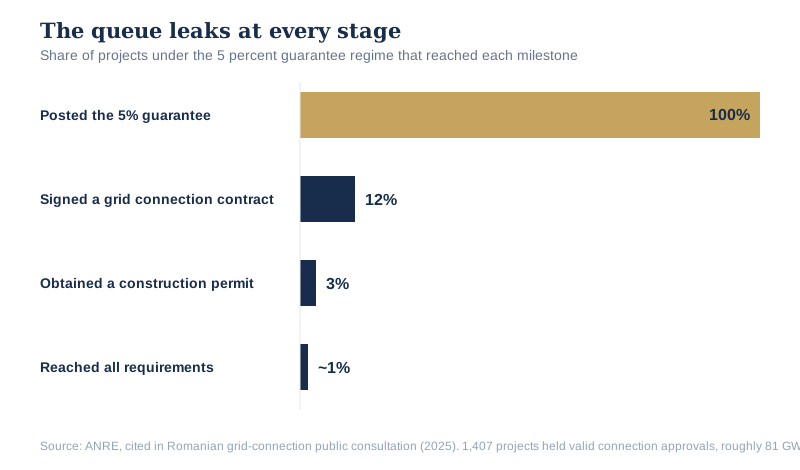
The speculation was not a small problem. Romania's connection queue had swollen to roughly 81 GW of projects behind 1,407 valid connection approvals, a pipeline several times larger than anything the grid can physically absorb. When ANRE looked at what those approvals actually became, the funnel was brutal. Of the projects that had posted the old 5 percent guarantee, only 12 percent went on to sign a connection contract, 3 percent reached a construction permit and around 1 percent cleared every requirement. A queue that is 99 percent inert is not a queue, it is a blockage. It is why real projects could not get a straight answer on capacity.
The auction is the response. Make capacity scarce and priced. The paper projects fall away because holding a slot now costs real money. The figures above are the regulator's and the operator's own numbers. The way we weigh them for a project is ours.
Who is affected and how differently
A standalone storage developer new to Romania gets the clearest deal and the sharpest test. The path is finally legible. Standalone batteries are eligible, there is grant money aimed straight at them and there is a defined mechanism to win capacity. The test is that grid access is now a competitive bid, so a thin business case that only worked when connection was free and automatic no longer clears the first gate.
Investors underwriting Romanian storage should move grid access from an assumption to a diligence line. In the diligence we run, the projects that disappoint are the ones that treated a connection approval as a given. In the new regime the question is whether the asset can win its capacity at a price the model can carry and whether the sponsor has the guarantees funded to stay in the auction. A grant award means little if the grid slot is lost.
Developers already holding a valid ATR from the old queue sit in the strongest spot, because they hold exactly the scarce thing the auction now rations. That reservation has become an asset with real option value. Anyone relying on a speculative early-stage application is on the other side of the same trade. The reform is built to squeeze that position out.
Co-location changes too. A solar or wind site adding a battery of 5 MW or more is inside the auction scope for the added capacity, so the storage layer is no longer a quiet retrofit. It is a capacity request that competes on the same clock as everyone else.
What to do about it
A few concrete moves for this quarter.
File for the first round if a project is anywhere near ready. Applications close on 14 July 2026 and the next annual window is a year away. Missing it is not a delay of weeks, it is a delay of a full cycle.
Size the guarantees into the model now, not later. Budget the participation guarantee at roughly 20,000 euro per megawatt and the connection guarantee at 20 percent of the connection fee. Confirm the treasury can carry both through to award without straining the equity case.
Model the auction clearing price as a capex line. Treat what you pay for capacity as spend that competes with the grant. Test the return across a range of clearing prices rather than a single assumed number. If the case only works when capacity is free, it does not work.
Sequence the grant and the grid together. The 150 million euro tender and the capacity auction are separate processes on separate clocks. Winning one without the other strands the project, so line up the timing before committing to either.
For anyone holding an ATR from the old queue, value it properly. It is now a scarce, auctioned right. Understand what it is worth before trading, transferring or building on it.
Where we come in
This is exactly the kind of entry we at Auranova Ventures work through with developers and investors moving into a new market. Romania has turned grid access into a priced, competitive, dated event, which is a market-entry and bankability question as much as an energy one. The two clocks have to be modelled together rather than assumed. If you are weighing a Romanian project and want a second read on how the auction and the grant reshape its economics, reply or start a conversation. We are also building a tool that models storage revenue stacks and access costs across markets, so tell us if you would like early access when it opens.
Which gate is the real risk on your Romanian project, the money or the grid? We read every reply.
Sources
- Transelectrica new grid allocation rules for 2026 (reported): https://www.pv-tech.org/romanian-tso-transelectrica-publishes-new-grid-allocation-rules-2026/
- Balkan Green Energy News, Romania to launch grid capacity auctions this autumn (first-round dates, guarantees): https://balkangreenenergynews.com/romania-set-to-launch-grid-capacity-auctions-this-fall-to-fend-off-speculators/
- Schoenherr, Romania's grid connection reform: capacity auctions, increased guarantees and tighter deadlines: https://www.schoenherr.eu/content/romania-s-grid-connection-reform-capacity-auctions-increased-guarantees-and-tighter-deadlines
- Kinstellar, Transelectrica approves the grid capacity allocation procedure (ANRE Order 53/2024, effective 1 January 2026): https://www.kinstellar.com/news-and-insights/detail/3787/ready-or-not-its-here-transelectrica-approves-the-grid-capacity-allocation-procedure-effective-next-year
- Wiren, what Romania's capacity auctions mean for developers (5 MW threshold, storage eligibility, Art. 25 Law 123/2012): https://www.wiren.com/what-romanias-capacity-auctions-mean-for-developers/
- European Commission, approval of the 150 million euro Romanian electricity storage scheme (CISAF, Modernisation Fund, 2,174 MWh): https://ec.europa.eu/commission/presscorner/detail/en/ip_26_524
- Energy-Storage.news, European Commission approves Romania's battery storage subsidy scheme: https://www.ess-news.com/2026/03/09/european-commission-approves-romanias-battery-storage-subsidy-scheme/
- energynomics, grid connection approvals and the ANRE guarantee funnel (81 GW, 1,407 ATRs, 12/3/1 percent): https://www.energynomics.ro/en/9-things-to-know-about-technical-grid-connection-approvals-a-contribution-to-the-public-debate/
- Grigorescu Partners, Romania's battery storage market 2026 (NECP storage targets, standalone storage recognition): https://grigorescupartners.ro/articles/romania-battery-storage-market-2026-regulation-grid-access-investment/