Two Months Set at Zero: Fingrid's Balance Service Volume Fee Turns Up for 2027
29 October 2026 · 8 min read · Auranova Ventures
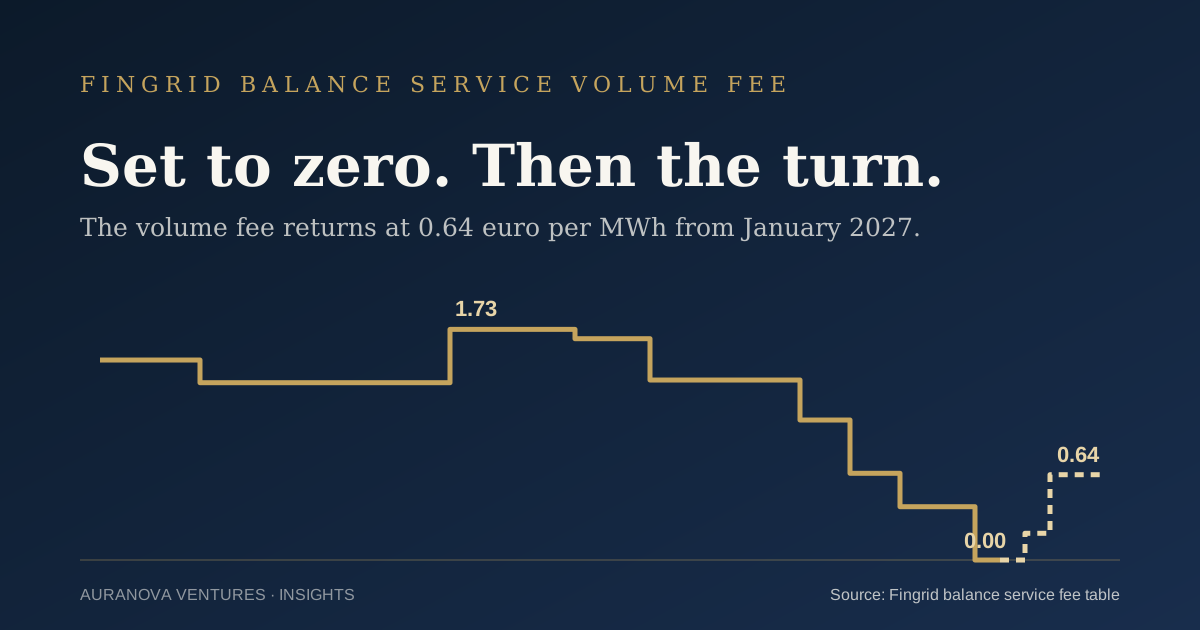
In October 2026 Fingrid's balance service volume fee stands at 0.00 euro per megawatt hour and November is set to the same zero, the floor of six consecutive cuts. On 27 October Fingrid published what comes next: 0.20 euro for December and 0.64 euro from 1 January 2027, the first upward moves in the fee table since January 2025. In August we wrote up the collapse. This is the turn. It is easier to misread than the collapse was.
The development
Fingrid, Finland's transmission system operator (TSO), charges every balance responsible party (BRP) a set of balance service fees. A BRP is the company financially answerable for the gap between what its portfolio promised and what it delivered. The fee appendix to the balance agreement defines the volume fee as charged on a BRP's total actual production and consumption in each imbalance settlement period, the block over which deliveries are settled. It is the component Fingrid moves as the costs it covers come in above or below forecast. The other two components, a 30 euro weekly fee and a 1.15 euro per MWh imbalance fee, have not moved since November 2023 and stay unchanged now.
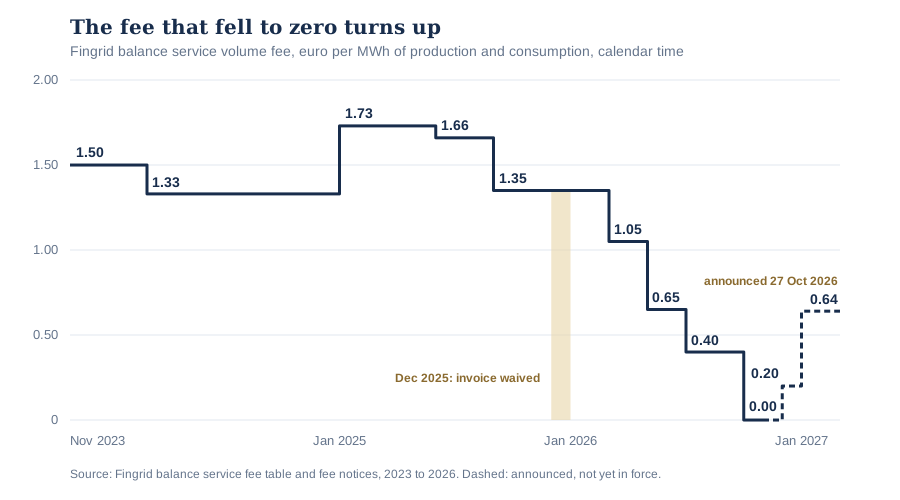
The autumn ran in three notices. On 31 August Fingrid announced that the volume fee would not be charged in October 2026, citing a "lower level of the power system reserve costs and higher level of the electricity trade result". On 23 September the same was announced for November, for the same reason. Then the 27 October notice set December at 0.20 and January 2027 at 0.64, "based on forecasts of the power system's reserve costs and the imbalance power trading".
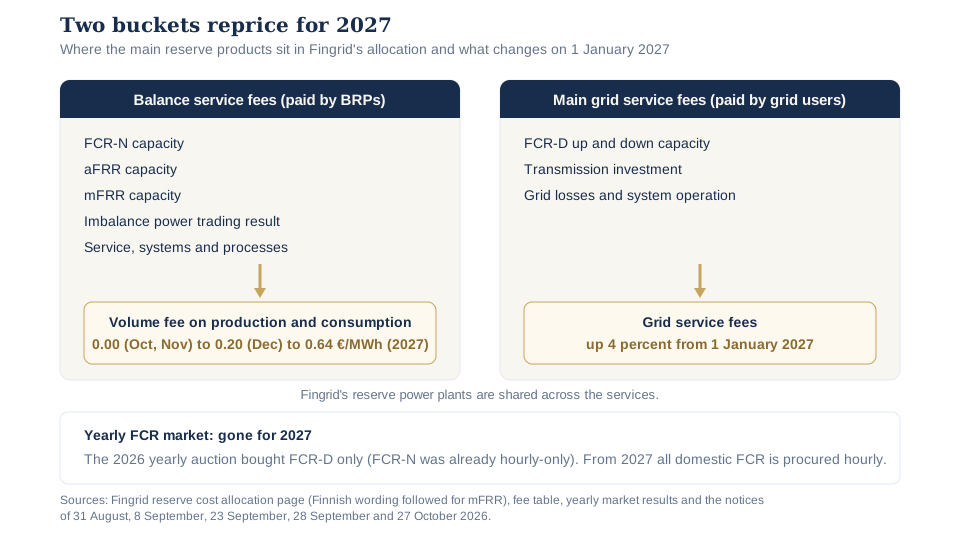
Two other autumn decisions matter here and both sit in a different bucket. On 8 September Fingrid dropped the yearly FCR market for 2027, moving all domestic procurement of frequency containment reserves (FCR, the first reserves to respond when grid frequency moves) to the hourly market. That is in practice a story about FCR-D, the disturbance product: FCR-N, the normal-operation product, already left the yearly market for 2026, so the 2026 yearly auction bought FCR-D only. FCR-D costs are recovered through the main grid fees, not the balance service. And on 28 September Fingrid announced that main grid service fees rise 4 percent from the start of 2027, naming investment and system growth as the drivers. Keeping those buckets apart is half the work of reading this autumn correctly.
What it actually means
The volume fee is cost recovery, not a traded price. The fee appendix states that the fees "cover the costs of the balance services" and allow a reasonable return. On Fingrid's allocation page, the balance service carries FCR-N plus aFRR and mFRR, the automatic and manual frequency restoration reserves, with Fingrid's reserve power plants shared across services. (The English page's wording differs on mFRR; the Finnish page assigns it to the balance service, the reading we follow.) On top of the reserves sit the result of imbalance power trading (the energy Fingrid buys and sells to settle BRPs' delivery gaps) and the running of the service itself. Fingrid revises the fee as those costs land above or below forecast. That is how the autumn reached zero: both zero months carried the same stated reason, reserve costs below forecast and a better trading result.
Zero was a real tariff rate but not a reserve-market price: it is what the correction mechanism produces when costs land well below the level the fee was set against. The 0.64 is, in Fingrid's words, based on its forecasts of 2027 reserve costs and imbalance power trading. It is a composite rate with no published decomposition. A recovery rate can rise for several reasons (the list is our inference, not Fingrid's): higher expected reserve costs, a smaller expected trading surplus, prior over-recovery running out or a lower billed-volume forecast. The public record does not separate them. In August the trap was reading the collapse as battery reserve revenue dying. The trap now is reading 0.64 as reserve prices recovering. Both over-read the same aggregate.
What the record does support is narrower. The level in force on 1 January has fallen in two successive year-on-year comparisons: 1.73 in 2025, 1.35 in 2026 and 0.64 announced for 2027, down 22 percent, then 53 percent, 63 percent overall. And for the first time since January 2025, the published fee path points up rather than down. Direction of the rate, not decomposition of the costs, is the news.
Product-level evidence lives elsewhere. Reserve capacity is traded in hourly markets, the mFRR energy market runs on 15-minute periods and aFRR energy is priced at 4-second intervals within 15-minute bids. Anyone pricing reserve revenue should read those product records, not this fee, in either direction.
Who pays what from January
The arithmetic below is ours, not Fingrid's, annualised as if each rate held all year. A BRP billed for one terawatt hour of combined production and consumption pays at a 1.73 million euro annual rate at the January 2025 level, nothing in October and November and a 640,000 euro rate from January.
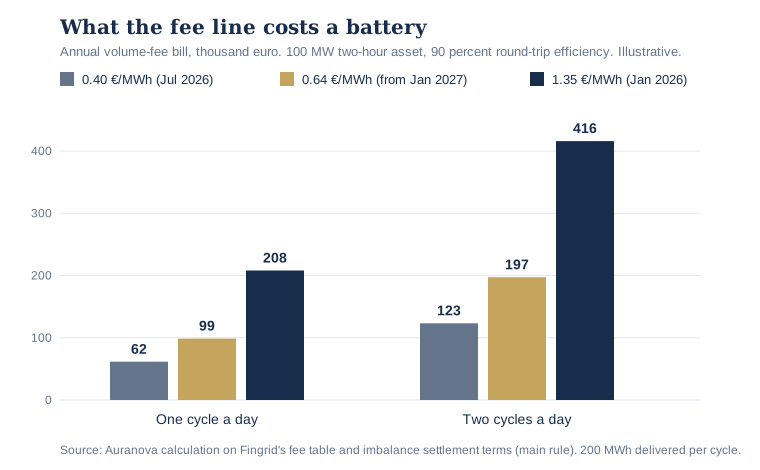
For batteries the detail that matters is the settlement basis. Under Fingrid's imbalance settlement terms taking effect on 1 November 2026, the main principle is that a storage facility is registered as two metering points, consumption when charging and production when discharging, with no netting of the two within a settlement period. Exceptions are narrow: same-meter netting where the metering decree allows it. For storage integrated with a production unit, only the qualifying discharge may be netted against that unit's production, while charging stays separately reported. On the main rule a cycling battery pays the fee on both sides of every cycle. Take a 100 megawatt two-hour asset delivering 200 megawatt hours to the grid each day at 90 percent round-trip efficiency (energy out over energy in): roughly 73 gigawatt hours discharged and 81 charged a year, about 154 gigawatt hours billed. The chart below runs that asset across fee levels and cycling rates. The sums are illustrative and land first on the asset's BRP, with pass-through set by contract. Materiality depends on throughput and strategy. What the line is not is zero. A line that sat at zero is easy to leave out.
Developers and battery owners should keep the one hard fact above the cash: the published fee path turns up for the first time since January 2025. Treat the 0.64 as the announced rate it is, not as your price curve for reserves. Utilities sitting as BRPs get a 2027 budget reset and their retail and industrial contracts decide how much moves on. Investors should resist reading the turn as a revenue story and go to the product records instead. For policymakers the story is the volatility itself: 1.73 to zero to 0.64 between January 2025 and January 2027 warns against building anything long-lived on a single point of this series.
What to do about it
Five moves for the quarter. Put the fee back into 2027 Finnish operating models at 0.64 on the volumes your asset's settlement treatment actually bills (both charge and discharge under the main rule), with the BRP pass-through in your contract checked rather than assumed. Carry a spread around that rate: Fingrid has revised this fee repeatedly in both directions over the observed period. Price reserve revenue off the product records, never off the fee. Keep the buckets apart in any Finnish cost model: FCR-D sits behind the main grid fees, which rise 4 percent, while FCR-N, aFRR and mFRR sit behind the balance service. And if you plan to sell FCR in 2027, plan for hourly-only procurement: Fingrid has asked market operators to review their ability to always offer their full available reserve capacity, especially at the turn of the year.
Where we come in
The fee levels, dates and settlement rules above are Fingrid's; the worked examples are our arithmetic, assumptions stated. This is the kind of question we at Auranova Ventures work through with developers and investors across the Nordics, Baltics and wider Europe: which lines in a revenue stack (the set of revenue and cost lines an asset earns and pays across markets) are prices and which are cost-recovery rates. If you are sizing a Finnish asset or re-forecasting one you hold, reply and we will walk through where this fee sits in yours.
Is your 2027 Finland model still carrying this fee at zero or at 0.64?
Sources
- Fingrid, Balance service fees in December 2026 and from the beginning of January 2027 (27 October 2026): https://www.fingrid.fi/en/news/news/2026/balance-service-fees-in-december-2026-and-from-the-beginning-of-january-2027/
- Fingrid, balance service fee table: https://www.fingrid.fi/en/electricity-market/balance-service/fees/
- Fingrid, Appendix 2 to the Balance Agreement, fee components and determination of fees (valid from 30 September 2026): https://www.fingrid.fi/globalassets/dokumentit/en/electricity-market/reserves/valid-from-30.09.2026-appendix-2-fee-components-and-determination-of-fees.pdf
- Fingrid, Balance responsible parties will not be charged for the volume fee for production and consumption in October 2026 (31 August 2026): https://www.fingrid.fi/en/news/news/2026/balance-responsible-parties-will-not-be-charged-for-the-volume-fee-for-production-and-con-sumption-in-october-2026/
- Fingrid, Balance responsible parties will not be charged for the volume fee for production and consumption in November 2026 (23 September 2026): https://www.fingrid.fi/en/news/news/2026/balance-responsible-parties-will-not-be-charged-for-the-volume-fee-for-production-and-consumption-in-november-2026/
- Fingrid, The procurement of frequency containment reserves will be focused to the hourly market in 2027 (8 September 2026): https://www.fingrid.fi/en/news/news/2026/the-procurement-of-frequency-containment-reserves-will-be-focused-to-the-hourly-market-in-2027
- Fingrid, Growth in the power system increases costs, main grid service fees will rise by 4 per cent at the beginning of the year (28 September 2026): https://www.fingrid.fi/en/news/news/2026/growth-in-the-power-system-increases-costs--main-grid-service-fees-will-rise-by-4-per-cent-at-the-beginning-of-the-year/
- Fingrid, reserve costs included in the balance service (English): https://www.fingrid.fi/en/electricity-market/balance-service/description-of-balance-model/reserve-costs-included-in-balance-service/
- Fingrid, tasepalveluun sisältyvät reservikustannukset (Finnish, followed where the English wording differs): https://www.fingrid.fi/sahkomarkkinat/tasepalvelut/tasemallin-kuvaus/tasepalveluun-sisaltyvat-reservikustannukset/
- Fingrid, reserve markets: https://www.fingrid.fi/en/electricity-market/reserves/reserve-markets/
- Fingrid, frequency containment reserve for disturbances, yearly market results: https://www.fingrid.fi/en/electricity-market-information/reserve-market-information/frequency-controlled-disturbance-reserve/
- Fingrid, general terms and conditions concerning imbalance settlement (valid from 1 November 2026): https://www.fingrid.fi/globalassets/dokumentit/en/electricity-market/reserves/valid-from-01.11.2026-fingrid-oyj-general-terms-and-conditions-concerning-imbalance-settlement.pdf
Related insight: Auranova Ventures, What Fingrid's 77 Percent Fee Cut Actually Tells Finnish Battery Owners (5 August 2026): https://www.auranova.io/insights/finland-balance-fee-collapse-2026