What Fingrid's 77 Percent Fee Cut Actually Tells Finnish Battery Owners
5 August 2026 · 9 min read · Auranova Ventures
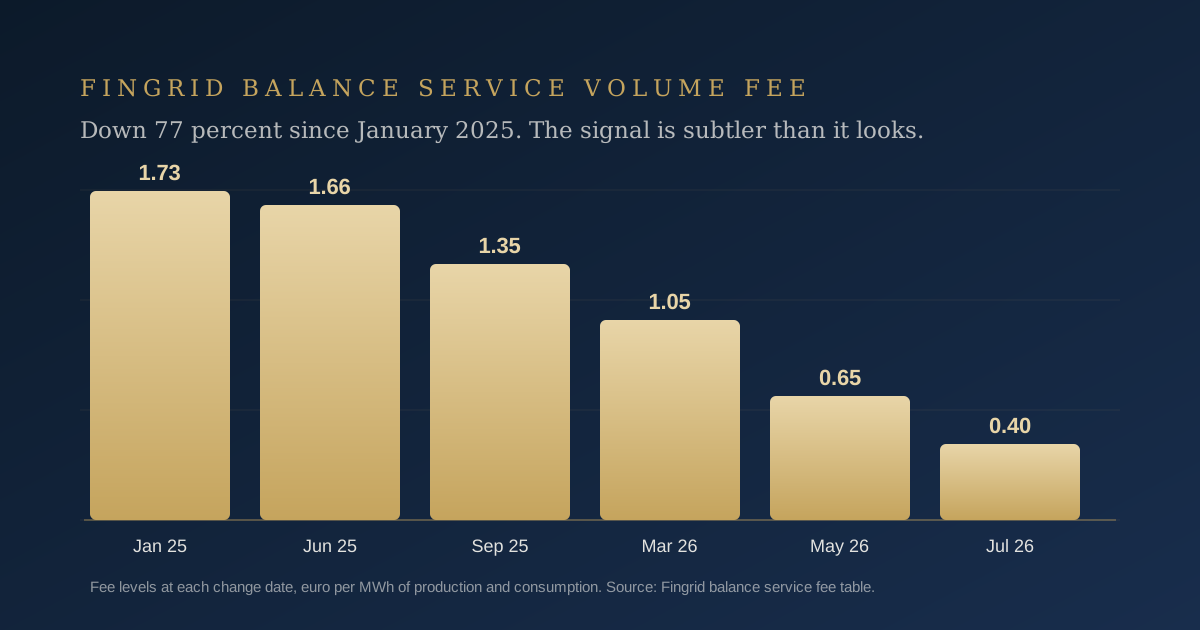
On 1 July 2026 Fingrid, Finland's transmission system operator (TSO), cut the volume fee it charges for balance services to 0.40 euro per megawatt hour, its third cut of 2026. The January 2025 peak in Fingrid's published fee table was 1.73 euro. For December 2025 Fingrid waived the invoice entirely. The stated reason, three announcements in a row: reserve costs came in lower than expected. It is tempting to read that as battery reserve revenue disappearing into consumers' pockets. The signal is subtler and more useful.
The development
Start with the mechanics. Every producer and consumer in Finland sits behind a balance responsible party (BRP), the company financially answerable for the gap between what its portfolio promised and what it delivered. Fingrid holds the system steady in real time by buying reserves, standby capacity that reacts when the grid frequency moves. The balance service fees it charges BRPs cover, in Fingrid's own words, the costs arising from power system reserves, which it lists as mFRR, aFRR and FCR-N, the manual, automatic and normal-operation reserve families defined below, plus the running of the service itself. The volume fee, charged per megawatt hour of production and consumption, is the component Fingrid revises as those costs come in above or below its forecast. The two other components (a 30 euro weekly fee and a 1.15 euro imbalance fee) have not moved since November 2023.
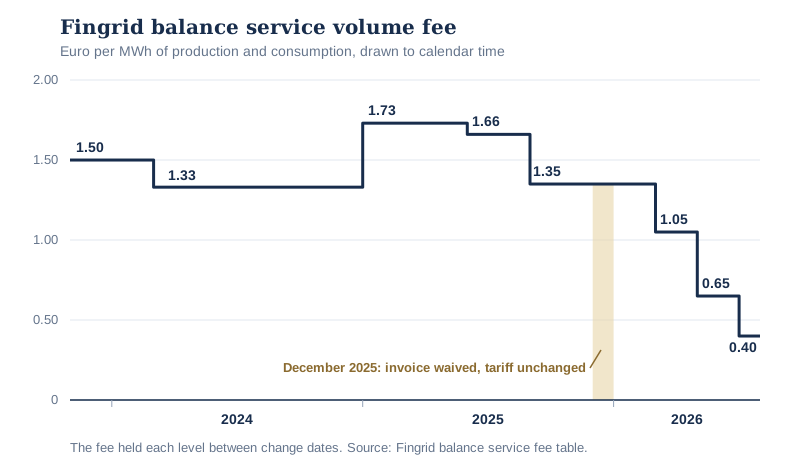
The volume fee stood at 1.50 euro per megawatt hour in November 2023, eased to 1.33 from March 2024, then jumped to 1.73 in January 2025 as reserve costs climbed. Then it turned: 1.66 from June 2025, 1.35 from September, a December for which Fingrid waived the volume fee invoice while the tariff itself stayed in the table, then 1.05 from March 2026, 0.65 from May and 0.40 from July. All three 2026 cuts carried the same sentence: Fingrid is able to reduce the fee thanks to "lower than expected reserve costs". The 23 July half-year report repeats it in the past tense.
What it actually means
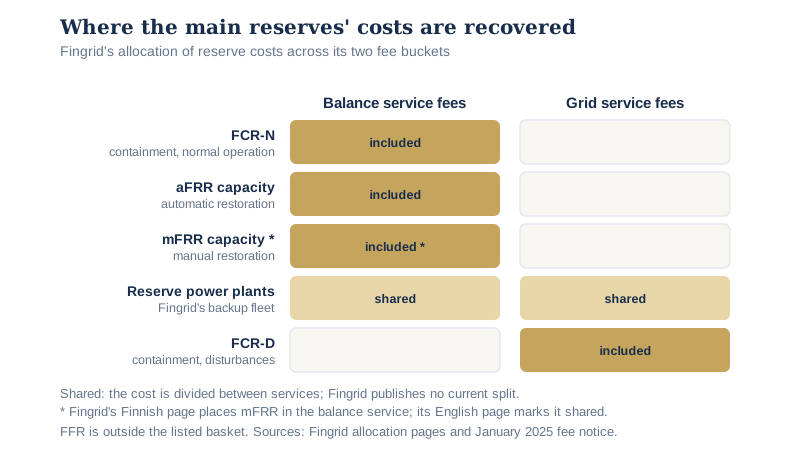
The part that is easy to get wrong: Finland's reserve costs do not sit in one pot. The balance service carries the normal-operation and restoration products. FCR-N is the frequency containment reserve (FCR) for small everyday frequency swings. aFRR is the automatic frequency restoration reserve, reaching full activation within five minutes to help restore frequency. mFRR is the manual frequency restoration reserve, the slowest product, activated on the TSO's request; the balance service carries the balancing capacity Fingrid buys in its market. Fingrid's allocation page adds detail: FCR-N belongs fully to the balance service and Fingrid's reserve power plants are shared with other services. (The English page also marks mFRR capacity as shared; the Finnish page assigns it fully to the balance service. No split is published.) FCR-D, the frequency containment reserve for disturbances (its up products support a falling frequency, its down products absorb a rising one), belongs to the grid service and is recovered through grid fees instead.
The allocation is long-standing. What moved is the two price tags, in opposite directions. The balance-service volume fee fell 77 percent from its peak while Fingrid raised grid service fees by 8 percent at the start of 2026, citing drivers from investment to a growing need to procure reserves. Anyone reading the fee cut as an FCR-D story is reading the wrong bucket.
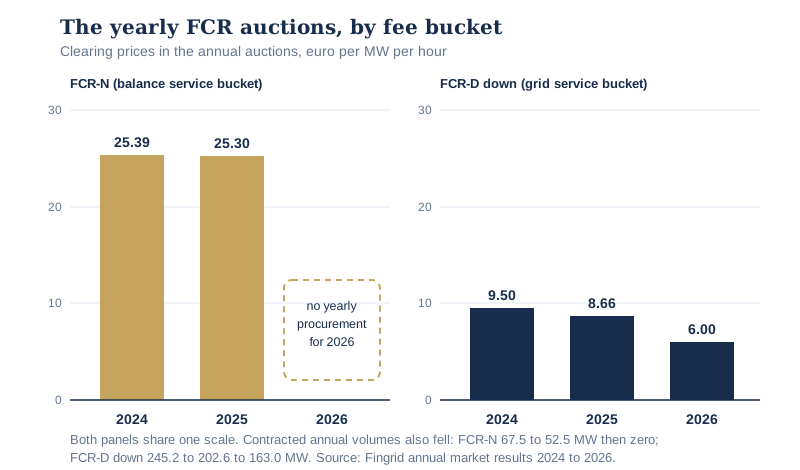
The public auction record tells two stories by bucket. In the balance-service bucket, the yearly FCR-N price barely moved, 25.39 euro per MW per hour for 2024 and 25.30 for 2025. What changed is that for 2026 Fingrid stopped buying FCR-N through the yearly market at all, moving procurement to the hourly market and imports. In the grid-fee bucket, FCR-D down cleared at 9.50 euro for 2024, 8.66 for 2025 and 6.00 for 2026. The maximum capacity contracted through that market fell alongside, from 245.2 MW through 202.6 to 163.0. Those megawatts cap one channel only: actual delivery varies hourly and Fingrid tops up in the hourly market and across borders against 2026 obligations of 309 MW up and 298 MW down. The yearly auctions cover the FCR products only. For aFRR and mFRR capacity Fingrid publishes hourly market data rather than an annual auction series, so reading those products takes real aggregation work. The fee itself stays aggregate and lagging evidence, not a product index.
Why did the costs undershoot? Our read (and it is a read, not a finding): supply arrived faster than the TSO's budget assumed and batteries are the likeliest marginal supplier in the fast products. Fingrid's own first-quarter review put connected electricity storage at approximately 1,050 megawatts and reported the lower-than-expected reserve costs in the same document, without connecting the two. Fingrid does not publish the technology mix of cleared suppliers, so the attribution cannot be proven from public data; we hold it as a working hypothesis. Sweden offers a data point of the same limited kind. Svenska kraftnät announced reduced Nordic aFRR procurement volumes for the first quarter of 2026 and named "new reserve technologies (batteries) with fast activation time" among the contributors to improved frequency quality. Less volume procured is not proof of less money spent. The notice supports one narrow statement: the Nordic TSOs needed less of the product and fast assets are part of why.
The queue behind the prices
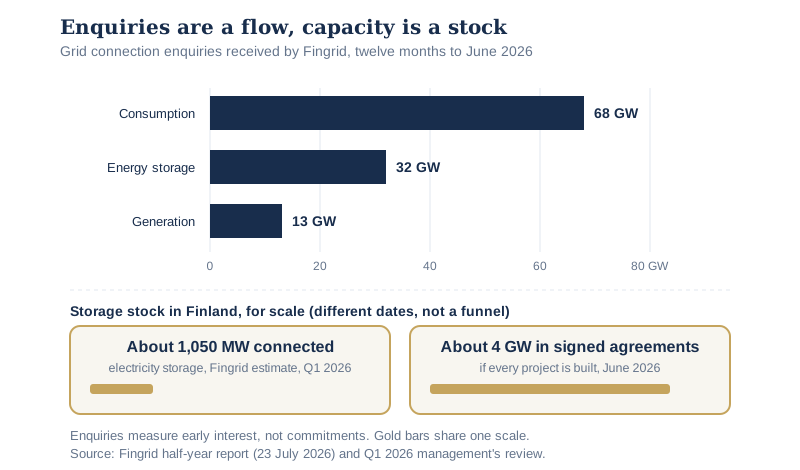
In the twelve months to June 2026 Fingrid received grid connection enquiries of roughly 68 gigawatts for consumption, 13 for generation and 32 for energy storage. Those enquiries are a flow of early interest, not committed projects. The stock numbers are smaller and dated differently: approximately 1,050 megawatts of electricity storage connected per Fingrid's first-quarter estimate and signed storage connection agreements reaching about four gigawatts if every project is built. Set any of those against Finland's entire FCR obligation for 2026 (under 750 megawatts across FCR-N and both FCR-D directions) and the mismatch is stark. The comparison is crude, nameplate megawatts against directional reserve obligations, yet the gap is more than an order of magnitude. Our read: if even a modest share of that interest gets built, the frequency products cannot host it, so any credible plan for those megawatts leans mostly on energy arbitrage, buying cheap hours and selling expensive ones, plus the aFRR and mFRR balancing markets. The enquiry figure is a temperature reading, not a project list.
Who feels it and how differently
Fingrid invoices BRPs, so the direct saving lands there first. A portfolio billed for one terawatt hour of production and consumption a year pays 400,000 euro at the current fee against 1.73 million at the January 2025 level. The comparison is illustrative. Utilities sit in the middle: as BRPs they book the saving and their retail contracts decide how much of it moves on to end customers.
Owners of operating batteries should map each revenue line to its bucket. The yearly FCR auctions have either repriced downward (FCR-D) or moved out of the yearly market entirely (FCR-N). For aFRR and mFRR capacity the record is hourly and takes work to read: assume neither stability nor collapse without doing that work.
Developers get a signal they did not pay for: how much interest circles the same Finnish markets and what the established products pay.
Investors get a published, dated series to calibrate against. A sponsor deck holding Finnish FCR prices flat through 2030 is arguing with the TSO's own auction results.
What to do about it
Five moves for the quarter. Read the fee paths as aggregate signals and the auction series as the product-level record. Wire both into the model rather than a flat reserve assumption. Re-run the stack, the combination of revenue lines an asset earns across markets, with energy and the balancing products leading and the FCR lines as supporting revenue. Stress duration: in our scenario work we test one-hour against two-hour builds under continued FCR compression as well as stabilisation, label the outputs as scenarios and let the spread between them size the equity risk. If you hold a Finnish connection enquiry, confirm your connection point and timeline are real before spending further; 32 gigawatts of others are circling. If you invest, ask what the equity case looks like if the 2024 to 2026 auction path continues for three more years, an assumption, not a forecast.
Where we come in
This is the kind of question we at Auranova Ventures work through with developers and investors across the Nordics, Baltics and wider Europe. The figures above are Fingrid's and Svenska kraftnät's, including the bucket allocation itself. The judgement about how fast each revenue line decays and what that does to a project's equity case is ours. If you want a second read on how this repricing lands on a project you are sizing or a portfolio you already hold, reply and we will walk through it.
What does your model assume the Finnish frequency products pay in 2029? We read every reply.
Related insight
- Where Nordic battery revenue is actually moving in 2026, our June piece on the reserve shift this article extends.
Sources
- Fingrid, the new balance service fees will come into effect on 1 January 2025 (reserve basket: mFRR, aFRR and FCR-N): https://www.fingrid.fi/en/news/news/2024/the-new-balance-service-fees-will-come-into-effect-on-january-1-2025/
- Fingrid, reserve costs included in the balance service (cost allocation by product): https://www.fingrid.fi/en/electricity-market/balance-service/description-of-balance-model/reserve-costs-included-in-balance-service/
- Fingrid, balance service fees with the fee table from November 2023: https://www.fingrid.fi/en/electricity-market/balance-service/fees/
- Fingrid, balance service fees to decrease on 1 March 2026 (29 January 2026): https://www.fingrid.fi/en/news/news/2026/balance-service-fees-for-balance-responsible-parties-to-decrease-on-1-march-2026/
- Fingrid, balance service fees to decrease on 1 May 2026 (26 March 2026): https://www.fingrid.fi/en/news/news/2026/balance-service-fees-for-balance-responsible-parties-to-decrease-on-1-may-2026/
- Fingrid, balance service fees to decrease on 1 July 2026 (25 May 2026): https://www.fingrid.fi/en/news/news/2026/balance-service-fees-for-balance-responsible-parties-to-decrease-on-1-july-2026/
- Fingrid, no volume fee invoiced for December 2025 (19 November 2025): https://www.fingrid.fi/en/news/news/2025/fingrid-will-not-invoice-the-volume-fee-for-the-production-and-consumption-of-balance--responsible-parties-for-december-2025/
- Fingrid, reserve costs included in the balance service, Finnish version (mFRR and aFRR listed in the balance service): https://www.fingrid.fi/sahkomarkkinat/tasepalvelut/tasemallin-kuvaus/tasepalveluun-sisaltyvat-reservikustannukset/
- Fingrid, half-year report 1 January to 30 June 2026 (23 July 2026): https://www.fingrid.fi/en/news/news/2026/fingrid-groups-half-year-report-1.1.30.6.2026/
- Fingrid, management's review 1 January to 31 March 2026 (connected electricity storage estimate): https://www.fingrid.fi/en/news/news/2026/fingrid-group--managements-review-1.1.31.3.2026/
- Fingrid, grid service fees to rise 8 percent at the start of 2026: https://www.fingrid.fi/en/news/news/2025/the-expanding-and-changing-electricity-system-increases-costs--fingrid-to-raise-grid-service-fees-at-the-start-of-the-year/
- Fingrid, power system reserves (obligations and activation requirements): https://www.fingrid.fi/en/electricity-market/reserves/power-system-reserves/
- Fingrid, procurement of frequency containment reserves from the annual market 2024: https://www.fingrid.fi/en/news/news/2023/procurement-of-frequency-containment-reserves-from-annual-market-2024/
- Fingrid, procurement of frequency containment reserves from the annual market 2025: https://www.fingrid.fi/en/news/news/2024/procurement-of-frequency-containment-reserves-from-annual-market-2025/
- Fingrid, procurement of frequency containment reserves from the yearly market 2026: https://www.fingrid.fi/en/news/news/2025/procurement-of-frequency-containment-reserves-from-yearly-market-2026/
- Svenska kraftnät, procurement of aFRR in Q1 2026 (17 December 2025): https://www.svk.se/en/about-us/news/news/procurement-of-automatic-frequency-restoration-reserve-afrr-in-q1-2026/