Where Nordic Battery Revenue Is Actually Moving in 2026
5 June 2026 · 8 min read · Auranova Ventures
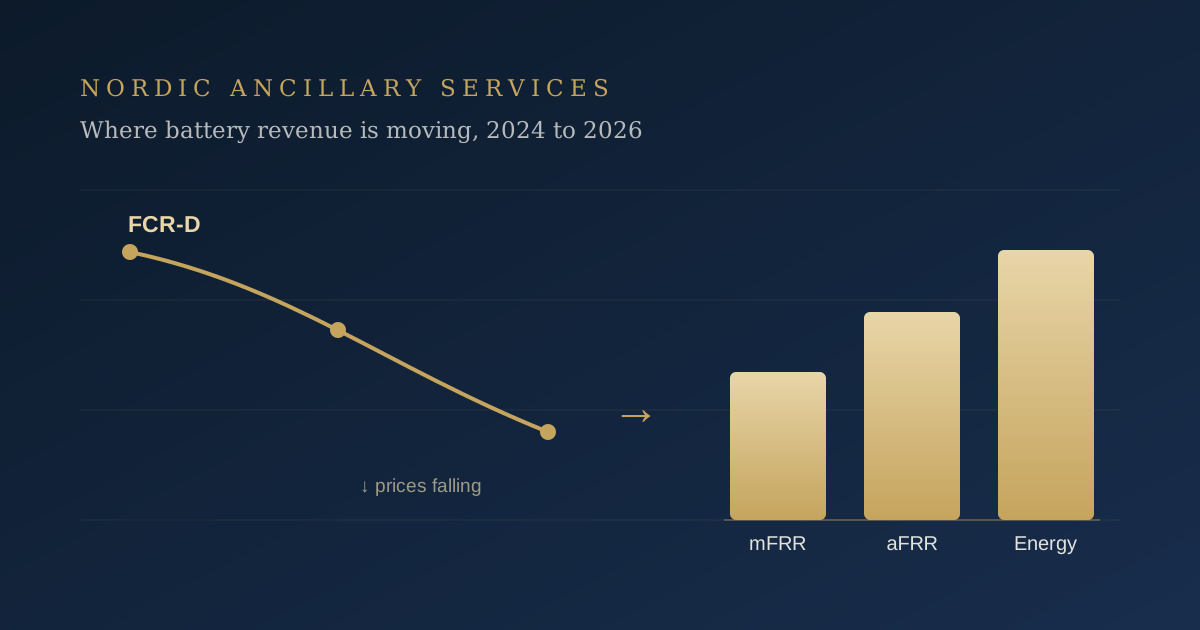
A battery that cleared Finland's yearly FCR-D down market at 9.50 euro per MW per hour for 2024 is looking at 6.00 euro for 2026. Same asset, same product, roughly a third less revenue from that single line in two years. The frequency markets that made Nordic batteries bankable are filling up and the money is moving to where fast assets are still scarce.
The development
FCR-D has been the anchor revenue line for Nordic grid-scale batteries. It is the fast reserve that arrests a frequency drop, batteries are very good at it and for a while it paid handsomely. That is changing on two fronts at once.
A quick map before the numbers. Sweden, Finland, Norway and eastern Denmark sit in one synchronous grid and share the same reserve products, but each country procures them through its own system operator at its own price. Fingrid runs the Finnish markets, Svenska kraftnät the Swedish, Statnett the Norwegian and Energinet the Danish. The figures below differ by country while the direction is the same, which is what lets a developer in one market read across to the next.
In plain terms, these are the services the grid pays a battery to provide. They sit on a ladder of speed. FCR, frequency containment reserve, is the fastest. It arrests a frequency drop within seconds. FCR-D is the version that handles the larger disturbances, the product Nordic batteries have lived on. aFRR, automatic frequency restoration reserve, is the next rung. It restores the frequency over the following minutes, automatically. mFRR, manual frequency restoration reserve, is slower again, called on by the operator to refill the balance. The further down this ladder you go, the more the product rewards stored energy and endurance over raw speed, which is the whole story of this piece.
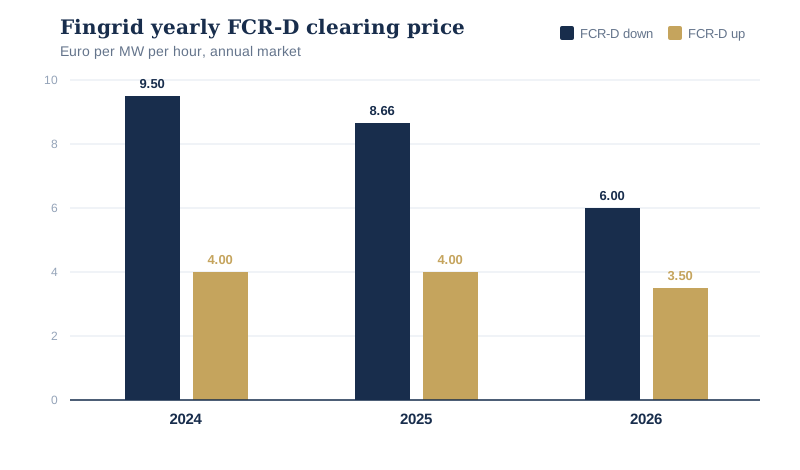
First, price. Fingrid's yearly FCR-D market shows the trend cleanly. The down product cleared at 9.50 euro per MW per hour for 2024, 8.66 for 2025 and 6.00 for 2026. The up product slipped from 4.00 to 3.50 over the same window. For 2026 Fingrid stopped buying FCR-N from the yearly market altogether and moved it to the hourly market and imports. Prices fell across every FCR reserve. We lead with Finland because it publishes the cleanest annual series. Sweden's FCR-D prices followed the same path down.
Second, structure. Svenska kraftnät switched its FCR markets to marginal pricing on 1 February 2024, which sharpened bidding and pushed average prices down further. Underneath both, supply simply arrived. The FCR-D requirement is a capped volume set by the size of the largest credible fault, several hundred megawatts in each direction, while Sweden's battery fleet passed 600 MW in 2024. We take these numbers from the system operators' own procurement notices rather than secondary trackers, because the second-hand figures drift. Once a fleet that size is chasing a fixed requirement, the product clears for less. There is no other outcome.
What it actually means
FCR-D is doing what every easy revenue line eventually does. It is getting competed away. The volume the TSOs need is capped by physics and grid size, not by how many batteries want to sell into it, so each new megawatt of capacity bids the price down for everyone already there. Marginal pricing accelerated the convergence by paying everyone the clearing price rather than their bid.
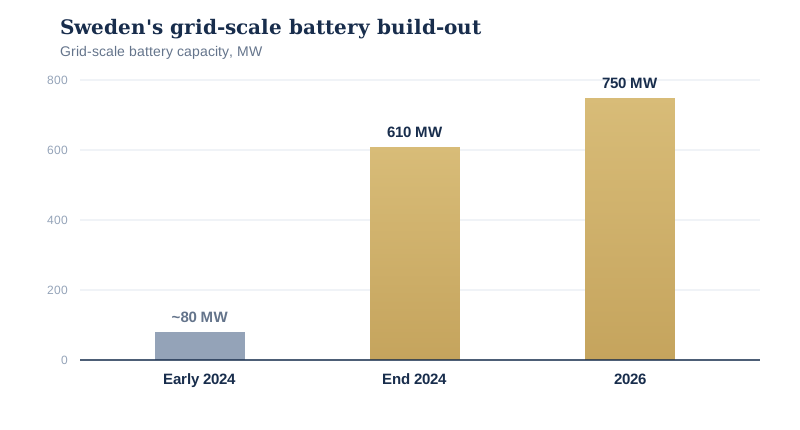
Finland is on the same curve a step behind, with around 390 MW of batteries against Sweden's 750 MW in 2026, so Finnish developers can read Sweden as a preview of where their own FCR-D market is heading. Norway and eastern Denmark are smaller again but face the same mechanics once batteries cluster on a node.
For an asset underwritten on a fat FCR-D number, that is a direct hit to the part of the model that looked safest. The reserve is not disappearing, it still clears and it still pays, but it can no longer carry a business case on its own. The stack has to widen.
When we re-run a one-hour merchant case in our revenue-stack model under the 2026 reserve prices, the FCR-D line that used to anchor the return now covers a fraction of it. How large the hit is depends on the node, the duration and the dispatch strategy, so we model the price move and the saturation effect per jurisdiction rather than applying one blended decline. The blended number is exactly what hides the risk. The figures we quote here are market data, the modelling around them is ours.
Who feels it and how differently
A one-hour merchant battery built almost entirely on FCR-D is the most exposed. Its whole route to market is the product losing value fastest, with the least stored energy to redeploy elsewhere.
Longer-duration assets, two hours and up, are more insulated because they can lean on the energy markets and the slower reserves. Investors who signed off models with FCR-D revenue held flat for a decade now have a sensitivity to revisit. Teams still in planning have the easiest job. They can design for the market that is arriving rather than the one that paid in 2023.
In the diligence we run for investors, the assets that disappoint are almost always the one-hour merchant builds that underwrote FCR-D flat for years. The ones that hold up planned for the stack to widen from the start.
Where the revenue is going
Three places, mostly.
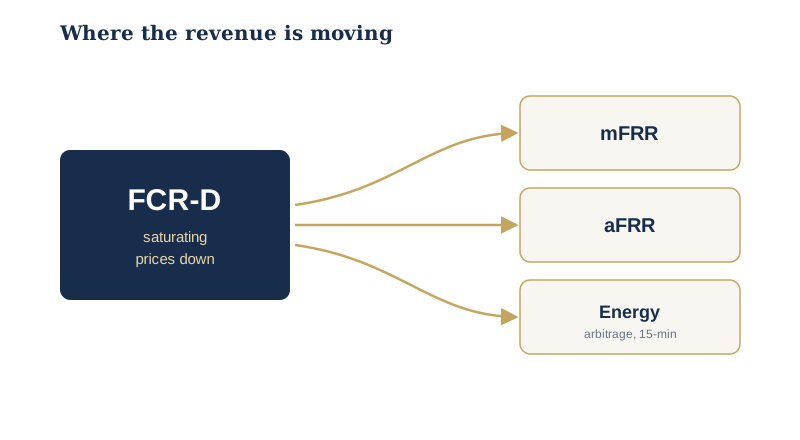
mFRR is the clearest. The automated Nordic mFRR Energy Activation Market went live on 4 March 2025 at fifteen-minute resolution and batteries moved in fast. Prequalified battery capacity for mFRR in Sweden jumped roughly fivefold in the first quarter of 2025 alone according to Clean Horizon and the build-out has kept running into 2026. When one door narrows, this is the one operators keep walking through.
aFRR is the second line. The Nordic aFRR capacity market has run as a daily cross-border procurement since December 2022, so it is not new, but its role is growing as FCR economics thin. Procured volumes move around (the TSOs adjusted them through 2025 and into 2026 as frequency quality improved), which makes aFRR a real but more variable contributor rather than a set-and-forget line.
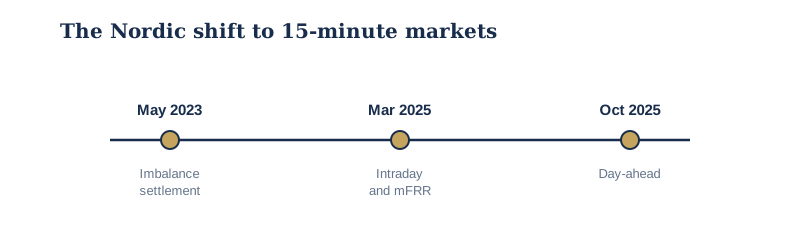
Energy is the third. The Nordics moved day-ahead trading to a fifteen-minute settlement period on 1 October 2025, after intraday and imbalance pricing went to fifteen minutes in March 2025. Shorter settlement rewards assets that can move fast and often, which is the natural home for a battery once its reserve income softens.
Finland is where this bites hardest. Its generation mix is binary, a large nuclear base on one side and fast-growing wind on the other, which gives it some of the widest short-term price swings in Europe. When the wind blows hard, day-ahead prices collapse toward zero or below. During nuclear outages or wind lulls they spike past 300 to 400 euro per MWh. Olana Energy, a Finnish operator, frames it well. A wave of new demand, gigawatts of data centre and electric-boiler load now under construction, is set to widen those swings further. That volatility is the raw material a battery on energy arbitrage turns into revenue, the line that keeps growing as the reserve markets fill.
The TSOs' own April 2025 study, Batteries in the Nordic reserve markets, reaches the same conclusion from the system side. Batteries can serve every reserve and the system increasingly needs them across all of them. The market is moving the same way on duration. The one-hour assets built for FCR-D are giving way to two-hour systems, which is where we see the economics for Nordic projects commissioning now, with four-hour durations gaining ground across Europe as build costs fall. The logic is the same in each case, earn from energy and the slower reserves rather than from one saturated product.
When we model an asset across all three lines, the stack can still clear a healthy return, but only when the duration, the prequalification work and the route to market are matched to the node. That sizing question, which products to chase at what duration for a given site, is exactly what our project-sizing and bankability work is built to answer.
What to do about it
A few concrete moves for the next quarter.
Re-run the revenue stack with FCR-D as a supporting line rather than the lead. Test it under both a continued-compression and a stabilisation scenario rather than a single point forecast, because the spread between those two is where the equity risk lives. If the case only works at 2023 reserve prices, it does not work.
Model mFRR and aFRR participation properly, including the prequalification effort and the dispatch behaviour each one demands. They are not free additions. They change how the asset is operated.
Stress-test duration. Compare a one-hour and a two-hour configuration against a stack that assumes continued FCR-D compression rather than flat prices.
For investors, add a reserve-saturation sensitivity to diligence. Ask which products the model leans on and what happens to the equity case when those products halve.
Check the route to market. Confirm that your optimiser or offtaker actually trades the mFRR Energy Activation Market and the fifteen-minute products, not just the reserve you signed up for two years ago.
Where we come in
We at Auranova Ventures spend a good part of our week re-running exactly these stacks for developers and investors across the Nordics and Baltics, under the reserve products and rules that actually apply rather than a blended assumption. If you are sizing a project right now and want a second read on how the reserve shift hits its economics, reply or start a conversation. We are also building a tool that models these revenue stacks across markets automatically, so tell us if you would like early access when it opens.
Which line are you betting on for your next project? We read every reply.
Sources
- Fingrid, procurement of frequency containment reserves from the yearly market 2026: https://www.fingrid.fi/en/news/news/2025/procurement-of-frequency-containment-reserves-from-yearly-market-2026/
- Svenska kraftnät, introduction of marginal pricing on FCR markets: https://www.svk.se/en/about-us/news/news/introduction-of-marginal-pricing-on-fcr-markets/
- Svenska kraftnät, how the FCR volume requirement is determined (set by the dimensioning incident): https://www.svk.se/en/stakeholders-portal/electricity-market/provision-of-ancillary-services/questions-and-answers-about-reserves/fcr/how-is-the-fcr-volume-requirement-determined/
- Statnett, confirmation of mFRR EAM go-live 4 March 2025: https://www.statnett.no/en/for-stakeholders-in-the-power-industry/news-for-the-power-industry/confirmation-of-mfrr-eam-go-live-march-4th-2025/
- Clean Horizon, batteries rush to mFRR in Sweden: https://www.cleanhorizon.com/news/batteries-rush-to-mfrr-in-sweden/
- Nordic TSOs, Batteries in the Nordic reserve markets (April 2025): https://en.energinet.dk/about-our-reports/reports/batteries-in-the-nordic-reserve-markets-2025/
- Olana Energy, the merchant BESS business case (Finnish energy-market volatility): https://olana.fi/blog-posts/the-merchant-bess-business-case
- Nord Pool, transition to the fifteen-minute market time unit: https://www.nordpoolgroup.com/en/trading/transition-to-15-minute-market-time-unit-mtu/
- Energy-Storage.news, Sweden and Finland surge ahead of Norway for BESS deployments: https://www.energy-storage.news/sweden-and-finland-surge-ahead-of-norway-for-bess-deployments/
- Ember European Electricity Review 2026, reported by Euronews (Sweden 750 MW and Finland 390 MW of operational storage in 2026): https://www.euronews.com/business/2026/05/08/europes-electricity-storage-race-which-countries-lead-in-battery-capacity