Denmark Starts Answering Its Grid Queue. Grid-Scale Batteries Hear Last.
25 October 2026 · 7 min read · Auranova Ventures
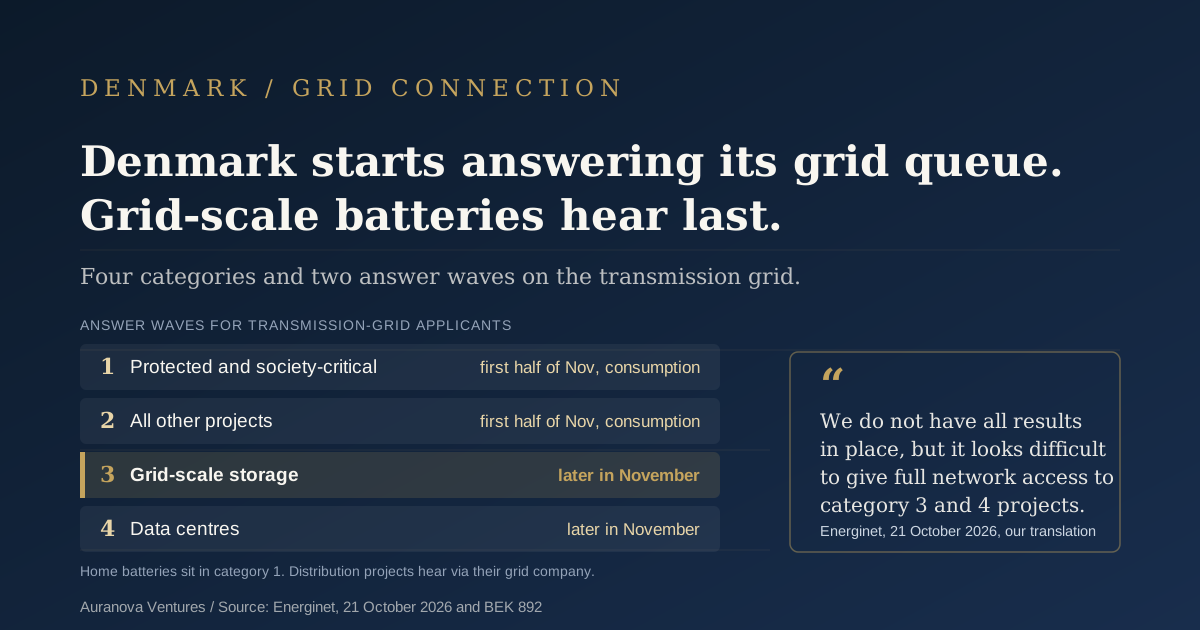
Denmark is about to answer its grid queue. On 21 October Energinet announced that several hundred applicants learn in November whether they get capacity. Consumption projects in categories 1 and 2 on the transmission grid hear in the first half of November. Category 3, where grid-scale storage sits, hears later: transmission applicants directly, distribution projects via their local grid company. Energinet's early read (our translation, results still being calculated) is that full access "looks difficult" for categories 3 and 4. What should a storage developer do with that letter?
The development
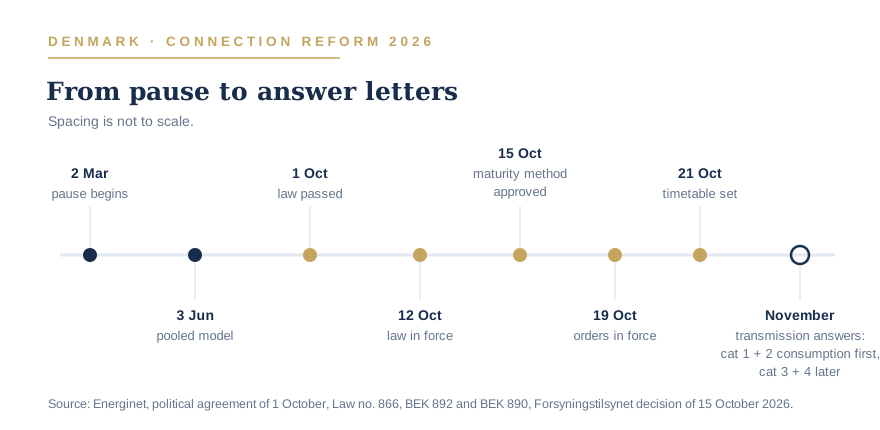
In July we covered this reform as a bill. It is now law. Law no. 866, passed by Folketinget on 1 October with a broad majority and in force since 12 October, ends first come, first served when capacity is short. The detail lives in two executive orders of 9 October, both in force since 19 October. BEK 892 sets the priority model: category 1 is protected needs: households with their home batteries, smaller businesses up to 3 MW (unless the request itself is category 3 or 4), society-critical functions, certain heavy-vehicle charging and normal growth in existing consumption. Category 2 is everything not in the other categories, in practice electrification and renewables. Category 3 covers batteries, with a carve-out we return to, electric boilers and other storage beyond a user's normal need, plus consumption that cannot be tied to normal need. Category 4 is data centres, except critical ones, which count as category 1. Requests of 3 MW or more go into regional pools, allocation rounds run per region at least twice a year, while category 1 and smaller requests are handled continuously, except those in categories 3 and 4. An operator must refuse a category 3 or 4 request when two conditions are both met: capacity is constrained and the request cannot be met without displacing higher-priority needs. A refusal can be appealed to Forsyningstilsynet, the energy regulator, within four weeks.
BEK 890 governs flexible connection agreements, contracts that limit or control a project's injection and withdrawal; they require a certified power-control system and leave agreements signed before 13 January 2025 untouched. In areas with little or no spare capacity, operators must make temporary flexible connection possible, converting to full access once the grid is reinforced. Signing one stays voluntary; permanent variants exist too. Methods for temporary flexible connection are due to Forsyningstilsynet by 1 January 2027. The regulator approved Energinet's maturity requirements, the documentation gates showing a transmission applicant is real and ready, on 15 October.
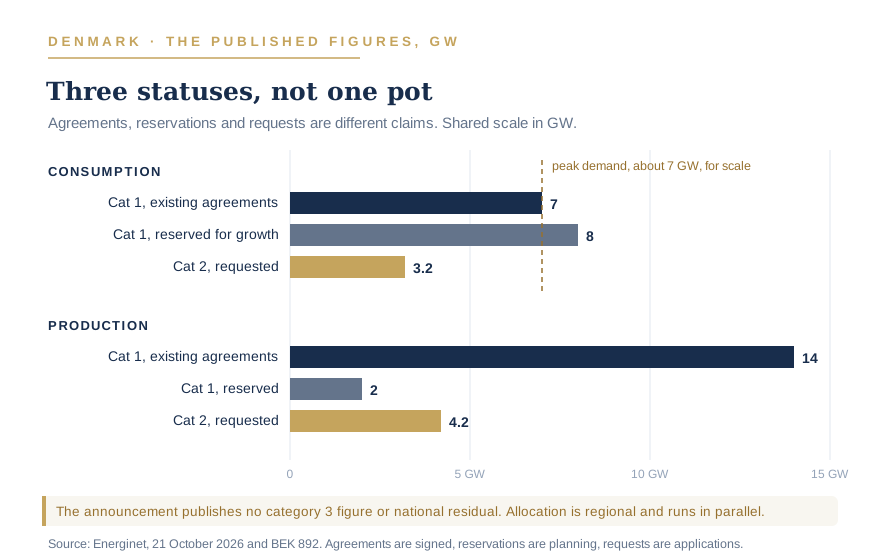
Energinet's 21 October announcement supplies the numbers. Category 1 holds 7 GW of consumption under existing agreements plus 8 GW reserved for growth. On the production side it holds 14 GW plus 2 GW reserved. Category 2 applicants have requested 3.2 GW of consumption and 4.2 GW of production. For scale, Denmark's peak demand is about 7 GW. When Energinet paused new agreements in March it reported roughly 60 GW of requested new consumption across transmission and distribution grids. What is left for category 3 is not yet published: allocation is regional and categories can be processed in parallel. Energinet has filed one new flexibility product with Forsyningstilsynet, plans five more before year end, will overbook rather than hold capacity back and will open a dialogue with selected existing customers about limited access at a lower tariff, the grid-use fee.
What it actually means
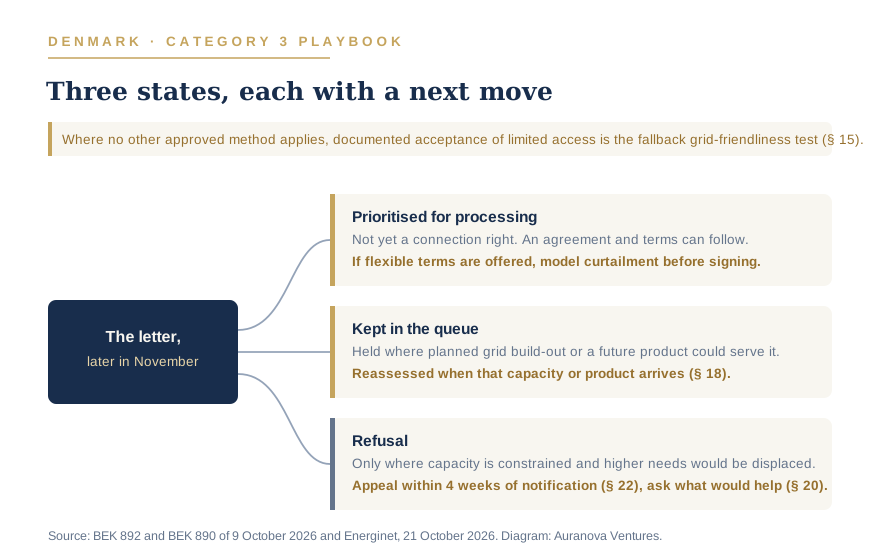
First, nothing in the ranking is final until signed. Priority is explicitly indicative and can be revised until a binding connection agreement exists. The states the rules allow are narrower than a yes: prioritised for further processing, kept in the queue for reassessment or refused.
Second, grid-friendliness is narrower in law than in the political rhetoric. The order lists load profile, location and operating flexibility as possible criteria, but they only count once a regulator-approved method exists for them. Where no approved method covers a project, the fallback rule applies: it counts as grid-friendly if it accepts limited network access on approved terms. One lever a battery controls is its documented willingness to run under terms that let the operator curtail it, restrict its injection or withdrawal, in defined situations. Even that has a ceiling: flexibility does not create capacity, cannot displace higher-priority needs and does not replace the maturity gates every applicant passes first. Where flexible solutions are scarce they go to higher categories first.
Third, the queue survives. A category 3 request that cannot be served now can be kept in the connection queue when planned grid build-out or a future product is expected to accommodate it within a reasonable horizon, to be reassessed when that capacity or product arrives. Refusal is the outcome when neither is in sight. After each pool Energinet must publish how much capacity each category received and how much waits, the market's first hard data on the category 3 constraint.
Our read: the commercial question has changed shape. It is no longer "where am I in the queue" but "what do flexible terms do to my revenue stack", the combined income a battery earns across markets. A battery earns capacity payments for standing ready in frequency reserves and trading income from charging cheap hours and discharging expensive ones. Frequency reserves range from frequency containment reserve (FCR), the fast first response, to automatic frequency restoration reserve (aFRR), which acts over minutes. What curtailment costs depends on which hours are restricted, in which direction and what tariff relief comes back. In the modelling we run, those are site-specific inputs: the same product can be cheap for one site and ruinous for another. The comparison that matters this autumn is flexible now against firm later against not connecting at all.
Who is affected and how differently
Developers of standalone projects face the sharp end: pooling, the category 3 test and the refusal power. The preparation that pays is documentary: acceptance of limited access only counts when the operator can document it.
Household and co-located batteries are treated differently by design. Home batteries are category 1. A battery at a co-located site, built behind the same connection point as an existing producer or consumer, falls into category 3 only to the extent its capacity exceeds the host's normal need. A request spanning several installations at one point can be split across categories. Sizing against that boundary is worth real money.
Holders of existing agreements have both an asset and a trap. A binding agreement keeps its allocated capacity and is shielded from the new refusal power. But reactivating a closed point, raising capacity or taking idle capacity into use can run through the priority model, judged case by case on past use, so a dormant agreement is not automatically a bankable shortcut. In the diligence we run on Danish assets, the checklist now opens with category, grid level, documented flexibility and whether idle capacity would survive that test. Policymakers have scheduled a first review by the end of 2027. The agreement behind the law names its own worst case: projects that cannot connect turning to gas instead.
What to do about it
Document conditional willingness to accept limited access and the thresholds you would sign at. Under the fallback rule, documented acceptance of approved terms is what grid-friendliness turns on.
Set walk-away terms per site before terms arrive. Model the stack under the curtailment patterns you could be offered, by hour and direction, to know what tariff relief compensates you.
Check your category boundary. Co-location carve-outs, the household rule and the electric-boiler tests move projects between categories.
Treat unused capacity with care in acquisitions. A binding agreement is valuable precisely because it predates the model, but reactivating idle capacity can run through the priority rules.
If refused, start two clocks. The appeal to Forsyningstilsynet runs four weeks from notification of the decision. You can also request information, possibly for a fee, about measures that would improve a later application.
This is the kind of question we at Auranova Ventures work through with developers and investors across the Nordics, Baltics and wider Europe: what flexible terms do to a revenue stack, which sites can afford them and when waiting for firm access destroys more value than curtailment would. We price such terms site by site today. If a November letter is about to land on your desk, reply and we will compare notes.
When the letters go out, will your project be holding documented flexibility or just a date stamp that no longer decides on its own?
Sources
- Energinet: Energinet gør klar til prioriteret kapacitetstildeling og tager nye virkemidler i brug, 21 October 2026
- Lov nr. 866 af 7. oktober 2026 (priority of grid capacity), in force 12 October 2026
- BEK nr. 892 af 9. oktober 2026 (priority categories and refusal), in force 19 October 2026
- BEK nr. 890 af 9. oktober 2026 (flexible connection agreements), in force 19 October 2026
- Forsyningstilsynet: decision approving Energinet's maturity requirements, 15 October 2026
- Energinet: Forsyningstilsynet godkender Energinets krav til kunders modenhed og fremdrift, 16 October 2026
- Ministry of Climate, Energy and Utilities: Bredt flertal har stemt for akutplanen for elnettet, 1 October 2026
- Aftale om akutplan for elnettet, political agreement, 1 October 2026 (PDF)
- Energinet: Energinet indfører midlertidig pause i nye nettilslutninger, 2 March 2026
Related reading: Denmark's Grid Bill Would Rank Storage Third, Auranova Ventures, 23 July 2026