Nine Times the Battery Energy, 70 Per Cent More Net Exports. Bulgaria's Fleet Showed Up. Now It Has to Keep Its Margin.
13 October 2026 · 9 min read · Auranova Ventures
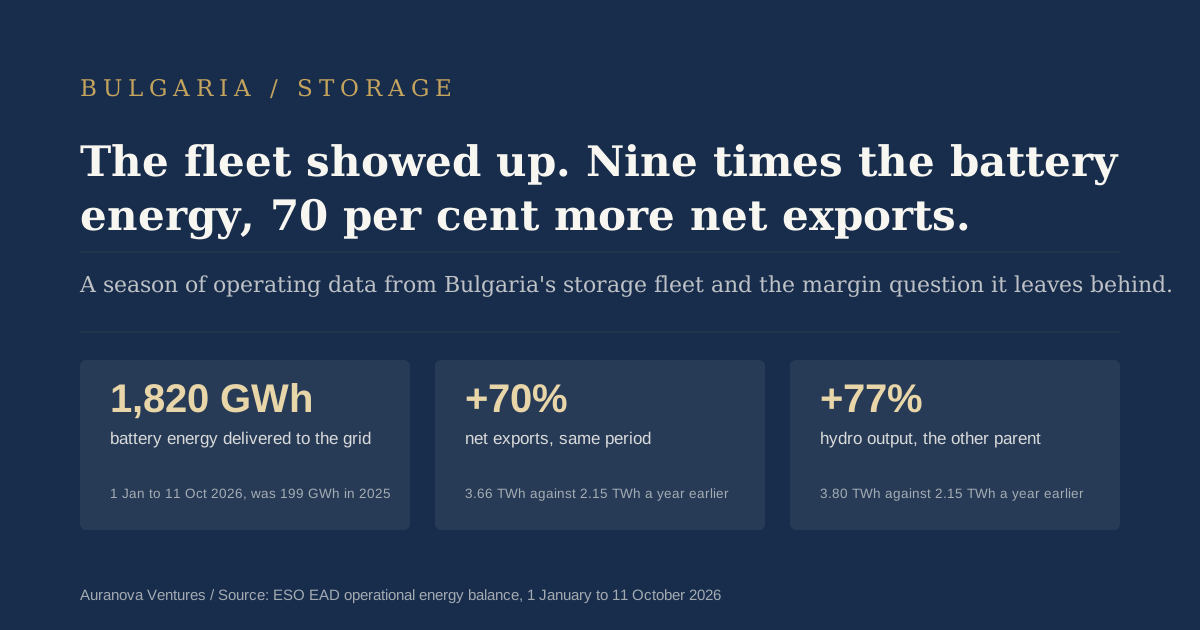
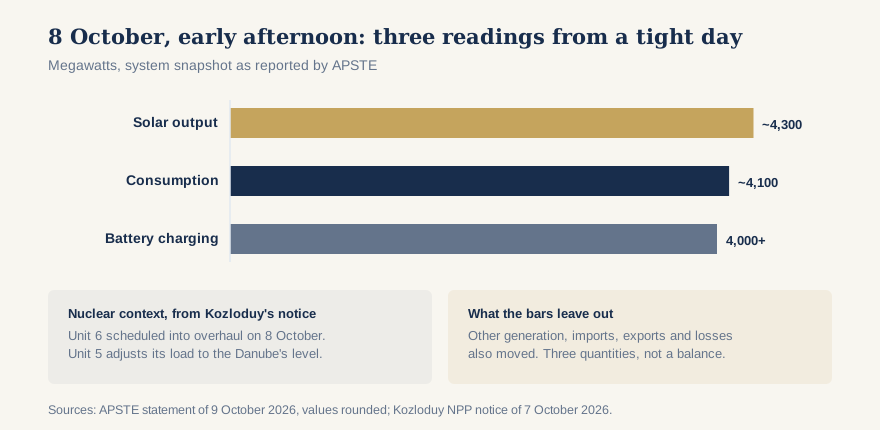
In the early afternoon of 8 October 2026, by the storage association's account, Bulgarian solar produced close to 4,300 MW while the whole country consumed about 4,100 MW. Kozloduy unit 6 was scheduled to begin its annual overhaul that day and unit 5 was running to the Danube's water level. The surplus had somewhere to go: batteries were charging at more than 4,000 MW. The transmission operator's running balance says batteries have put nine times as much energy into the grid this year as last. Net exports are up 70 per cent.
Two definitions first. Time-shifting, often called arbitrage, is the battery business of absorbing electricity in cheap hours and selling it back in expensive ones. The captured spread is what a battery earns per megawatt hour it discharges: the sell price minus the buy price grossed up for round-trip losses, before fees and degradation. The piece is about where Bulgaria's captured spread came from in 2026 and who takes it away.
The development
On 9 October APSTE, the Association for Production, Storage and Trading of Electricity, published season figures citing ESO EAD, the Bulgarian transmission system operator: net exports up 62 per cent to early October and renewable generation of 11.5 TWh carrying close to 80 per cent of the production growth.
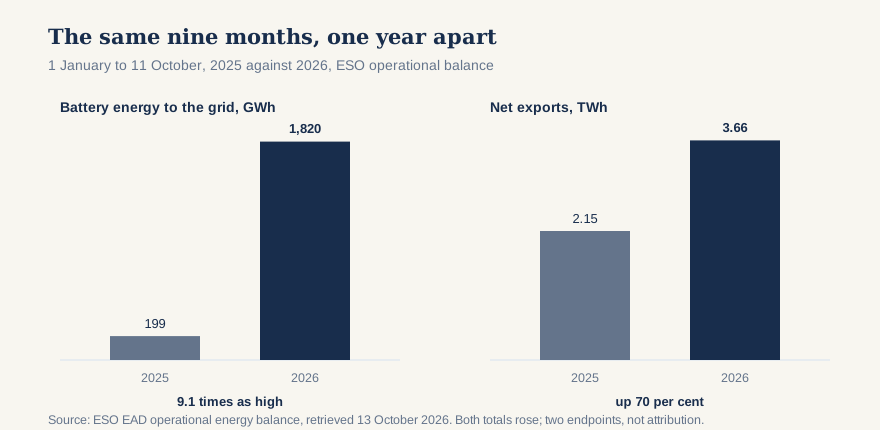
ESO's own operational balance (the dated table is archived here), retrieved on 13 October and covering 1 January to 11 October, carries the record a week further. Battery discharge: 1,819,966 MWh against 199,207 MWh a year earlier, 9.1 times as high. Net exports, ESO's export-import saldo, reached 3,659,837 MWh against 2,149,522 MWh, up 70 per cent.
Behind those lines stands a fleet the energy ministry's own release of 7 August put at more than 6 GW introduced into the system in less than a year. APSTE's October estimate is near 6 GW of power and about 17 GWh of energy capacity, alongside nearly 7 GW of solar. The readings differ in date and basis; we treat the fleet as a range near 6 GW.
Readers of our July piece will recognise the scale. RESTORE, Bulgaria's recovery-plan grant scheme for grid-scale storage, selected more than 13,700 MWh across two rounds, with the second round's conditions setting the latest permitted build date at 31 July 2026. No public record joins the award lists to the operating fleet. We wrote that in July and find none in the ministry's notices as of 13 October, so we will not name this fleet the grant cohort. What the record does show: a programme of that size ran through its build deadline and a fleet of matching scale is now discharging.
What it actually means
Our read of the mechanism: Bulgaria now works like an export terminal for midday sun. Nearly 7 GW of panels push the midday price down, on 8 October past total national demand. Storage absorbs the surplus and returns it in the evening, when regional prices are set by whatever flexibility remains. A terminal earns most when the destination market is short. The sellers' own officials say it was. The ministry's August release has Bulgaria supporting the region with record exports through the Danube summer. APSTE's chair Nikola Gazdov contrasts neighbours' high prices and shortages with Bulgaria storing its own power.
Now the limits of that read. Aggregate totals cannot trace a megawatt hour from a battery to a border. On ESO's ledger the export rise is production minus consumption: production grew 3.9 TWh, consumption 2.4 TWh and the 1.5 TWh difference is the export increase. Hydro alone added 1.65 TWh, more than that entire increase, running 77 per cent above 2025. Batteries are net consumers of energy once charging losses count. On the annual ledger, hydro did at least as much work as storage. The battery story is the shape of the day: without storage, midday solar sells at the day's worst price or is curtailed. On 8 October, by APSTE's account, batteries charged at more than 4,000 MW in the hours solar exceeded national consumption, while Kozloduy's notice had unit 6 scheduled into overhaul that day and unit 5 following the Danube.
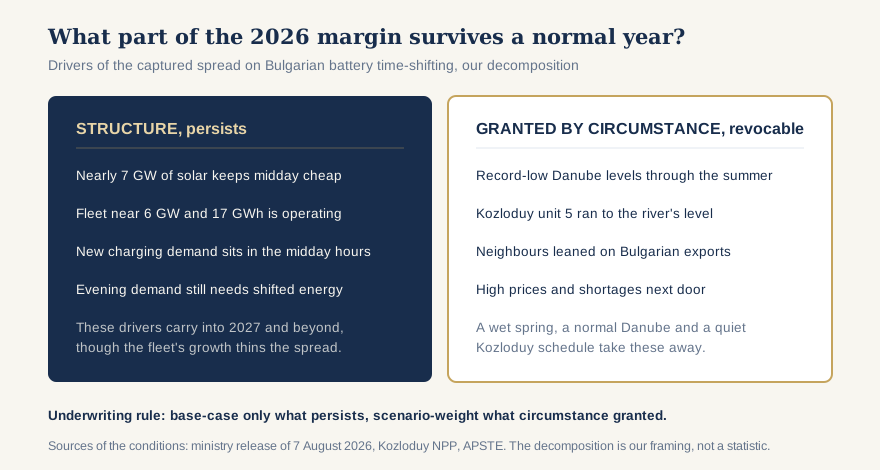
Here is the distinction we would put at the top of any 2026 Bulgarian storage model. Part of this year's captured spread is structural: the solar base, the fleet and the physics of time-shifting are not going away. Charging at this scale is new midday buying in the hours solar used to crash. Our read is that it supports the midday price while the same fleet's evening discharge competes down the evening price; the record gives volumes, not margins, so we keep the direction and leave the size to modelling. Part of the spread was granted by circumstance: record-low Danube levels and a summer that left the neighbourhood short. Circumstance is revenue the weather granted and the weather can revoke. A wet spring, a normal Danube and a quiet Kozloduy schedule would narrow the 2027 spread even if every battery runs perfectly.
The fleet also works against its own margin: every megawatt added to the noon charge lifts the buy price and every megawatt added to the evening discharge cuts the sell price. The neighbour clock runs too. RWEA, the Romanian wind industry association, expects about 2 GW of Romanian battery power by year-end and at least 4 GW by the end of 2027. This month the industry asked ANRE, Romania's energy regulator, to cut Order 16/2026's establishment-authorisation guarantee of 30 euro per kW, 30,000 euro per MW, sixfold for standalone storage. When we model a Bulgarian asset's export-linked revenue, the arrival curve of neighbouring storage is one of the inputs that moves the answer most.
Who is affected and how differently
For a developer, the RESTORE rounds are closed and the next project underwrites from market prices with no grant underneath. The 2026 operating year is the best marketing slide available and the worst baseline to underwrite, because it contains the drought.
For an investor, the diligence question has moved since July: then which state an asset was in, selected, built, qualified or paid; now which year its revenue was earned in. Twelve months read off October 2026 embed a regional scarcity event. Normalising them is the work.
For a utility or trader, a system whose net exports reached 3.66 TWh in just over nine months trades differently at the border than last year's Bulgaria. Border positions and evening prices in the region now have a fleet of about 17 GWh in the room.
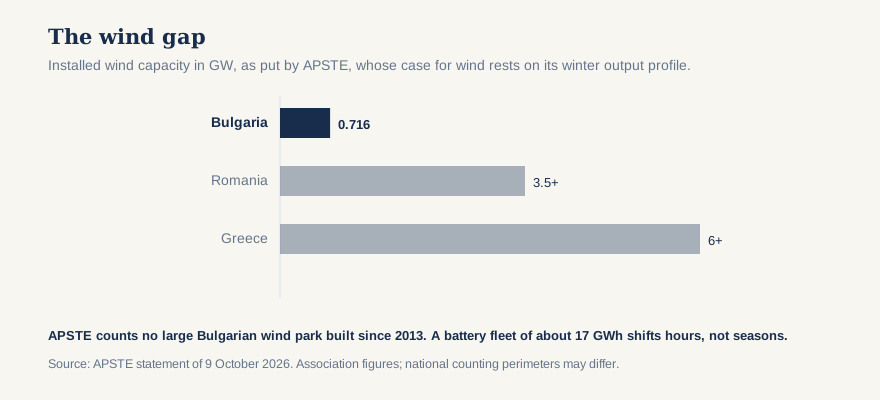
For policymakers, APSTE's statement points at the gap. Solar collapses in winter while consumption rises. The association puts Bulgaria's wind at 716 MW, a fraction of Romania's or Greece's count, with no large wind park built since 2013. A fleet of about 17 GWh can move a sunny day into the evening. It cannot move August into January.
What to do about it
Underwrite 2026 as a scenario, not a run-rate (a single year multiplied forward). Split every revenue line into what persists and what circumstance granted before anything becomes a base case.
Model the fleet's self-cannibalisation explicitly: charging lifts the floor, discharging cuts the peak and both scale with the installed base, not with your asset.
Put the neighbours' build-out on the sheet. The evening export premium erodes as neighbouring storage arrives, so date your assumptions about its commissioning curve.
Model winter on winter data. Solar falls while consumption rises, so the charge source and the spread both change shape. Extrapolating summer in either direction is a guess.
Keep watching the reserve tenders. For delivery on 31 July, ESO's daily tender drew 20 MW of offers against 45 sought in FCR, the fast reserve that steadies grid frequency within seconds. It drew 70 against 155 in aFRR, the automatic correction behind it. Watch those gaps narrow as more of the fleet qualifies; the first oversubscribed tender signals reserve prices compressing the other leg of the stack.
Where we come in
Separating what persists from what was granted is most of what we at Auranova Ventures do when a storage asset crosses our desk, in Bulgaria, the Baltics or the Nordics. The 2026 record is a gift to sellers and a trap for buyers: its best numbers come from its least repeatable conditions. If you are pricing a Bulgarian battery or deciding whether your next one pencils without a grant, reply and we will give you a second read on which part of this year's margin your model is allowed to keep.
When you look at a Bulgarian battery's 2026 revenue, how much of it do you think survives a wet year? We read every reply.
Sources
- ESO EAD, operational energy balance report (Оперативна справка за енергиен баланс), period 1 January to 11 October 2026 against the same period of 2025, retrieved 13 October 2026 (production 35,374,750 MWh, up 12.46 per cent, consumption 31,714,913 MWh, up 8.22 per cent, net exports 3,659,837 MWh against 2,149,522 MWh, battery discharge 1,819,966 MWh against 199,207 MWh, hydro 3,797,344 MWh against 2,148,791 MWh, up 76.72 per cent; the page serves a rolling snapshot, archived copy of the dated table linked in the text): https://www.eso.bg/doc/?39
- APSTE, Bulgaria records 62 per cent surge in electricity exports driven by renewables and batteries, 9 October 2026 (net exports 3.5 TWh against 2.16 TWh to early October, renewables 11.5 TWh, batteries 1,720 GWh against 190 GWh to 4 October, solar near 7 GW, batteries near 6 GW and 17 GWh, wind 716 MW against more than 3.5 GW in Romania and more than 6 GW in Greece, 8 October system snapshot, Gazdov quotes): https://apste.eu/bulgaria-records-62-surge-in-electricity-exports-driven-by-renewables-and-batteries/
- Bulgarian Ministry of Energy, minister Petrova on Kozloduy, record-low Danube levels and record exports, 7 August 2026 (more than 6 GW of storage introduced into the system in less than a year, Bulgaria supporting the region with record exports): https://www.me.government.bg/bg/news/ministar-petrova-aec-kozlodui-raboti-normalno-vapreki-niskite-niva-na-r-dunav-balgariya-podkrepya-regiona-s-rekorden-iznos-na-elektroenergiya-3894.html
- Bulgarian Ministry of Energy, RESTORE 2 conditions for applying (section 13: built, connected and in operation no later than 31.07.2026): https://www.me.government.bg/uploads/manager/source/VOP/obshtestveno%20obsajdane/obshtestveno%20obsajdane/Restore2/Nasoki%20za%20kandidastvane_RESTORE%202.zip
- Bulgarian Ministry of Energy, RESTORE award notices of 17 April 2025 (82 projects, 9,712.89 MWh) and 17 December 2025 (31 projects, more than 4,000 MWh): https://me.government.bg/bg/news/82-proekta-na-obshta-stoinost-pochti-1-150-mlrd-lv-shte-badat-finansirani-po-restore-3640.html and https://www.me.government.bg/news/31-proekta-na-stoinost-blizo-229-mln-lv-shte-badat-finansirani-po-procedurata-restore-2-3741.html
- Kozloduy NPP, notice of 7 October 2026 (unit 6 scheduled to begin its annual overhaul on 8 October, expected until the end of November; unit 5 load adjusted to the Danube's water level): https://www.kznpp.org/bg/novini/685
- ESO EAD, daily reserve tender for delivery on 31 July 2026, archived result of 30 July 2026 (FCR 20 MW offered against 45 sought, aFRR 70 against 155): https://web.archive.org/web/20260730230850/https://webapps.eso.bg/tendappl/
- ANRE Order 16 of 21 May 2026, published in Monitorul Oficial 439 of 25 May 2026 (financial guarantee of 30 euro per kW of installed power for establishment authorisations, held until the works-completion protocol): https://legislatie.just.ro/Public/DetaliiDocument/310974
- E-nergia.ro, Romania to reach 2 GW of batteries by year-end and 4 GW by end-2027, 1 October 2026 (forecast attributed to RWEA vice-president Liviu Gavrilă): https://e-nergia.ro/romania-va-avea-2-gw-de-baterii-la-finalul-anului-si-4-gw-la-finalul-lui-2027-nu-avem-de-ce-sa-intram-intr-o-competitie-cu-bulgaria
- Balkan Green Energy News, Romanian renewables industry calls for battery project guarantees to be cut sixfold, 6 October 2026 (RWEA and RPIA request to ANRE on the establishment-authorisation guarantee for standalone storage): https://balkangreenenergynews.com/romanian-renewables-industry-calls-for-battery-project-guarantees-to-be-cut-sixfold/
- Auranova Ventures, Bulgaria selected 13,700 MWh of batteries for grants, 31 July 2026 (the two rounds' award totals and deadlines, the absence of a public crosswalk between award lists and the provider register and the 31 July reserve tender detail): https://www.auranova.io/insights/bulgaria-restore-storage-subsidy-2026