Bring Your Own Metronome: Fingrid Moves to Require Grid-Forming from New Wind and Solar
6 October 2026 · 9 min read · Auranova Ventures
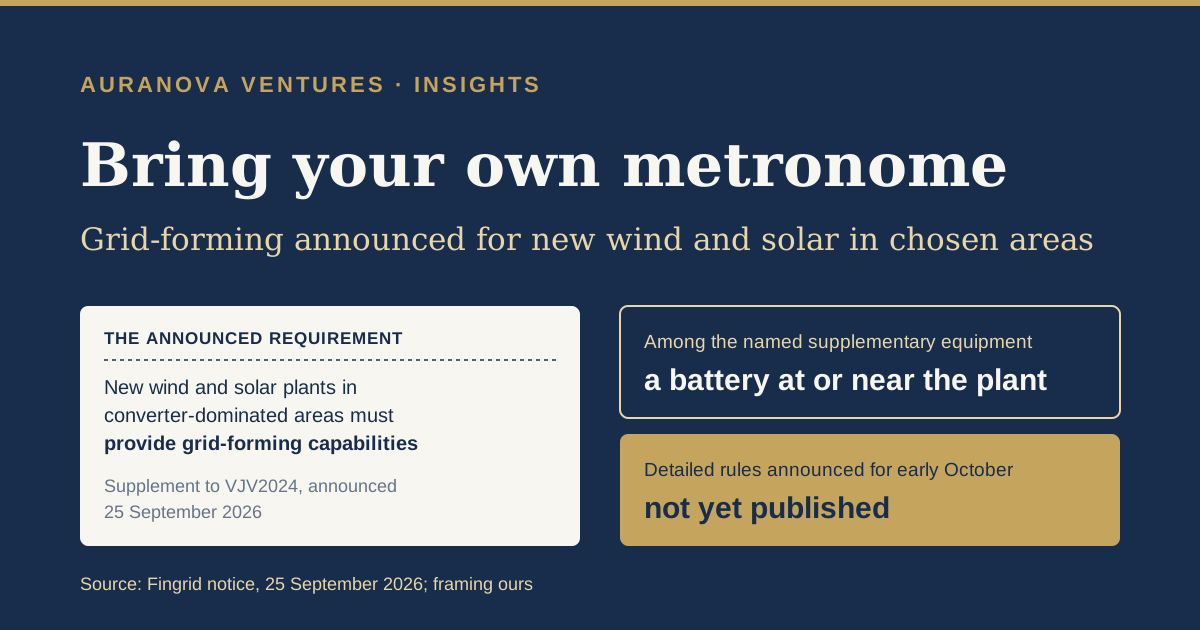
On 25 September Fingrid, Finland's transmission system operator (TSO), announced that new wind and solar plants connecting in parts of the grid already crowded with them must provide grid-forming capability: the ability to hold the grid's rhythm rather than follow it. Among the equipment Fingrid names for the job is a battery energy storage system (BESS). That mention could change what a battery is in those corners of Finland: from market asset to something a wind developer needs.
The development
Finland's wind fleet is concentrated in what Fingrid calls converter-dominated areas, particularly along the west coast. The converters in question are the power electronics through which wind turbines, solar panels and batteries connect to the alternating current grid. Where converters dominate and too few spinning machines remain, Fingrid says power system security and reliability may in the worst case be affected.
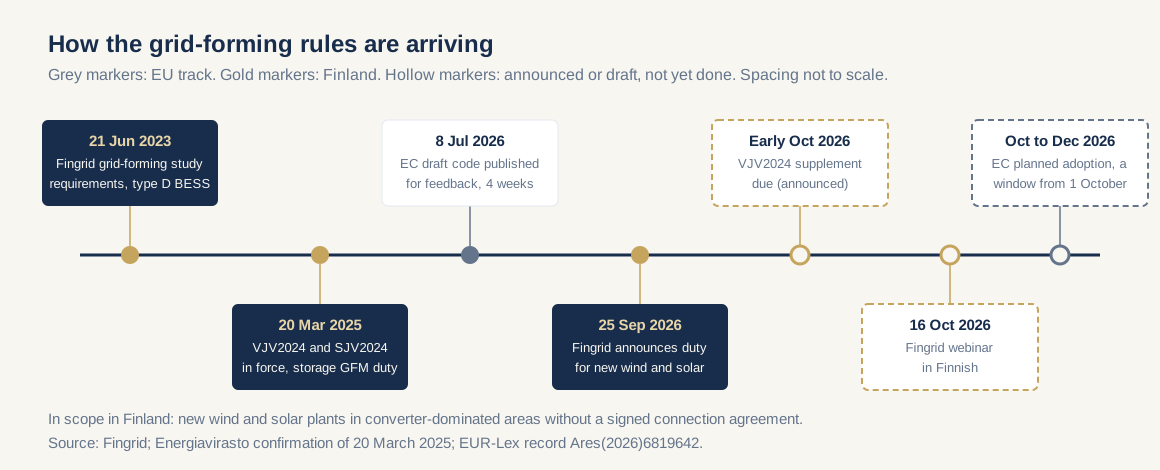
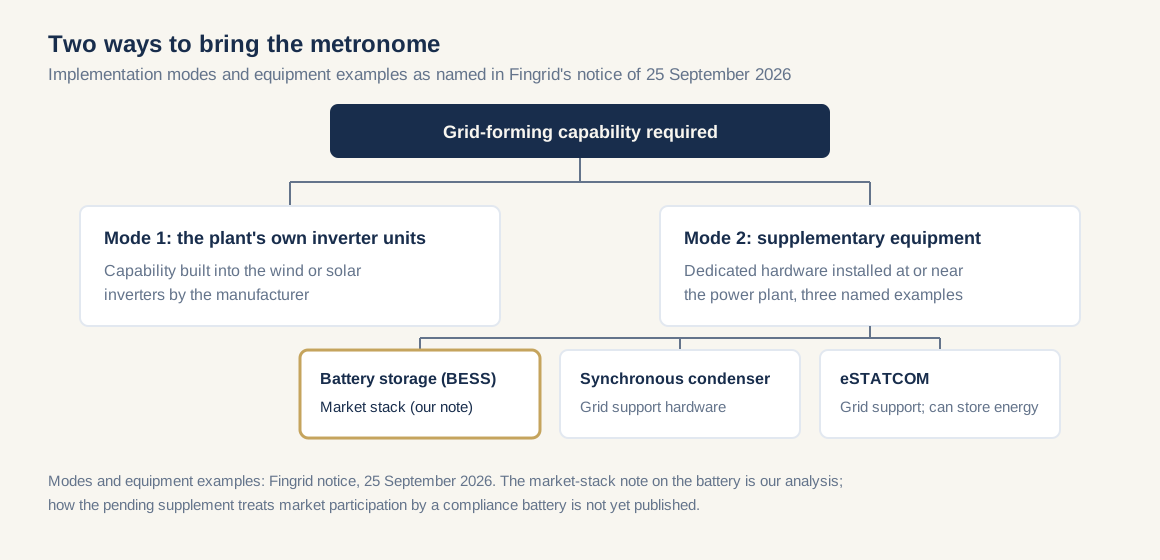
The announced requirement applies to new wind and solar plants connecting in those areas. Operating plants and projects that already hold a grid connection agreement are out. In-scope plants must provide the capability in one of two ways: in their own inverter units or through dedicated supplementary equipment installed at or near the plant. As examples of that equipment Fingrid names battery energy storage systems, eSTATCOMs (static synchronous compensators, voltage-support power electronics here enhanced with an energy store) and synchronous condensers (spinning machines providing voltage support and inertia without producing net energy). The requirements arrive as a supplement to VJV2024, Fingrid's grid code for power-generating facilities. The detailed text is due on Fingrid's website in early October (not yet published as we write), with a webinar on 16 October, in Finnish only.
What grid-forming actually is
Think of the grid as an orchestra that must hold one common beat, the Nordic system's nominal frequency of 50 hertz. Conventional power stations hold that beat physically: their heavy spinning generators resist any change of tempo, a property engineers call inertia. Most inverters on the system today are grid-following: they listen to the beat and play along, which works while enough drummers remain in the room. A grid-forming inverter is different. It holds a beat of its own, like a metronome. It steadies the voltage around it rather than leaning on the voltage set by others.
For Finnish batteries, grid-forming is already the law. SJV2024, Fingrid's grid code for grid energy storage, confirmed by the regulator on 20 March 2025, requires type C and D storage (from 10 MW upward or any size connected at 110 kV and above) to run grid-forming converters constantly, whenever connected and regardless of charging state. A battery below 10 MW integrated into a larger hybrid plant is exempt. The lineage is older still: Fingrid's June 2023 study requirements put grid-forming duties on the largest batteries at specific locations. That text named coastal Ostrobothnia, home to the majority of Finnish wind power, as a region where more grid-following inverters could not connect without such measures. It specified how a grid-forming battery behaves when participating in FCR-N, the frequency containment reserve for normal operation. What changed on 25 September is the direction of the duty: it now reaches the wind and solar plants themselves.
What it actually means
For an in-scope project the requirement is a design decision. Fingrid lists the options without ranking their economics; the ranking question is ours. Of the named equipment, the battery is the one with an established merchant revenue stack in the Nordic markets. If the supplement lets a compliance battery keep selling into reserve and energy markets, part of the compliance cost comes back as trading income. We put that as a conditional. The open questions: how much capacity the duty ties up, which operating states it must hold and whether the same capacity can serve duty and market at once. The storage precedent, grid-forming always on under SJV2024 with FCR-N participation contemplated in the 2023 text, suggests Fingrid does not treat duty and market as exclusive. The new supplement must say so itself.
When we screen the battery route for a client we reduce it to one comparison: the battery's extra capital cost over the cheapest pure-compliance option on one side, the net trading income the duty leaves on the other. The supplement will not price anything but it sets the technical parameters those numbers hang on, so the work now is structural: identify exposed projects and frame the scenarios.
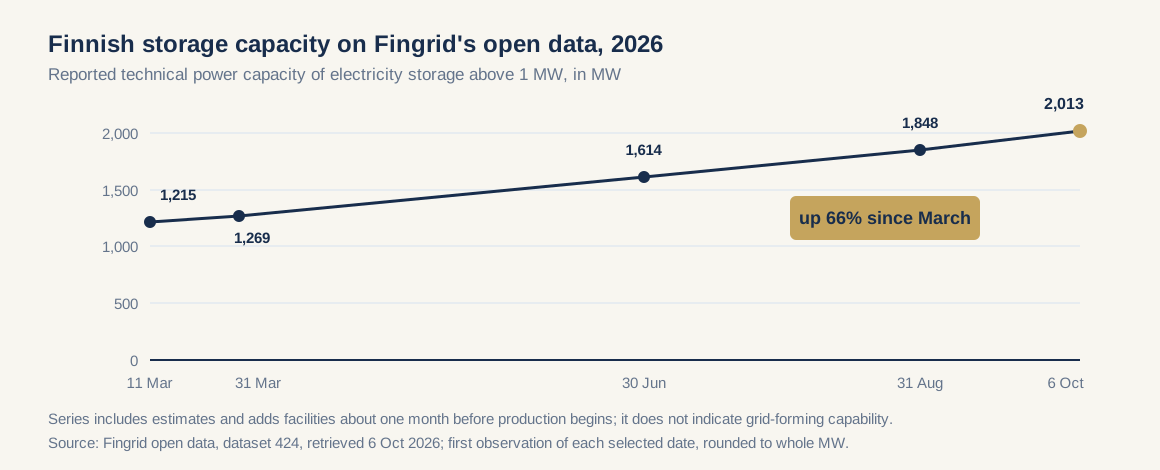
Fingrid's stated reason is converter concentration in specific areas, not national totals, but the totals show the direction. Reported technical power capacity of electricity storage above 1 MW licensed for the Finnish market reached 2,013 MW on Fingrid's open data in early October 2026, up 66 per cent from 1,215 MW on 11 March. The series includes estimates, adds facilities about one month before production begins and does not say which megawatts are grid-forming. Fingrid says more than 13,000 MW of clean generation is already connected and over 8,000 MW of new consumption is coming under concluded agreements.
Finland is not acting alone. The four Nordic TSOs said in a November 2025 joint report that they are already introducing grid-forming requirements for HVDC links (high-voltage direct current connections), STATCOMs and battery storage, with wind and solar to follow as the European rules develop. Those European rules are moving: the European Commission published a draft delegated regulation for feedback on 8 July 2026 that would replace the network code governing generator grid connections, Regulation (EU) 2016/631, with battery storage among the developments it names. Grid-forming is in the draft, tiered by plant category with transition provisions before it bites; the Commission plans adoption between October and December 2026 and a draft can still change. Our read is that Fingrid's October text is an early national preview of a compliance conversation the EU code would bring to developers across the Union, batteries included.
Who is affected and how differently
Wind and solar developers in Finland carry the immediate cost. The preliminary screen from the notice has three questions: is the project new, is it in a converter-dominated area and is the connection agreement unsigned? Three yeses keep a project potentially in scope, necessary answers rather than sufficient ones, since the supplement may add conditions, size thresholds or voltage levels among them. Which areas count is Fingrid's call, so the first thing to extract from the October text is the boundary.
Storage developers get a possible new demand channel. If a battery at or near a west coast wind farm proves a competitive compliance option, it gains a buyer who needs it for connection rather than trading. Ownership, a service or a shared connection point are structures to explore once the technical terms are known.
Inverter manufacturers face the question in procurement next. Our expectation is that grid-forming becomes a warranted line in Finnish tenders and the vendor gap shows up in bids.
Investors and lenders should treat the October text as a bankability document. A compliance battery with a defined stability duty is a different asset from a merchant battery; which is the better credit depends on the duty's terms and the market revenue they still allow.
Policymakers across the Nordics and Baltics get a live experiment to watch.
What to do about it
- Screen any Finnish pipeline against the three preliminary questions now and flag exposed projects before the supplement lands.
- Read the VJV2024 supplement the week it is published and attend the 16 October webinar with a Finnish speaker. The binding detail will be there, with SJV2024's storage grid-forming rules as the closest live precedent.
- Build provisional scenarios per exposed project: own-inverter compliance, stability hardware and a battery with and without market participation.
- If you develop wind or solar in Finland, open co-location conversations with storage developers early. Shared connection points take time to structure.
- For projects elsewhere in Europe, ask inverter vendors in writing how they would meet the draft EU code's grid-forming provisions if adopted as planned.
Related insight
- The receipt arrived, our October piece on where Finnish battery revenue goes next.
- Finland's flexibility building code, on KJV2026 and the demand-side half of the same rulebook.
The sizing question behind the rule
This is the kind of question we at Auranova Ventures work through with developers and investors across the Nordics, Baltics and wider Europe. The facts above are Fingrid's and the Commission's; the comparison framework is ours. When we model a hybrid project we size the battery from both ends, stability duty and reachable revenue stack, because the cheapest compliant battery and the most profitable one are rarely the same machine. If Fingrid's October text will touch a project you hold, reply and we will talk through how we would size it.
Which of your pipeline projects would a grid-forming requirement hit first and does its model know yet?
Sources
- New wind and solar power plants will be required to provide grid-stabilising control capabilities, Fingrid, 25 September 2026
- Grid Code Specifications for Grid Energy Storage Systems SJV2024, unofficial English translation, Fingrid (PDF)
- Grid code specifications, Fingrid (VJV2024 and SJV2024 confirmed by Energiavirasto on 20 March 2025)
- Specific Study Requirements for Grid Energy Storage Systems, version 1.0, Fingrid, 21 June 2023 (PDF)
- Documents complementing Grid code specifications, Fingrid (where the VJV2024 supplement is due to appear)
- Growth in the power system increases costs, main grid service fees will rise by 4 per cent at the beginning of the year, Fingrid, 28 September 2026
- Total installed battery energy storage system capacity, Fingrid open data, dataset 424
- Joint Nordic perspective on grid-forming converters presented in new report, Svenska kraftnät, 3 November 2025
- Network Code on Requirements for Grid Connection of Generators, revision, draft delegated regulation, EUR-Lex record Ares(2026)6819642, published for feedback 8 July 2026
- ENTSO-E publishes Phase II Technical Report on Grid Forming Requirements, ENTSO-E, 4 November 2025