Finland Is Turning Flexibility Into a Building Code
21 July 2026 · 7 min read · Auranova Ventures
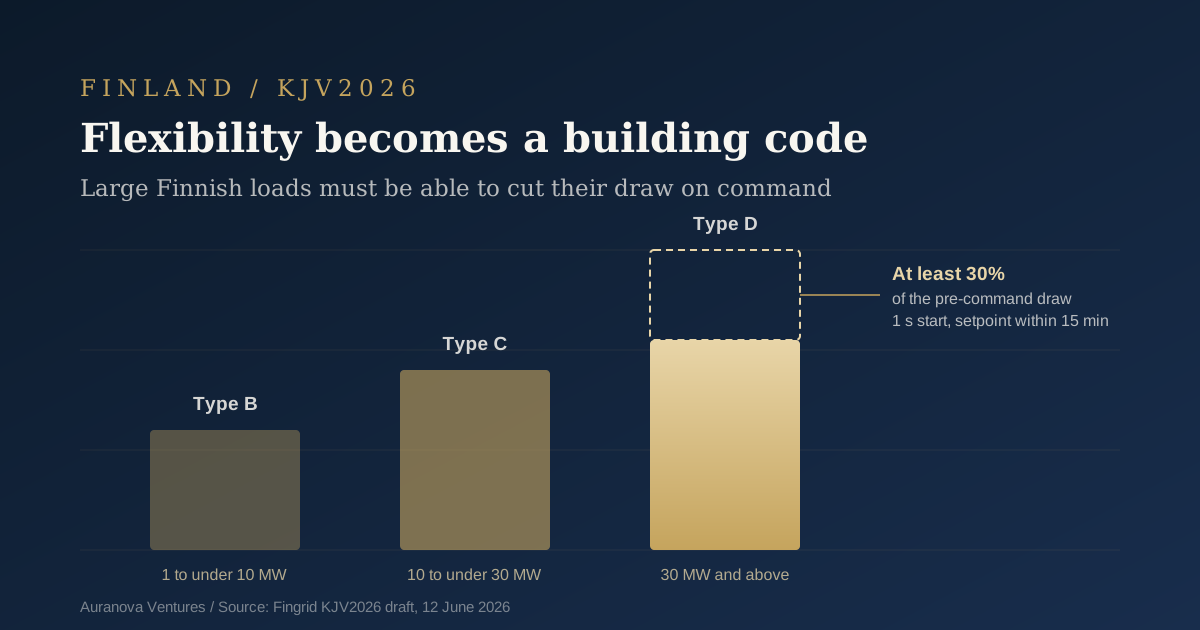
On 12 June 2026 Fingrid, the Finnish transmission system operator, put a new grid code for demand connections out for comment. KJV2026 would require every in-scope load of 30 MW and above to cut its draw by at least 30 percent on command, with the function starting within one second. The consultation closes on 21 August 2026. The reflex read is that batteries just gained a wave of competitors. The spec says something more interesting. The difference is worth money.
The development
KJV2026, the draft grid code specifications for demand connections, covers demand facilities, in Fingrid's own examples a data centre, an electric boiler or a power-to-gas plant. It sorts them by rated power alone. Type B runs from 1 MW to under 10 MW, Type C from 10 MW to under 30 MW and Type D from 30 MW up.
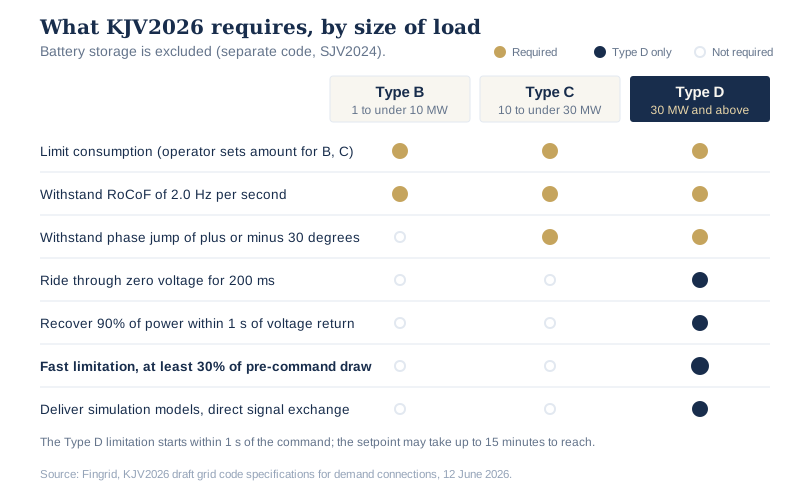
Every facility from 1 MW up must be able to limit its consumption, with the amount and speed set by the network operator. The heavy obligations sit on Type D. Those sites must ride through a fault in which the connection-point voltage drops to zero for 200 milliseconds, recover 90 percent of their pre-fault power within a second of the voltage coming back, exchange signals directly with Fingrid and deliver simulation models. And they must carry the headline function: on a command from Fingrid the site starts limiting within one second and reduces its draw by at least 30 percent, measured from whatever it was consuming just before the command, reaching the agreed setpoint within a pre-agreed time of at most 15 minutes. A second, separate version triggered by undervoltage exists too and is off by default until Fingrid asks for it.
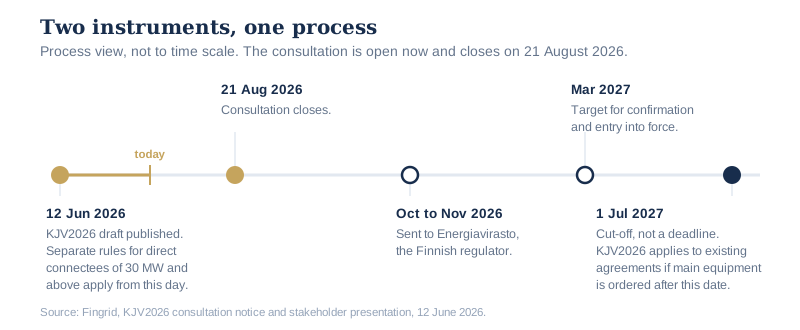
Two instruments arrived on the same day. The KJV2026 draft goes through consultation until 21 August 2026, then to Energiavirasto, the Finnish energy regulator, in October or November, with entry into force targeted for March 2027. A separate document, Technical requirements for large demand facilities, already applies from 12 June 2026 to sites of 30 MW and above connecting directly to Fingrid's grid. And 1 July 2027 is not a compliance deadline but a cut-off: an existing connection agreement falls under the new rules if the binding order for the site's main equipment is signed after that date.
One scope line changes how the rest reads. For energy storage the draft applies only to the pumping units of pumped hydro. Battery storage is excluded and regulated under its own specification, SJV2024. KJV2026 is not a rule about batteries. It is a rule about the loads around them.
What it actually means
Flexibility in Finland has been a product somebody chose to build and sell. KJV2026 makes a slice of it a condition of connection, the way a building code requires sprinklers rather than paying landlords for fire safety. That much of the reflex read is right. What the reflex read misses is which market the mandated capability can actually serve.
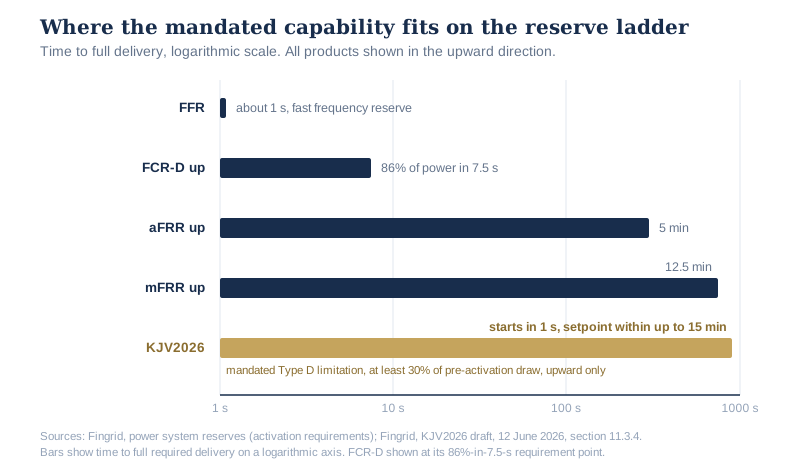
The reserve products sit on a ladder of speed. FFR, the fastest frequency reserve, activates in about a second. FCR-D, the disturbance reserve that has anchored Nordic battery revenue, must deliver 86 percent of its power in 7.5 seconds. aFRR, the automatic restoration reserve, has five minutes. mFRR, the manual restoration reserve, has 12.5 minutes. Those speeds come from Fingrid's own reserve specifications.
Now place the KJV2026 function on that ladder. It starts within a second, but the site may take up to 15 minutes to reach the setpoint. That is not FCR-D hardware. It is mFRR-shaped capability, with aFRR reachable only for sites engineered well beyond the minimum. And it points one way. A load that cuts consumption delivers upward regulation. Nothing in KJV2026 obliges a site to be able to increase its draw, so the mandated capability offers nothing in the downward direction.
Direction is where the money splits. The price collapse that repriced Nordic batteries was FCR-D down, from 9.50 euro per MW per hour in 2024 to 6.00 in 2026 in Fingrid's yearly market. The up product moved from 4.00 to 3.50. KJV2026 touches only the up side. Even there the route into FCR-D up is constrained: from September 2026 the Nordic TSOs cap static, relay-style FCR-D up provision at 50 percent of demand, tighter when system inertia is low, which is exactly the category staged load-shedding falls into.
A capability is also not a market position. Fingrid is explicit that grid-code commissioning and reserve prequalification are separate processes. A load owner still needs product tests, agreements, telemetry and a trading operation before a single euro arrives. When we model this for clients we treat mandated capability as a supply curve that feeds the upward mFRR market slowly, over years, against procurement that Fingrid itself forecasts rising from 290 MW in 2026 to 530 MW by 2033. An illustrative case: if 1 GW of new Type D load connects by 2030 and a tenth of its mandated curtailment ends up prequalified, that is 30 MW of new upward supply into a market growing by 240 MW. The inputs are Fingrid's, the arithmetic is ours and the conclusion is that the wave is real but narrow.
There is a second channel. It runs the other way. The draft names storage as compliance equipment: battery-based compensators are listed as a way to meet its power-oscillation limits and storage is listed as a permitted aid for post-fault power recovery. A code that storage does not have to comply with, but can help others comply with, is more than competition. It is demand.
Who is affected and how differently
Developers with one-hour merchant assets leaning on upward mFRR capacity should treat this as a slow-building supply risk and re-run the case with a demand-side entry scenario. Assets earning on the downward products keep that ground to themselves. Nothing in this code shorts a battery that earns on FCR-D down.
Developers who co-locate gain a new counterparty. Every Type D connectee inherits obligations, oscillation limits and recovery requirements, that a battery behind the same connection can help meet. The sizing question we work through in hybrid connections now includes what the load's own grid code is worth to it.
Investors should add one diligence question: how much mandated-capable demand could stand behind the upward products this asset leans on by year three, then what the equity case looks like if that arrives while procurement volumes also grow.
For load owners and their aggregators the code quietly pre-pays the hardest part of market entry. The control and telemetry a Type D site must install is most of what a balancing service provider needs to bid it in.
Policymakers elsewhere will read Finland as an early national mover on demand-side requirements. Where it goes next is a consultation question, not a foregone conclusion. The place to shape it is on the record.
What to do about it
Respond to the consultation before 21 August 2026. Storage is out of scope, which is exactly why storage-side views on the flexibility supply curve will be thin unless developers file them.
Re-run Finnish reserve cases with a demand-side entry scenario on the upward products only, then check the case still clears when mFRR up gains supply while FCR-D down stays battery territory.
Screen the co-location pipeline against Type D connectees. A data centre that must damp oscillations and recover power fast is a natural battery host. The code just made that value concrete.
Check whether your own project touches Type D. Co-located load, electrolysers and hybrid sites can push a connection past 30 MW. The direct-connection requirements already apply.
For investors, put the mandated-flexibility question in the Finnish diligence template now, while models that ignore it are still the norm.
Where we come in
We at Auranova Ventures spend our weeks re-running revenue stacks for developers and investors across the Nordics and Baltics under the rules that actually apply. A grid code that reshapes one side of the reserve market is exactly the kind of change a blended forecast hides. If you are sizing a Finnish project or a co-location and want a second read, reply or start a conversation. We are building a tool that models these stacks across markets automatically, so tell us if you would like early access.
Does your Finnish model know which direction its reserve line points? We read every reply.
Sources
- Fingrid, draft for comments: KJV2026 grid code specifications for demand connections (consultation 12 June to 21 August 2026, entry into force targeted March 2027): https://www.fingrid.fi/en/grid/grid-connection-agreement-phases/grid-code-specifications/draft-for-comments-kjv2026-grid-code-specifications-for-demand-connections/
- Fingrid, KJV2026 draft for public consultation, 12 June 2026 (Finnish; 30 percent limitation from pre-activation power, one-second start, 15-minute setpoint, undervoltage function off by default, energy storage excluded except pumped-hydro pumping, storage named as compliance aid for oscillation limits and post-fault recovery): https://www.fingrid.fi/globalassets/dokumentit/fi/palvelut/kulutuksen-ja-tuotannon-liittaminen-kantaverkkoon/kjv2026---luonnos-julkisesti-kuultavaksi-12062026.pdf
- Fingrid, KJV2026 stakeholder presentation, 12 June 2026 (facility tiers, process, 1 July 2027 applicability cut-off): https://www.fingrid.fi/globalassets/dokumentit/fi/palvelut/kulutuksen-ja-tuotannon-liittaminen-kantaverkkoon/kjv2026-presentation-12june2026.pdf
- Fingrid, grid code specifications for demand connections (Technical requirements for large demand facilities, applicable from 12 June 2026 to direct connectees of 30 MW and above): https://www.fingrid.fi/en/grid/grid-connection-agreement-phases/grid-code-specifications/grid-specifications-for-demand-connections/
- Fingrid, grid code specifications for grid energy storage systems, SJV2024: https://www.fingrid.fi/en/grid/grid-connection-agreement-phases/grid-code-specifications/grid-energy-storage-systems/
- Fingrid, power system reserves (reserve activation speeds and procurement volume forecast): https://www.fingrid.fi/en/electricity-market/reserves/power-system-reserves/
- Fingrid, how to participate in the reserve markets (prequalification separate from grid-code commissioning): https://www.fingrid.fi/en/electricity-market/reserves/reserve-products/how-to-participate-in-the-reserve-markets/
- Fingrid, implementation plan for the volume limitation on static FCR-D upward regulation (from September 2026): https://www.fingrid.fi/en/news/news/2025/implementation-plan-for-the-volume-limitation-on-static-fcr-d-upward-regulation/
- Fingrid, procurement of frequency containment reserves from the yearly market 2026 (FCR-D up and down clearing prices): https://www.fingrid.fi/en/news/news/2025/procurement-of-frequency-containment-reserves-from-yearly-market-2026/