Two Exchanges, One Price: What EPEX SPOT's Baltic Entry Changes for Batteries
29 September 2026 · 7 min read · Auranova Ventures
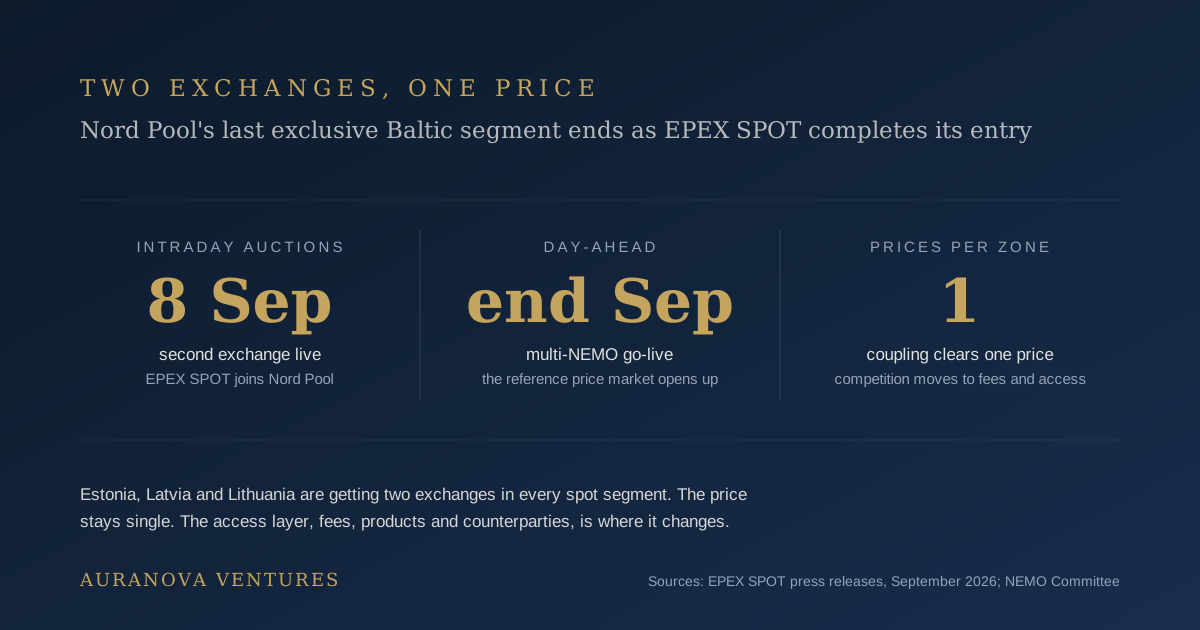
On 8 September 2026 the Baltic intraday auctions cleared with a second exchange connected for the first time. EPEX SPOT joined the intraday auction framework in Estonia, Latvia and Lithuania and the same announcement confirmed the bigger step: at the end of September 2026 the day-ahead market follows. That market sets the reference price for every battery revenue model in the region. Nord Pool's last exclusive segment in the Baltics is ending.
The development
The mechanics carry an unglamorous name, the Multi-NEMO Arrangement. A NEMO, a nominated electricity market operator, is an exchange designated to run the day-ahead and intraday markets, a role the EU created in its 2015 capacity allocation and congestion management regulation, CACM. Until November 2025 the only exchange operating in the Baltics was Nord Pool. CACM was written so that several exchanges can operate side by side in the same bidding zone, the price area, the way they long have in Germany or France.
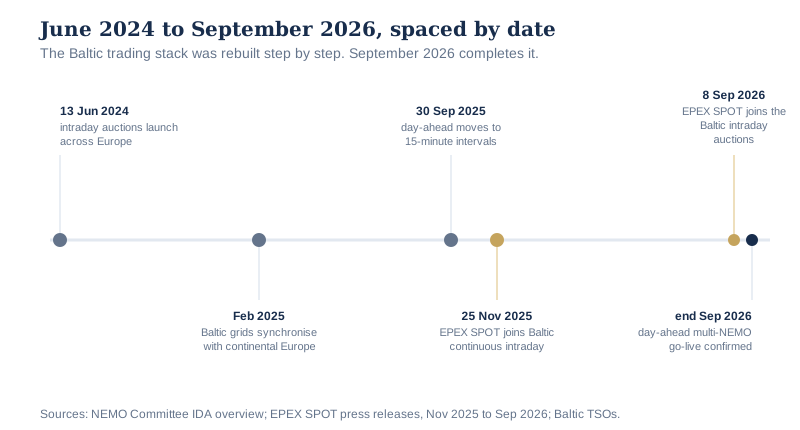
The opening comes in three steps. On 25 November 2025 EPEX SPOT connected to the continuous intraday market in all three countries. On 8 September 2026 it joined the intraday auctions, three daily auctions that put a firm price on cross-border capacity for the delivery day, two cleared the afternoon and evening before and one on the delivery morning covering noon to midnight. The final step, the day-ahead auction itself, is confirmed for the end of September 2026. The project parties span the region: the Baltic transmission system operators (TSOs) Elering, Augstsprieguma tīkls and Litgrid with Fingrid, Svenska kraftnät, Poland's PSE and the exchanges Nord Pool EMCO and EPEX SPOT.
What it actually means and what it does not
Start with the misunderstanding we hear most. A second exchange does not mean two prices for Baltic power on a normally coupled day. The coupled European day-ahead markets clear through a single calculation: every exchange collects its own orders, the orders flow into one shared calculation and one clearing price comes out per bidding zone per fifteen-minute interval. The intraday auctions work the same way. The continuous market has no clearing price at all, trades match one by one at the price on the order, but both exchanges' orders sit in a single shared book, so a bid entered through either one meets the same liquidity. Whichever logo is on your screen, you are in the same market.
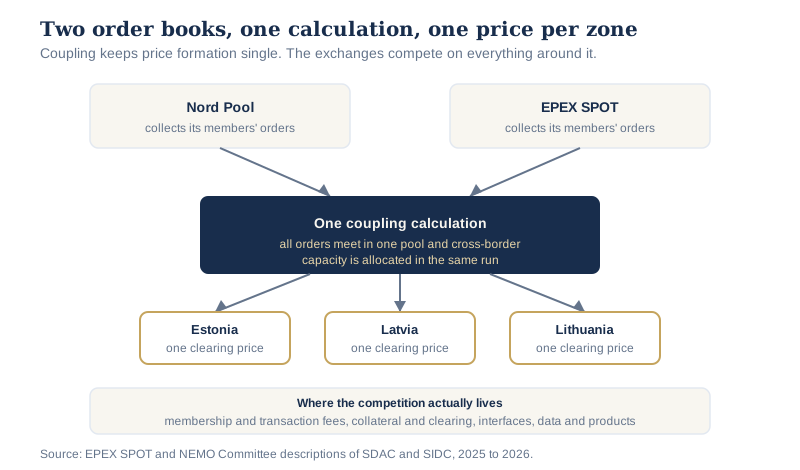
So the competition is real, but it lives in the access layer. Membership and transaction fees, collateral and clearing arrangements, trading interfaces, data services and product innovation are now contestable in the Baltics. For a battery operator the exchange bill is a small line, yet the access question decides bigger ones: which optimisers, the trading firms that dispatch and trade a battery for a fee, will enter the market, what they charge and what they can see. A trading firm that already clears EPEX SPOT volumes in Germany or Poland can extend into the Baltics without building a new membership from scratch. The region's thin trading bench has been one of the practical constraints we hear when developers negotiate route-to-market terms, the contract that gives a battery its trading access. The fair objection: most incumbents already hold Nord Pool memberships and will not switch. True, but the effect shows first in who else can enter and what incumbents can charge once entry is credible.
The exchanges are also courting storage directly. In July 2026 EPEX SPOT launched its TBx index family, daily benchmarks of the spread inside each day-ahead day, calculated with perfect hindsight as the average of the day's highest fifteen-minute prices minus the average of the lowest, eight of each for the two-hour version. One caveat: EPEX SPOT's own index documentation, the July 2026 release, states the indices are not yet available for Estonia, Latvia and Lithuania, so Baltic coverage is one to watch after the day-ahead go-live, not a given. Benchmarks still matter beyond marketing. Tolling agreements and revenue floors, the contracts where a counterparty buys a battery's trading capability or guarantees its income, need a neutral reference both sides trust. A published index is easier to underwrite than a counterparty's private backtest.
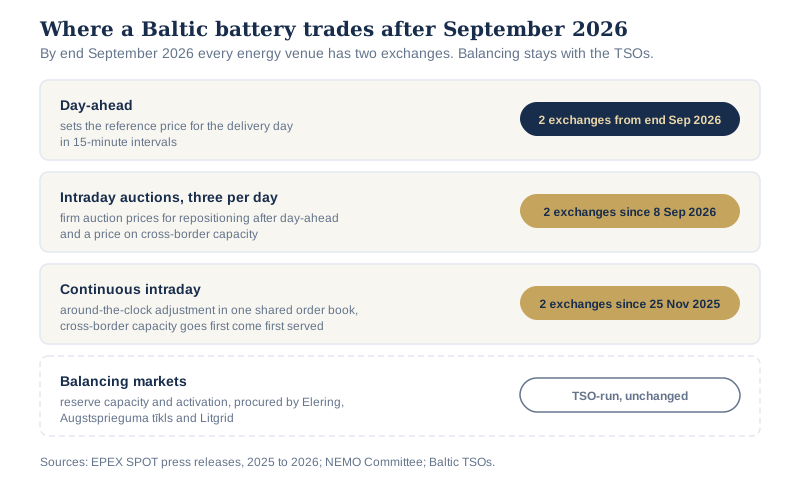
The deeper signal is about where Baltic battery revenue is heading. The balancing markets that carried the first wave of Baltic batteries, the markets for grid-stabilising reserves, are TSO-run and untouched by this change. The exchange entry says the growth is expected in the energy markets, day-ahead and intraday. The intraday auctions settle at fifteen-minute granularity and give a firm, auction-cleared price for repositioning after the day-ahead result, rather than the take-it-or-leave-it flow of the continuous book, where cross-border capacity goes first come, first served.
Who is affected and how differently
For developers, the near-term effect is negotiating leverage. Baltic route-to-market contracts have been priced against a short list of firms connected to one exchange. Renewals from October onwards happen in a market where access is cheaper to build and the provider list realistically longer.
For investors, the change works through bankability. A revenue model that leans on energy-market spreads is easier to defend when the underlying venues have redundant access, published storage benchmarks and a deeper pool of potential offtakers for tolls and floors. In the diligence we run, Baltic route-to-market concentration has been a recurring finding. This is the structural fix beginning to arrive.
For utilities and trading desks, the question is membership economics: one price, two fee schedules and two product sets to compare.
For policymakers, this is CACM doing what it was written to do. The next test is operational. EPEX SPOT's own Exchange Council discussed fallback procedures, the rules for a failed coupling session, at its 16 September 2026 meeting. With two exchanges in the chain, the region's first decoupling event will be the real proof of the design, because a decoupled day is the rare day the single price splits and each exchange's fallback auction sets its own price.
What to do about it
Reopen the route-to-market conversation before the contract says you must. Ask your optimiser which venues it actually connects to in the Baltics, both exchanges or one, auctions or only the continuous book and how that reach shows up in the fee.
Put the intraday auctions into the dispatch model explicitly. A battery that reoptimises against three firm auction prints per day is running a different strategy from one that only works the continuous book. The difference belongs in the revenue forecast, not in a footnote.
Use spread benchmarks in commercial structures where they exist and an equivalent metric computed from published day-ahead prices where they do not yet. A toll or floor referenced to a neutral daily number is cheaper to negotiate and easier to take to a credit committee than one referenced to a proprietary model.
Watch the day-ahead go-live the way you would a commissioning. The confirmed date, fallback behaviour and any teething in the auction calendar belong in your trading setup from day one.
And keep the balancing stack in view. Nothing here touches the TSO-run reserve markets, so a Baltic case is still won or lost on how energy and balancing revenues stack together.
Where we come in
Venue structure is the kind of assumption that sits silently under a Baltic revenue model. When we at Auranova Ventures model a revenue stack, the question is which venues the asset can actually reach, at what cost and with which counterparties competing for the contract, not just what the spreads were. If you are sizing a Baltic project or renegotiating route-to-market this autumn, start a conversation. We are also building a tool that models these stacks venue by venue, reply for early access.
When your optimiser contract next comes up, will you be pricing one exchange or two? We read every reply.
Sources
- EPEX SPOT, The SIDC Intraday Auctions Framework Expands in the Baltics as EPEX SPOT Joins (10 September 2026): https://www.epexspot.com/en/news/sidc-intraday-auctions-framework-expands-baltics-epex-spot-joins
- EPEX SPOT, Baltic Region: Successful Integration of EPEX SPOT into Single Intraday Continuous Framework (26 November 2025): https://www.epexspot.com/en/news/baltic-region-successful-integration-european-power-exchange-epex-spot-single-intraday
- EPEX SPOT, EPEX SPOT to launch TBx Index suite (9 July 2026): https://www.epexspot.com/en/news/epex-spot-launch-tbx-index-suite-unlock-full-value-battery-and-storage-trading
- EPEX SPOT, Exchange Council calls for practical and proportionate Fallback Solutions (28 September 2026): https://www.epexspot.com/en/news/exchange-council-calls-practical-and-proportionate-fallback-solutions-and-reaffirms-robust-and
- NEMO Committee, Intraday Auctions (IDA) overview, Europe-wide launch on 13 June 2024: https://www.nemo-committee.eu/ida
- ENTSO-E, successful synchronisation of the Baltic power systems with continental Europe (9 February 2025): https://www.entsoe.eu/news/2025/02/09/entso-e-confirms-successful-synchronization-of-the-continental-european-electricity-system-with-the-systems-of-the-baltic-countries/
- Nord Pool, About the SIDC intraday auctions, auction schedule and delivery coverage: https://support.nordpoolgroup.com/support/solutions/articles/8000111575-about-the-sidc-intraday-auctions-idas-
- EPEX SPOT, Description of EPEX SPOT Market Indices, July 2026, section 2.13 on Estonia, Latvia and Lithuania: https://www.epexspot.com/sites/default/files/download_center_files/EPEX%20SPOT%20Indices%202019-05_final.pdf
- EPEX SPOT and SDAC parties, Market Coupling Steering Committee confirms go-live of 15-minute MTU in SDAC on trading day 30 September 2025: https://www.epexspot.com/en/news/market-coupling-steering-committee-confirms-go-live-15-minute-mtu-sdac-trading-day-30
- EPEX SPOT, Successful market start for Baltic region, Exchange Council press release (9 December 2025): https://www.epexspot.com/en/news/successful-market-start-baltic-region