Last in Line: Finland's Draft Grid Queue Puts Utility-Scale Standalone Batteries in Group Four of Four
24 September 2026 · 8 min read · Auranova Ventures
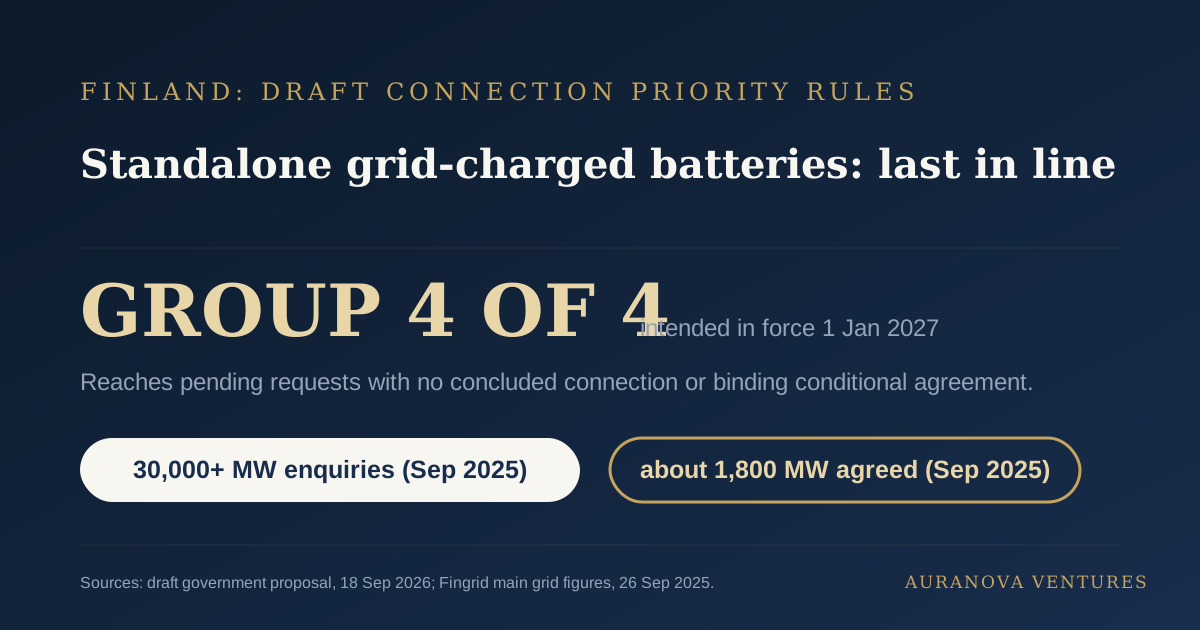
Since 18 September, Finnish battery developers can read in a draft law where a pending connection request stands once grid capacity runs short: last of four priority groups, behind the consumption sites and data centres competing for the same network. The amendment to the Electricity Market Act is out for consultation until 9 October and is meant to apply from 1 January 2027, reaching every request with no concluded connection agreement or binding conditional agreement. Fingrid has logged over 30,000 MW of storage enquiries; about 1,050 MW is built.
The development
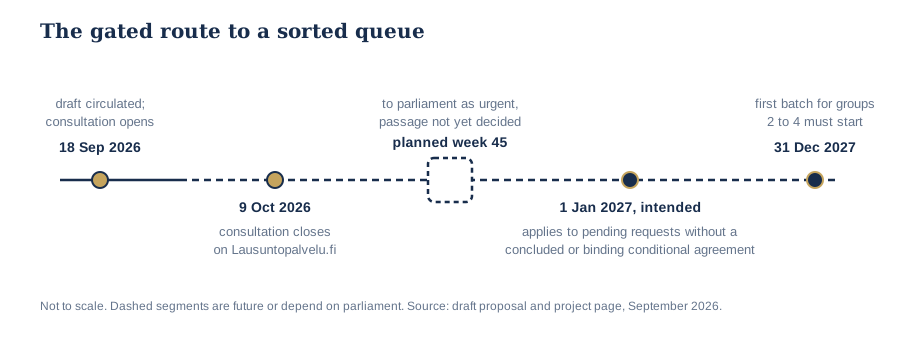
The Ministry of Economic Affairs and Employment circulated the draft government proposal on 18 September (project TEM043:00/2026, to parliament as urgent around week 45). It would write into the Electricity Market Act a priority procedure for connection requests, the formal step of asking a network operator for a connection offer. The procedure covers consumption sites and electricity storage, including requests to enlarge an existing connection; electricity production is excluded. It would bind the transmission system operator (TSO, in Finland Fingrid) and distribution operators alike: 87 network companies by the draft's own count, closed distribution networks exempt.
Think of it as boarding groups at a gate (the draft's sections 4.1.2 to 4.1.5 carry the detail). Group 1 holds consumption sites up to 3 MW, data centres up to 1 MW, sites whose connection is necessary for critical functions of society and two narrow kinds of storage: units up to 100 kVA (0.1 MVA, summed per connection point) and storage inside a power plant complex that is not charged from the grid, only from the plant's own production. Group 2 holds consumption sites above 3 MW up to 100 MW and data centres above 1 MW up to 10 MW. Group 3 holds the sites and data centres above those limits. Group 4 holds all other storage: every standalone battery energy storage system (BESS) above 100 kVA that charges from the grid.
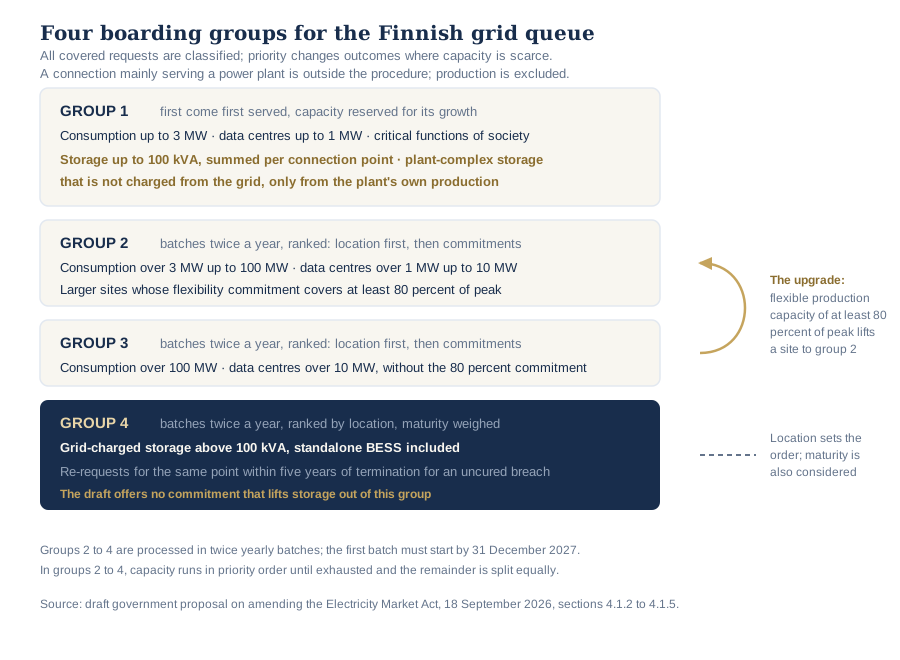
Group 1 keeps today's first come, first served treatment, with capacity reserved for its expected growth. Groups 2 to 4 are processed in batches twice a year, with the first batch starting by 31 December 2027. The upgrade counter does not serve batteries: a consumption site or data centre above the group 2 limits climbs back into group 2 by committing flexible production capacity covering at least 80 percent of its peak demand: weather-independent generation, offered continuously on an organised marketplace (a power exchange or balancing market), either fed to the grid or used behind the meter, inside the site's own connection, to cut its draw. Within groups 2 and 3, requests are ranked in tiers: location first, then any flexibility commitment (at least 10 percent of peak improves rank without changing group), then any production commitment (at least half of annual consumption from new generation in the same area). Within group 4, ranking is by location, with the project's maturity also weighed.
What it actually means
The connection obligation survives and the procedure adds no new ground for refusing anyone; it decides the order in which offers are made where capacity is scarce, network by network, with no single national queue. Fingrid reported in September 2025 over 30,000 MW of storage connection enquiries and has restricted new storage connections to its main grid in southern Finland until 2029, while pointing to thousands of spare megawatts in Ostrobothnia and northern Finland. Fingrid notes location matters little for a battery's commercial operation; the real constraint is the network, not the market. The draft would replace arrival order with a statutory ranking that reaches distribution networks too.
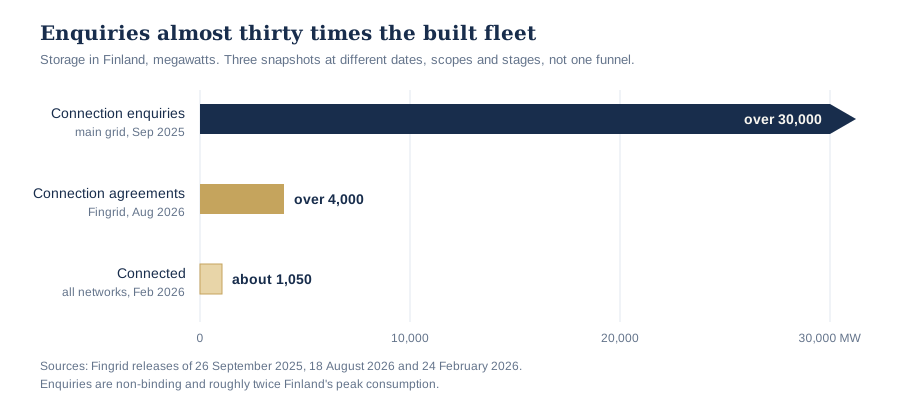
Scale gives the sorting teeth. About 1,050 MW of storage was connected by February 2026, with systems above 10 MW just 6 percent of units but 57 percent of capacity. By mid-August 2026 more than 4 GW of storage held connection agreements. The three figures are different populations at different stages (enquiries are non-binding) and do not subtract into a queue; the truly affected set, pending formal requests without agreements in scarce networks, is not public. But intent stacked almost thirty times above built reality is what the sorting would meet if even part of it converts into formal requests.
The transition rule is the sharp edge. The law would apply to every request made before entry into force under which no connection agreement or binding conditional connection agreement (a contract that reserves the connection subject to stated conditions) has been concluded. A battery request filed in 2025 would no longer hold the place its arrival date gave it; it would be re-sorted into group 4. Pending requesters may add commitments before the first batch, but commitments attach to consumption sites; a battery's remaining levers are location and maturity (how far developed the project is). Batch processing means waits of up to about six months, longer in 2027, against roughly two months in Fingrid's scarcity practice today.
Finland is not alone, but the models differ. The Netherlands has obliged network operators to prioritise transport-capacity requests in congestion areas since 1 October 2024. The regulator ACM's revised framework, in force after 1 January 2026, puts congestion softeners (projects that create grid capacity) at the front, a category defined by function rather than technology. France's TSO RTE consulted in early 2026 on moving consumer connections to first ready, first served. The Dutch route at least allows an asset to be queued by what it does for the network; Finland's draft sorts storage by category.
Who is affected and how differently
For developers of standalone BESS, the Finnish pipeline splits on one question: has a connection agreement or binding conditional agreement been concluded? Projects holding one keep their position. Projects without one inherit group 4, where siting decides rank. Illustratively, a 30 MW grid-charged project with a pending request in a tight southern network faces the existing main-grid restriction, then a twice-yearly batch, then group 4's turn. The same project sited where Fingrid reports available capacity ranks ahead of worse-sited peers and, capacity and maturity permitting, can see an offer far earlier. Treat connection dates as scenarios rather than a date: each six-month batch slip defers the battery's entire revenue stack (the combined income streams the asset earns) while land and development costs keep running. The modelling is illustrative; the asymmetry is in the draft.
For investors, connection status becomes a contractual diligence variable rather than a schedule assumption. In our Nordic storage screens, a pending Finnish request in a scarce area would carry queue risk that a concluded agreement would not, if the draft passes as written. Price the scenario before January, not after.
For owners of generation, co-location (a battery sharing a connection with a power plant) gets more technical. A connection whose principal purpose is serving the plant sits outside the procedure altogether, since production is excluded. Within the procedure, plant-complex storage earns group 1 only if it is not charged from the grid, which surrenders grid-charging revenue. Which side of those lines a hybrid project falls on is now a design decision worth real money.
For policymakers and large consumers, one open point stands out. The flexibility commitment is defined around capacity able to produce without interruption. The draft treats storage as its own category throughout, so whether storage can back such a commitment at all is left unstated. Worth putting on the record before 9 October.
What to do about it
Five moves this quarter. Audit every Finnish connection request in your pipeline by agreement status; requests without a concluded agreement are the exposed ones. Respond to the consultation by 9 October. Re-screen sites against network areas with available capacity, because a well-sited late request can now beat a badly sited early one. Re-examine co-location structures against the principal-purpose and no-grid-charging lines. And re-run revenue models with connection dates keyed to twice-yearly batches rather than single assumptions.
The queue as a modelling problem
A queue with rules is something you can model; a queue without them is something you wait in. Written into law, groups, location ranking and batch dates turn connection timing into scenarios a revenue model can carry honestly. This is the kind of question we at Auranova Ventures work through with developers and investors across the Nordics, Baltics and wider Europe, inside market-entry screens and bankability assessments. If your Finnish pipeline holds a pending connection request, reply and we will compare readings of the draft.
When Finland starts sorting its queue by purpose, size and location, will your projects hold a concluded agreement, a strong location or just a place in line?
Sources
- Ministry of Economic Affairs and Employment: Sähköverkkoon liittämisen etusijamenettely lausuntokierrokselle (18 September 2026)
- Finnish Government: Proposal on priority procedure for electricity network connections circulated for review (18 September 2026)
- Draft government proposal on amending the Electricity Market Act, consultation version (18 September 2026, PDF in Finnish)
- Project page TEM043:00/2026, Ministry of Economic Affairs and Employment
- Consultation on Lausuntopalvelu.fi, open until 9 October 2026
- Fingrid: Fingrid secures transmission capacity for growth, restrictions on new energy storage connections continued in southern Finland (26 September 2025)
- Fingrid: The combined capacity of electricity storages in Finland now exceeds 1,000 MW (24 February 2026)
- Fingrid: Electricity consumption is set to increase sharply, more balancing power will also be needed (18 August 2026)
- ACM: Codebesluit prioriteringsruimte bij transportverzoeken, prioritisation obligatory in congestion areas from 1 October 2024
- ACM: Giving priority to projects that contribute to major social objectives remains possible in new prioritization framework (12 December 2025)
- RTE: Refonte du raccordement des clients au réseau HTB, appel à contribution (27 January 2026)