The Baltic Battery Correction Is No Longer a Forecast
28 September 2026 · 8 min read · Auranova Ventures
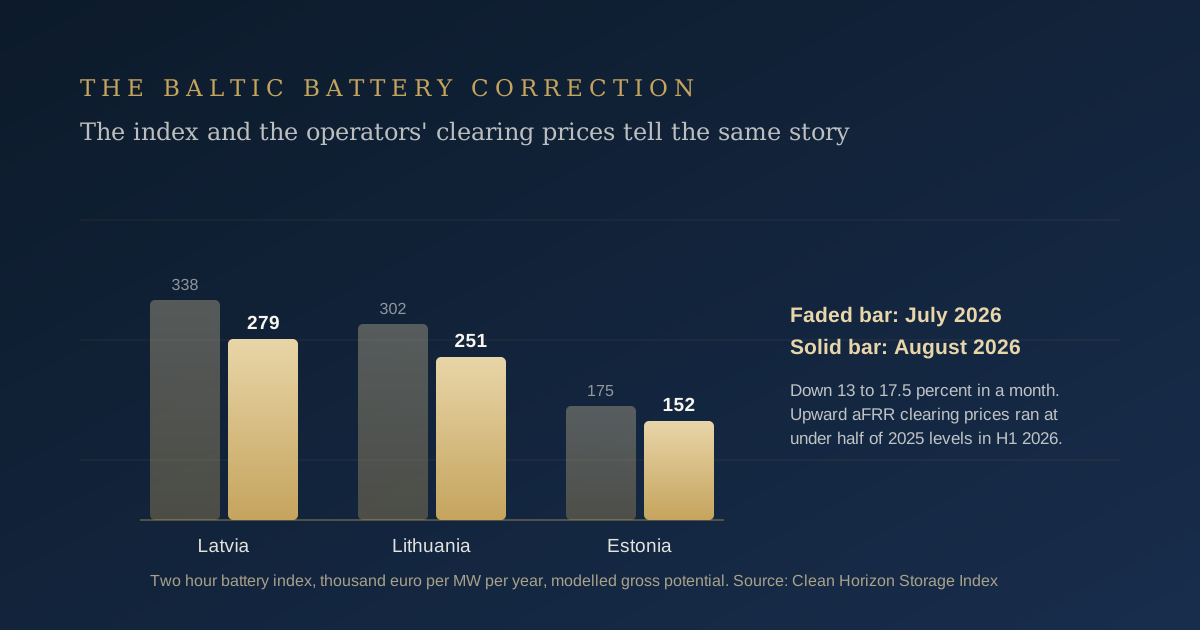
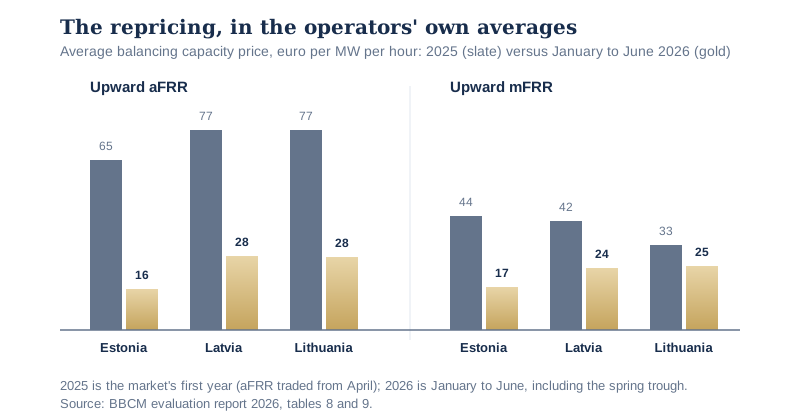
In 2025 a megawatt of upward aFRR capacity in Estonia cleared at an average of just over 65 euro per hour of reservation. In the first half of 2026 it cleared under 16. That is the average clearing price compiled in the Baltic operators' own market report, not an index. The trackers agree: Clean Horizon's August revenue index fell 13 to 17.5 percent across the three countries in a single month. In July we wrote that the Baltic scarcity premium had a fuse. The burn is now in the primary data.
The development
Two documents landed since our July piece. On 4 August the three Baltic transmission system operators, Elering in Estonia, Augstsprieguma tīkls (AST) in Latvia and Litgrid in Lithuania, published their second evaluation report on the Baltic Balancing Capacity Market, covering October 2025 to June 2026. Clean Horizon's Storage Index has since posted its August readings.
Grid reserves sit on a ladder of speed: FCR, the frequency containment reserve, arrests a frequency deviation within seconds; aFRR, the automatic frequency restoration reserve, pulls it back over minutes, automatically; mFRR, the manual frequency restoration reserve, is the slower workhorse activated on instruction. The joint Baltic capacity market opened in February 2025 when the region cut loose from the Russian grid; standard aFRR procurement followed that April. A capacity payment is what a battery earns for holding a product available, before activation payments.
The operators' report reads like a market normalising fast. Average capacity prices for upward aFRR fell from 65 to 77 euro per MW per hour in 2025 to 16 to 28 in the first half of 2026; upward mFRR fell from 33 to 44 down to 17 to 25. Concentration dropped in every product and direction. The report notes a recent surge of battery energy storage systems ("BESS and BESS-combined assets"), enough to push gas out of second place among prequalified capacity; across the period aFRR cleared at exactly zero euro on 32 to 42 percent of the market's 15 minute intervals.
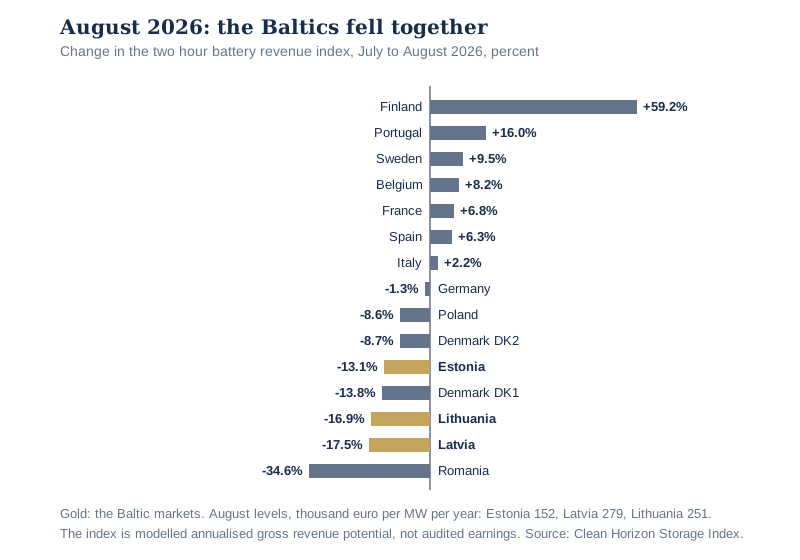
Clean Horizon's index tells the same story from the revenue side. The two hour series has stepped down in waves from launch-era extremes: Latvia read an annualised 955,000 euro per MW in October 2025, 615,000 at the February 2026 high and 279,000 in August, its second straight down month. Estonia ended August at 152,000 and Lithuania at 251,000. The index is modelled annualised gross revenue potential from each month's prices, not audited earnings. The Baltics were not alone: Denmark's two zones, Germany, Poland and Romania also fell in August (Romania by a third) while France, Portugal, Spain and a rebounding Finland rose.
What it actually means
The figures above are market data. The mechanism that follows is our read.
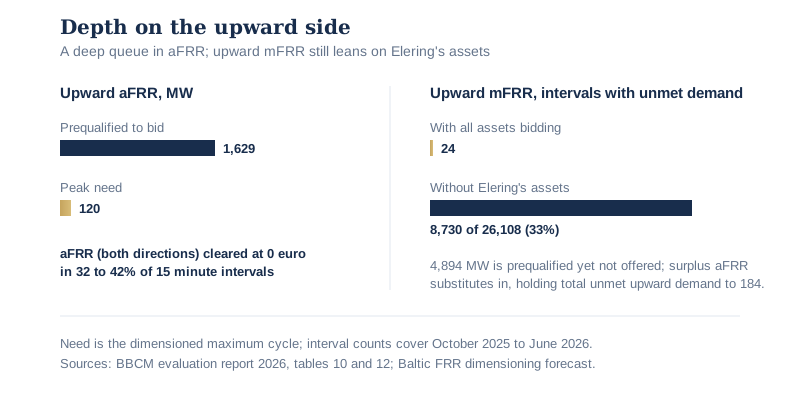
Reserve demand is dimensioned by the operators, not by appetite. Their forecast has upward mFRR growing from 604 MW in 2026 to 754 MW by 2035, downward mFRR to 991 MW and peak upward aFRR need near 120 MW throughout. In aFRR the queue is stark: 1,629 MW stands prequalified (has passed the operators' technical approval to bid) for a product needing at most 120. An illustration, ours: a megawatt holding upward aFRR in Estonia every hour of the year would have grossed about 572,000 euro at 2025 average prices and about 138,000 at first half 2026 prices, before any activation. mFRR looks similar on paper (4,894 MW prequalified) but the report's bid data says otherwise: with all assets in, upward mFRR demand went unmet in just 24 of 26,108 intervals; without Elering's assets it goes unmet in 8,730, a third of the period, though surplus aFRR substitutes in and holds total unmet upward demand to 184 intervals. Prequalified is not offered.
Two caveats belong next to that read. The averages hide seasonality: the 2025 base includes anomalous launch months and the 2026 half includes the spring trough, so the size of the correction depends on which months you compare, even if its direction does not. And Clean Horizon's January 2026 method change models the average battery given the installed fleet, so part of the index decline is the fleet itself growing. That is not a distortion but the point: dilution is what a crowding market does to the average asset.
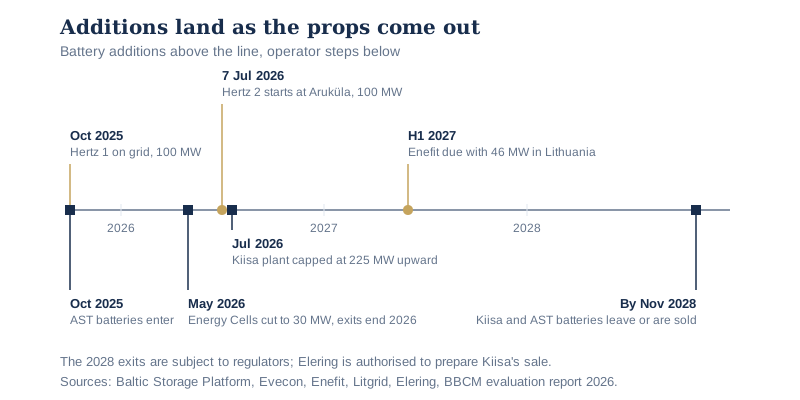
The stress line runs between directions, not between products. The report's conclusion is blunt: almost everything difficult sits on the upward side, prices, zone splits and daily swings alike, because upward flexibility "is highly dependent on a few select large assets". The products themselves have converged: aFRR is almost always over procured, aFRR and mFRR bids compete and the report finds aFRR prices driven primarily by overall reserve demand and mFRR supply rather than by aFRR demand. What still earns a premium is firm upward capability, whichever product it bids into. The supply keeps coming: Baltic Storage Platform's 100 MW Hertz 1 park at Kiisa was connected in October 2025 and in full service by year end, its twin Hertz 2 at Aruküla started on 7 July 2026 and Enefit has 46 MW more due beside its Lithuanian wind farms in the first half of 2027.
A second clock runs underneath. The operators plan to withdraw their own assets from propping up the market and the steps have begun: Litgrid cut Energy Cells' aFRR volume from 40 MW to 30 MW on 1 May 2026 (the arrangement runs only to the end of 2026) and Elering capped its Kiisa emergency reserve plant (a separate asset from the Hertz battery park there) at 225 MW of upward reserves from 1 July 2026. The plant and Latvia's operator owned batteries (8 MW of FCR and 32 MW of aFRR) are to leave the market no later than November 2028, subject to regulators; Elering is authorised to prepare Kiisa's sale. The exit will be careful: nine months of restoration reserve capacity cost 108.6 million euro (excluding FCR); the modelled scenario without any TSO resources reaches about 2.13 billion, a static scenario holding today's bids fixed. Kiisa's 225 MW is over a third of the peak upward mFRR requirement. Whether that capacity exits, sells into merchant hands or lingers under regulator direction is the biggest open volume question in this market.
Who is affected and how differently
Operating owners feel it first: the modelled stacks are heavy in reserve capacity payments, so the correction passes almost straight through to revenue. Re-anchor the model now rather than wait for a friendlier month.
Developers mid-build face the sharpest timing question. Every month between now and commissioning is a month of premium the project never books. Aurora Energy Research's estimate, reported by ESS News last October for a representative two hour standalone battery in Lithuania, was a 13 to 16 percent internal rate of return for 2026 entry, falling to 6 to 13 percent by 2029 as mFRR capacity shrinks to a small share and energy arbitrage (buying power cheap and selling it dear) grows. Aurora did not model aFRR. The operators' clearing prices already point the same way.
Investors screening Baltic entry should read the correction as sequencing information rather than a verdict: early entry captured a premium late entry will not. An asset priced off 2025 marks deserves a hard look at the half year clearing prices. Underwritten on the glide path, it may still pay, especially for assets that deliver firm upward capacity.
Policymakers and the operators will read the same numbers as success: falling prices and falling concentration are the design working. In Latvia the operator estimated its own batteries would roughly halve the balancing capacity costs passed to producers and consumers.
What to do about it
First, re-anchor the revenue model on the operators' published clearing prices, not a trailing average through the 2025 scarcity peak. The upward marks for the first half of 2026 are 16 to 28 euro per MW per hour for aFRR and 17 to 25 for mFRR (downward is mostly lower). They average across a spring trough and a summer rise; treat them as a base case, not a floor.
Second, track what is prequalified and what actually bids, per product and direction, not announced nameplate; the report publishes a snapshot of both. Only accepted capacity clears a price.
Third, position for firm upward capability, the thing the market still lacks. Duration, sustained output through an activation and prequalification are what the upward premium pays for. Then watch the Kiisa plant: whether its 225 MW leaves, sells or stays decides how much of that scarcity survives 2028.
Fourth, model the zero floor. aFRR cleared at zero on a third of intervals; the report ties its over procurement to reserve substitution and ample supply; our read is the zero floor also previews saturation. If the investment case needs aFRR capacity revenue well above zero for years, restructure the stack before the market does it for you.
The window has phases
This is the kind of question we at Auranova Ventures work through with developers and investors across the Nordics, Baltics and wider Europe: not whether a market is good or bad, but which phase of its life a given entry date buys. When we model a Baltic revenue stack now, the output is a glide path anchored on the operators' clearing prices with the 2028 exits as dated events. If you are pricing or holding a Baltic battery position, reply to this piece and we will compare notes on the path.
Where do you have Baltic reserve prices settling by the time the operators leave the market in 2028?
Sources
- BBCM Evaluation Report 2026, Elering, Augstsprieguma tīkls and Litgrid, 4 August 2026
- Clean Horizon Storage Index (monthly battery revenue index and methodology)
- Baltic LFC block FRR dimensioning forecast 2026 to 2035, Elering, Augstsprieguma tīkls and Litgrid, 29 July 2025
- BBCM Evaluation Report 2025, Baltic TSOs, 31 October 2025
- Elering, Baltic electricity transmission operators announce plan to phase out balancing resources, 7 November 2025
- Litgrid, balancing services page (Energy Cells aFRR volumes)
- Baltic Storage Platform, Hertz 1 and Hertz 2 project pages
- Evecon, the 100 MW Aruküla battery park started operating, 7 July 2026
- Enefit (Eesti Energia), Enefit to Increase Its Battery Storage Capacity, 19 March 2026
- ESS News, Baltic battery report: get in if you can, says Aurora, 16 October 2025
- Auranova Ventures, The Baltic Battery Window Is Open. The Clock Is Running, July 2026