The Baltic Battery Window Is Open. The Clock Is Running.
7 July 2026 · 7 min read · Auranova Ventures
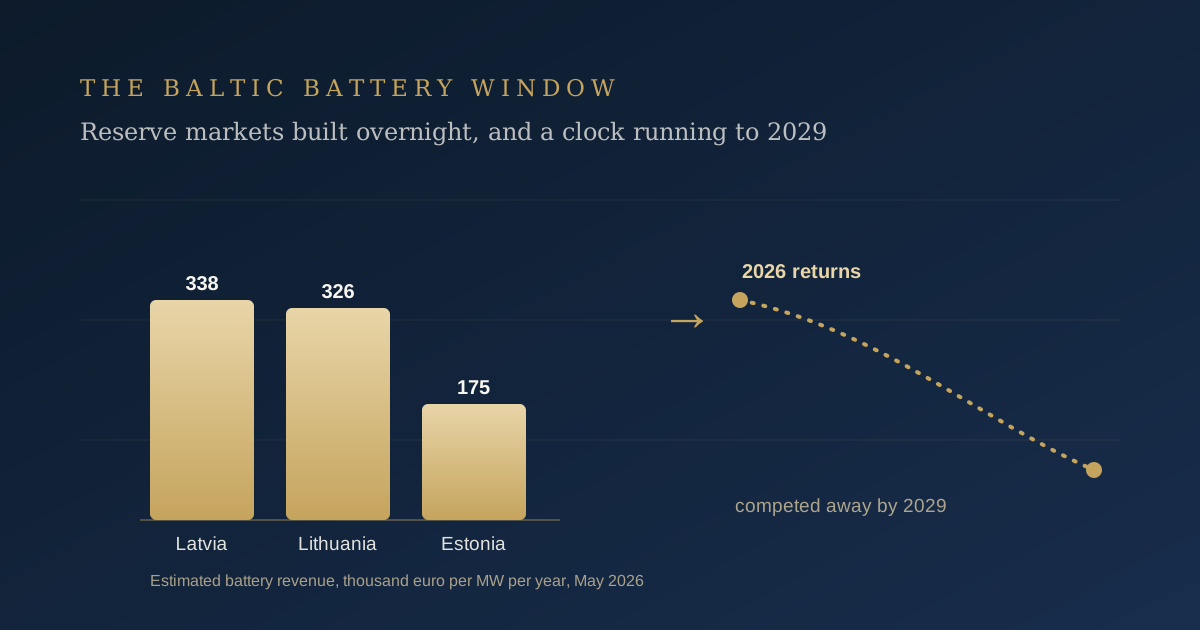
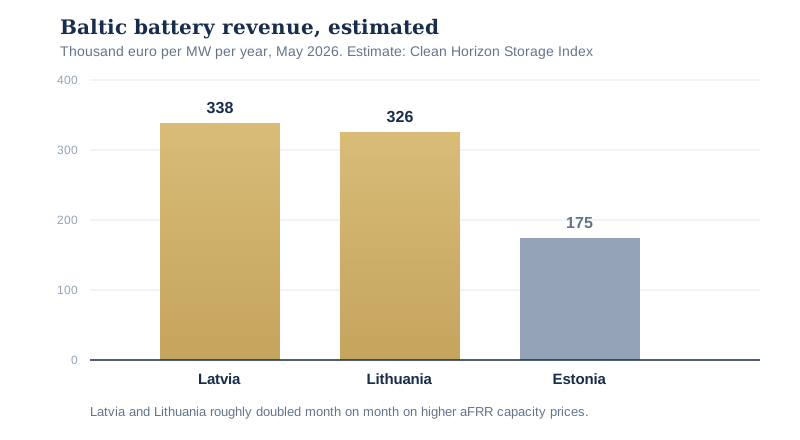
A grid-scale battery in Latvia is estimated to have earned around 338,000 euro per MW in the year to May 2026, close to double the month before. An Estonian battery earned around 175,000 over the same window. Those numbers are Clean Horizon's Storage Index estimates rather than audited accounts, but the direction is not in question. Fifteen months after the Baltic states unplugged from Russia and started running their own grid frequency, the reserve markets they had to stand up in a matter of weeks are paying like scarcity. They pay that way because they are scarce.
The development
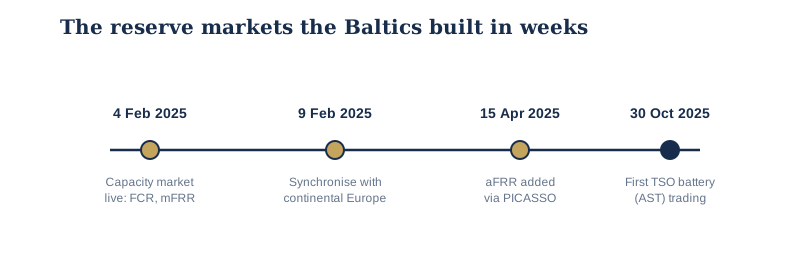
On 8 February 2025 Estonia, Latvia and Lithuania desynchronised from the Russian and Belarusian IPS/UPS system and cut the last interconnectors east. The next afternoon, at 14:05 on 9 February 2025, they synchronised with the Continental European grid, confirmed by ENTSO-E. For the first time in their modern history the three countries are responsible for their own frequency, second by second, rather than leaning on a Russian system operator to hold it.
That responsibility created three markets more or less overnight. The Baltic Balancing Capacity Market went live on 4 February 2025, with first delivery on 5 February, run jointly by the three transmission system operators, Elering in Estonia, AST in Latvia and Litgrid in Lithuania. It launched with two reserve products and added a third, aFRR, on 15 April 2025 once the Baltics joined the European automatic-reserve platform PICASSO.
A quick map for readers who do not live in these markets. Grid reserves sit on a ladder of speed. FCR, frequency containment reserve, is the fastest. It arrests a frequency drop within seconds. aFRR, automatic frequency restoration reserve, is the next rung. It restores the frequency over the following minutes, automatically. mFRR, manual frequency restoration reserve, is slower again, called on by the operator to refill the balance. Batteries are very good at all three. Under the old arrangement with Russia these products barely existed as a Baltic market. Now the three TSOs buy them every day.
What it actually means
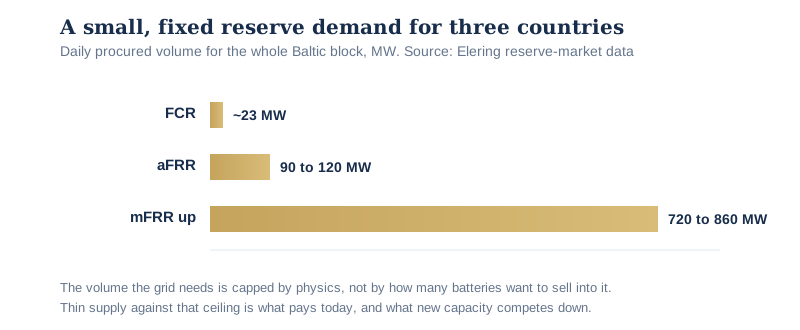
The demand for these reserves is small and it is fixed. Across the whole three-country block the operators procure roughly 23 MW of FCR, 90 to 120 MW of aFRR and 720 to 860 MW of upward mFRR in a given hour, per Elering's reserve-market data. The volume is set by the size of the largest credible fault and the shape of the system, not by how much capacity would like to sell into it. The capacity market's own price cap sits at 4,000 euro per MW per hour, a ceiling the Baltic TSOs wrote in precisely because they expected the early market to be tight.
Tight is an understatement. The Baltic TSOs' own evaluation report on the market, published on 31 October 2025, describes a "vast shortage of flexible supply". To keep the market from clearing at punishing prices, the operators pressed their own assets into service as demand-reduction resources, Estonia's Kiisa reserve power plant and resistors and Lithuania's Energy Cells battery among them, totalling 290 MW of upward and 80 MW of downward reserve by the end of the report period. The same report estimates that without those operator assets, procurement across the period would have cost more than 1.9 billion euro extra and left large volumes of upward mFRR demand unmet. When the grid operator is quietly propping up its own reserve market, the price a merchant battery can command is high.
That shortage is the revenue. It is also, by definition, temporary. Our read is that this is the Nordic FCR-D story from our last piece, fast-forwarded. The mechanics are identical. A fixed reserve requirement, a rush of batteries chasing it, a clearing price that competes down for everyone as the fleet grows. The Baltic version simply has a shorter fuse, because the markets are a fraction of the Nordic size and the development pipeline pointed at them is large. The figures here are market data. The modelling around them is ours.
Who is affected and how differently
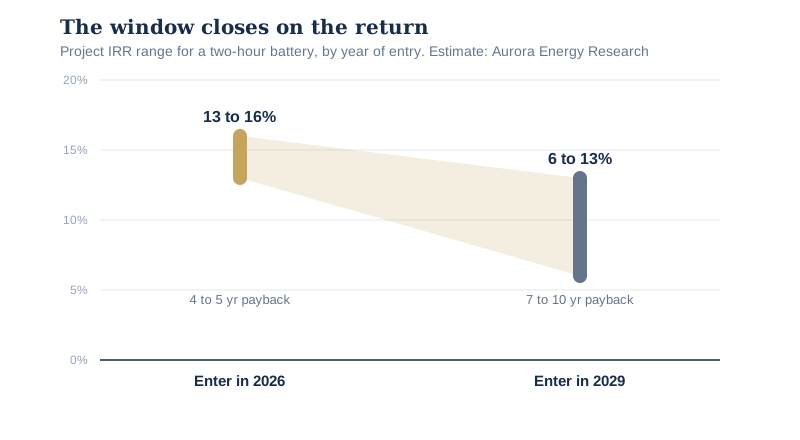
A developer deciding when to commission is the party this matters to most. Aurora Energy Research estimates that a two-hour battery entering service in 2026 earns a 13 to 16 percent project IRR with a four to five year payback, with mFRR capacity a meaningful part of that stack. By 2029, on the same estimate, the range falls to 6 to 13 percent and payback stretches to seven to ten years as competition arrives and the reserve premium thins to a small share of the total. The single biggest lever on the return is not the technology. It is the commissioning date.
Investors carry the mirror image of that risk. A model that underwrites today's reserve prices flat for a decade is making exactly the mistake Nordic FCR-D investors made, one market and two years earlier. The correction there was painful for the assets built on a single line.
Estonia, Latvia and Lithuania are not one market either. Estonia sits at the bottom of the revenue table, around 175,000 euro per MW against 326,000 to 338,000 for its neighbours, on a thinner aFRR position and heavier reliance on operator backstop. A revenue-stack assumption lifted from a Lithuanian project and dropped onto an Estonian node will read high.
The last shift is the most telling. The grid operators are becoming competitors. AST's own battery started trading on 30 October 2025. Every megawatt of operator or merchant supply that arrives bids the scarcity premium down a little further.
What to do about it
A few concrete moves for the next quarter.
Underwrite on the commissioning date, not on a steady state. Build the decline curve into the base case rather than holding 2026 reserve prices flat. If the return only clears at this year's prices, it does not clear.
Model the full stack, not the headline reserve. Put FCR, aFRR and mFRR alongside the day-ahead and intraday energy markets. The reserve premium is the part that erodes first. The energy line is the one that persists once the fleet fills in.
Add an operator-withdrawal sensitivity. As market supply arrives, the TSOs will pull their own assets back out, which can push prices in either direction depending on how fast merchant capacity lands. Test both.
Pick the country and the node deliberately. Estonia is not Latvia and a blended Baltic number hides which one you are actually building in.
Stress the duration. Compare a two-hour and a four-hour configuration against a stack that assumes reserve compression rather than flat prices and check the year the reserve premium goes, not just the return on day one.
Where we come in
We at Auranova Ventures spend a good part of our week re-running exactly these stacks for developers and investors weighing Baltic entry, under the reserve products, the operator backstop and the saturation curve that actually apply rather than a flat assumption. If you are sizing a project right now and want a second read on how much of its case rests on a premium that is already being competed away, reply or start a conversation. We are also building a tool that models these revenue stacks across the Nordic and Baltic markets automatically, so tell us if you would like early access when it opens.
Which year are you underwriting your next Baltic project on? And does the case still work if the reserve line halves? We read every reply.
Sources
- ENTSO-E, confirmation of the successful synchronisation of the Continental European system with the Baltic countries (9 February 2025): https://www.entsoe.eu/news/2025/02/09/entso-e-confirms-successful-synchronization-of-the-continental-european-electricity-system-with-the-systems-of-the-baltic-countries/
- Elering, energy and capacity market for balancing services (Baltic Balancing Capacity Market, go-live and reserve products): https://elering.ee/en/energy-and-capacity-market-balancing-services
- Baltic TSOs (Elering, AST, Litgrid), BBCM Evaluation Report 2025 for aFRR and mFRR (31 October 2025), go-live, shortage of flexible supply, TSO resource use and the 4,000 euro per MW per hour price cap: https://elering.ee/sites/default/files/public/Elektriturg/Reservide%20v%C3%B5imsusturg/BBCM%20Evaluation%20report%202025.pdf
- ESS-News, Poland and Italy lead Europe's battery storage revenue rankings (1 July 2026), Baltic revenue estimates for May 2026 from the Clean Horizon Storage Index: https://www.ess-news.com/2026/07/01/poland-italy-lead-europes-battery-storage-revenue-rankings/
- ESS-News, Baltic battery report: get in if you can, says Aurora (16 October 2025), Aurora Energy Research IRR and payback estimates for 2026 and 2029 entry: https://www.ess-news.com/2025/10/16/baltic-battery-report-get-in-if-you-can-says-aurora/
- Auranova Ventures, where Nordic battery revenue is actually moving in 2026 (the Nordic FCR-D saturation precedent): https://www.auranova.io/insights/nordic-ancillary-services-shift-2026