Bulgaria Selected 13,700 MWh of Batteries for Grants. Its Minister Puts First-Round Payouts at About 6 Per Cent.
31 July 2026 · 10 min read · Auranova Ventures
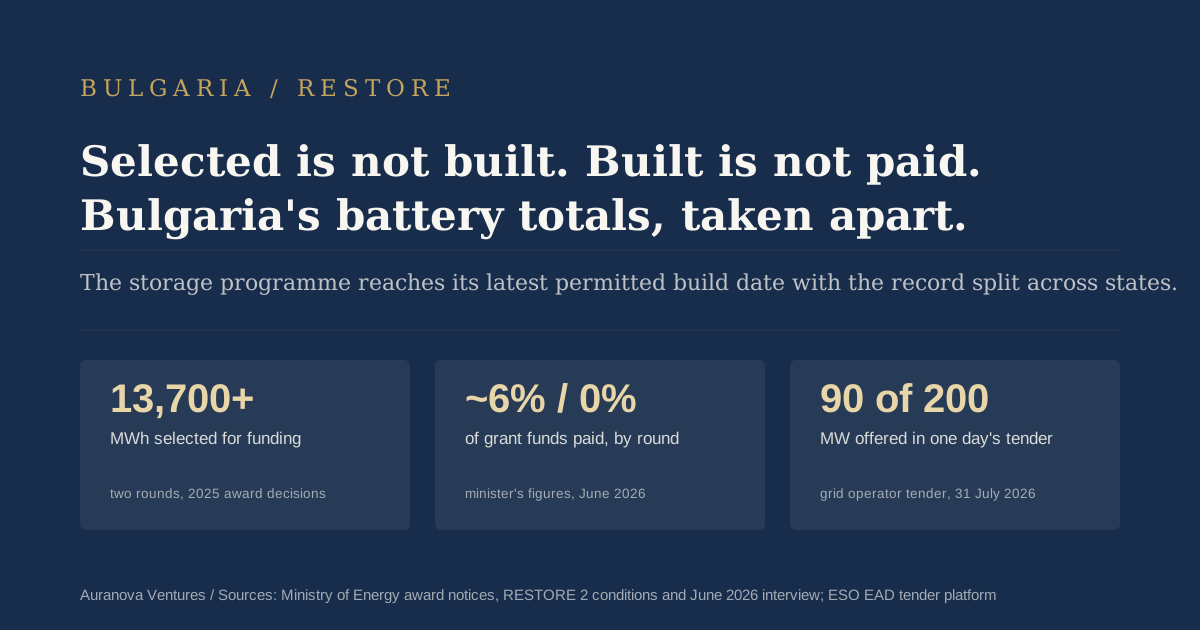
Bulgaria has selected more than 13,700 MWh of grid-scale battery storage for capital grants across two rounds of one programme. In June 2026 its energy minister put grant funds paid out at about 6 per cent for the first round and nothing for the second. The second round's latest permitted date to be built, connected and in operation is 31 July 2026. And the day before that date, the grid operator's daily tender for frequency reserves drew offers covering less than half of what it asked for.
Three names carry this piece, plus one unit distinction: MW measures instantaneous power response while MWh measures stored energy. ESO EAD is Bulgaria's transmission system operator, the buyer of these reserves. Frequency containment reserve, FCR, called primary regulation in Bulgaria, is the fast response that contains frequency deviations within seconds. Automatic frequency restoration reserve, aFRR, known in Bulgaria as automatic secondary regulation, is the slower automatic correction over the following minutes. A battery sells a product once it qualifies for that product. Qualification is per product and runs from grid-access contracts through technical tests to a signed protocol and registration as a balancing service provider.
The development
RESTORE pays capital grants for grid-scale electricity storage out of Bulgaria's National Recovery and Resilience Plan, the country's share of the EU recovery fund. It has run twice, under two procedure codes.
The first round, BG-RRP-4.034, opened in August 2024 with 1,153,939,700 leva. Bulgaria joined the euro area on 1 January 2026 at an irrevocable rate of 1.95583 leva per euro, which makes that budget 590 million euro. The round sought a minimum of 3,000 MWh of usable energy capacity. Grants were limited to 50 per cent of eligible costs and to 371,607.70 leva excluding VAT per MWh, which is 190,000 euro. In April 2025 the ministry announced awards to 82 projects totalling 1,149,013,428.49 leva against 9,712.89 MWh.
The second round, BG-RRP-4.036, is formally a scale-up of that measure. It opened in September 2025 with 230,787,940 leva (118 million euro) and sought at least 1,900 MWh through the EUMIS procedure record, the state's electronic grant-management system. For this procedure the official clarifications treat usable capacity, for application and grant-limit purposes, as equal to the installed capacity in the project's grid-connection document. The grant ceiling was cut to 156,466 leva excluding VAT per MWh, which converts to 79,999.80 euro, in effect an 80,000 euro ceiling. Applications closed at 17:00 on 19 November 2025 and 93 arrived. Evaluation concluded on 15 December and on 17 December the ministry announced 31 selected projects carrying more than 4,000 MWh, with 30 more held on a reserve list worth just over 100 million leva. The funded-project list itemises the 31 grants, which sum to 228,878,172.50 leva.
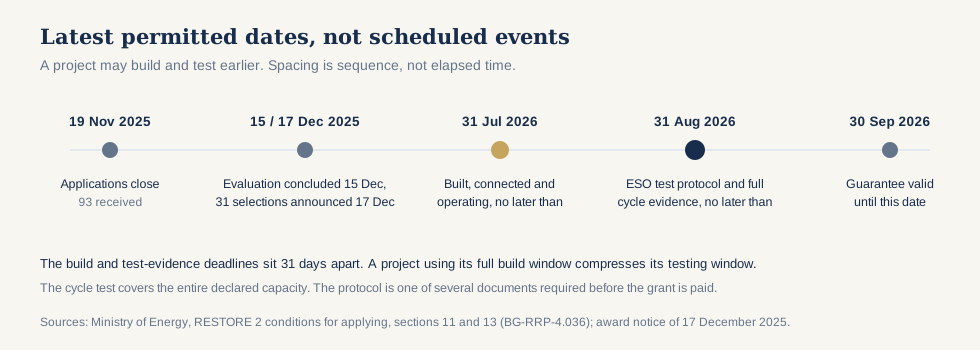
The conditions for applying set latest dates rather than a schedule. Under section 13, facilities must be built, connected and put into operation no later than 31.07.2026. No later than 31 August 2026, recipients must hand over a protocol signed with ESO EAD, the transmission system operator, evidencing passed tests for primary or automatic secondary frequency regulation, together with one full charge and discharge cycle across the entire declared capacity. The protocol is one of the documents required before the aid is paid rather than the payment trigger on its own. Under section 11, a good-performance bank guarantee worth 10 per cent of the grant must remain valid until 30.09.2026. Projects may build and test well before any of these dates. They are ceilings, not a sequence.
What it actually means
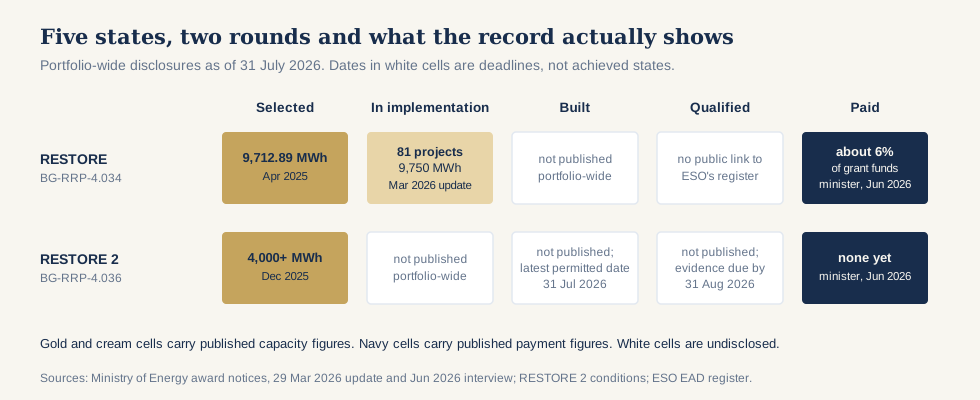
Start with the distinction the headlines blur. In a June 2026 interview, energy minister Iva Petrova put the share of grant funds disbursed under RESTORE at around 6 per cent and said no payments had yet been made under RESTORE 2. Payment lags construction because grants are reimbursed late in the process. A ministry update of 29 March 2026 reported 81 first-round projects covering 9,750 MWh in implementation, against the 82 projects and 9,712.89 MWh announced in April 2025. The ministry has not published a reconciliation of the two counts. Nor is there a portfolio-wide table stating which selected projects are contracted, built, qualified or paid. ESO publishes a register of balancing service providers with their technical parameters, but nothing public joins that register to the RESTORE award lists. We did not identify such a crosswalk in the ministry's notices, the EUMIS records or ESO's register as of 31 July 2026.
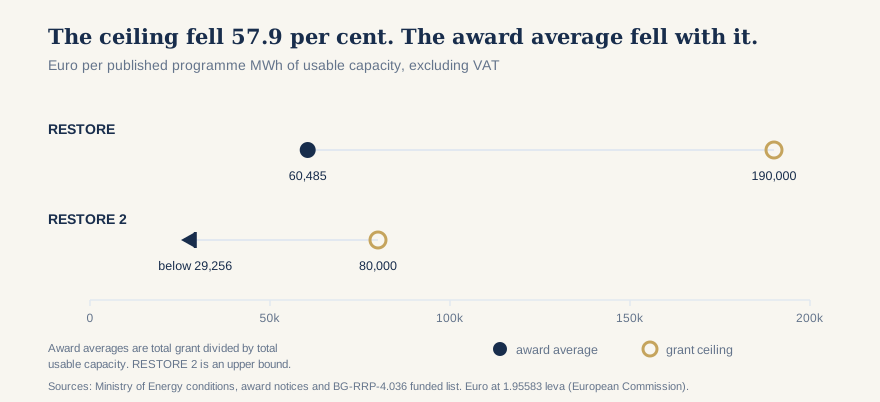
Second, the price of the policy. The ceiling fell 57.9 per cent between rounds, from 190,000 to 80,000 euro per MWh. Aggregate grant intensity came in far under both ceilings. Dividing the first round's 1,149,013,428.49 leva by its 9,712.89 MWh gives an award average near 118,298 leva per MWh, about 60,485 euro. The second round's 228,878,172.50 leva against more than 4,000 MWh puts its average below 57,220 leva, about 29,256 euro. These are volume-weighted averages of what was awarded rather than clearing prices. On that basis the average grant per MWh fell by at least half alongside the ceiling.
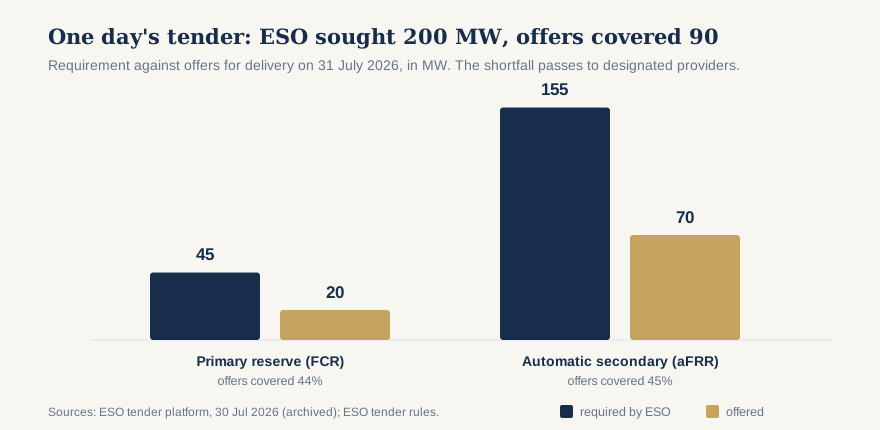
Third, the reserve tender. For delivery on 31 July 2026, ESO's daily tender (result also archived) sought 45 MW of primary reserve and was offered 20. It sought 155 MW of automatic secondary reserve and was offered 70. That does not mean the grid went short. ESO's own tender rules provide that when bids are insufficient, the operator makes up the shortfall by designating balancing service providers at the amounts and prices set under the market rules. The same rules oblige every registered provider to bid any free capacity not already committed to a schedule to sell energy. One tender is a snapshot, not a series. And the minister's interview notes that batteries have entered the system suddenly and at very large scale, so a thin tender can reflect qualification lead times, capacity committed elsewhere or product-specific capability rather than missing hardware.
The award data and the tender data meet in one piece of illustrative arithmetic, not a market model. The second-round cohort carries more than 4,000 MWh. The programme's technical annex requires at least two hours of discharge duration. A tenth of the cohort at that two-hour minimum is roughly 200 MW of response, about the size of the 200 MW ESO tendered for across both products on 31 July. At four hours the same tenth halves to roughly 100 MW. The assumptions doing the work are the share that qualifies, the duration mix and the product split. None of the three is published anywhere. That mapping, from selected MWh to qualified, product-specific MW, is the piece of work a Bulgarian reserve forecast needs. It decides whether this fleet fills the tender or floods it.
Who is affected and how differently
For a developer holding a second-round award, the binding fact is that the latest build date and the latest test-evidence date are 31 days apart. A full charge and discharge across the entire declared capacity is a commissioning programme rather than a paperwork exercise. A project that used its full permitted build window has compressed its own testing window into whatever remains.
For an investor, the diligence question is which state an asset is actually in. Selected, contracted, built, qualified and paid are five different risk positions. The award proves selection. The signed ESO protocol evidences passed tests and a completed cycle. Sustained availability still has to be shown in operation.
For anyone underwriting Bulgarian reserve revenue, the honest input today is a scenario weight rather than a point forecast. The minister describes procurement challenges and one day's tender was under-offered. The selected fleet's size makes eventual compression a live scenario once qualified capacity accumulates.
For policymakers designing storage support elsewhere, the open questions in Bulgaria's record now sit at commissioning, testing and payment rather than at selection.
What to do about it
Label every Bulgarian capacity number with its state. Selected, contracted, built, qualified or paid. Mixed states produce wrong models.
When you diligence a Bulgarian asset, request the records that separate the states: the grid-connection document behind the declared capacity, the ESO protocol by product, the commissioning permit, the payment claim status and the guarantee's validity.
Model the reserve stack in MW of qualified response against ESO's published requirements rather than in MWh of selected energy. The mapping between the two does not exist in public today.
Weight both price directions. Scarcity now and compression later are both consistent with the record. Carrying only one is a bet, not a forecast.
Where we come in
We at Auranova Ventures spend much of our week turning scheme conditions like these into a revenue stack a lender will accept, across the Nordics, the Baltics and southeast Europe. Bulgaria is a useful case because the published numbers and the bankable numbers are in different units and different states. If you are sizing a Bulgarian asset or an acquisition that leans on reserve income, reply and we will give you a second read on how much weight that line can carry.
Which state are the Bulgarian capacity figures in your own model actually counting? We read every reply.
Sources
- Bulgarian Ministry of Energy, launch of the RESTORE procedure under the National Recovery and Resilience Plan, 20 August 2024 (BG-RRP-4.034, budget 1,153,939,700 leva, minimum 3,000 MWh usable capacity, grant up to 50 per cent and no more than 371,607.70 leva excluding VAT per MWh): https://me.government.bg/news/me-startira-procedurata-nacionalna-infrastruktura-za-sahranenie-na-elektroenergiya-ot-vazobnovyaemi-iztochnici-restore-ot-npvu-3499.html
- Bulgarian Ministry of Energy, 82 projects worth almost 1.150 billion leva to be financed under RESTORE, 17 April 2025 (82 projects, 1,149,013,428.49 leva, 9,712.89 MWh usable capacity): https://me.government.bg/bg/news/82-proekta-na-obshta-stoinost-pochti-1-150-mlrd-lv-shte-badat-finansirani-po-restore-3640.html
- EUMIS (ISUN 2020, NPVU section), procedure record for BG-RRP-4.036 RESTORE 2 (opened 19 September 2025, budget 230,787,940 leva, at least 1,900 MWh, applications closed 17:00 on 19.11.2025): https://eumis2020.government.bg/bg/s/Procedure/Info/74c7fe76-9c7d-42be-bdf3-0d7613bffa37
- EUMIS, official questions and answers for BG-RRP-4.036 (usable and guaranteed capacity treated as equal to the installed capacity in the grid-connection opinion, preliminary connection contract or connection contract): https://eumis2020.government.bg/bg/s/Procedure/InfoDownload/74c7fe76-9c7d-42be-bdf3-0d7613bffa37?fileKey=645296a0-1504-4163-b9ac-38b3e28d3761
- Bulgarian Ministry of Energy, RESTORE 2 guidelines package including the conditions for applying (section 13: built, connected and in operation no later than 31.07.2026, ESO protocol on primary or automatic secondary frequency regulation plus one full charge and discharge cycle of the entire declared capacity no later than 31 August 2026; section 11: good-performance guarantee of 10 per cent valid until 30.09.2026): https://www.me.government.bg/uploads/manager/source/VOP/obshtestveno%20obsajdane/obshtestveno%20obsajdane/Restore2/Nasoki%20za%20kandidastvane_RESTORE%202.zip
- Bulgarian Ministry of Energy, evaluation concluded and 31 projects announced under RESTORE 2, 17 December 2025 (93 proposals, evaluation concluded 15 December, more than 4,000 MWh, 30 reserve-list projects worth just over 100 million leva): https://www.me.government.bg/news/31-proekta-na-stoinost-blizo-229-mln-lv-shte-badat-finansirani-po-procedurata-restore-2-3741.html
- Bulgarian Ministry of Energy, list of funded proposals under BG-RRP-4.036 (31 grants summing to 228,878,172.50 leva): https://www.me.government.bg/uploads/manager/source/VOP/NPVU/spisaci/1.Spisuk-finansirani-BG-RRP-036.pdf
- Bulgarian Ministry of Energy, interview with Minister Iva Petrova, June 2026 (about 6 per cent disbursed under RESTORE, no payments yet under RESTORE 2, challenges in procuring volumes of primary and automatic secondary regulation reserve): https://www.me.government.bg/bg/interviews-detail-team-506-39.html
- Bulgarian Ministry of Energy, update of 29 March 2026 (81 RESTORE projects covering 9,750 MWh in implementation): https://me.government.bg/bg/news/stotici-aneksi-za-dni-ministar-traikov-podpisa-nad-160-dopalnitelni-sporazumeniya-za-stotici-milioni-evro-po-pvu-3801.html
- ESO EAD, tender platform result for delivery on 31 July 2026, auction concluded 30 July 2026 (primary regulation reserve requirement 45 MW against 20 MW offered, automatic secondary reserve requirement 155 MW against 70 MW offered; dated results are retrievable via the platform's tender archive; an archived copy of the result is kept at the Wayback Machine): https://webapps.eso.bg/tendappl/PArhTend , archived copy: https://web.archive.org/web/20260730230850/https://webapps.eso.bg/tendappl/
- ESO EAD, tender rules for procuring FCR, aFRR and mFRR (insufficient bids: the operator makes up the shortfall by designating balancing service providers per Art. 114(2) of the market rules; qualification procedure for providers): https://webapps.eso.bg/tendappl/ViewPr0e.aspx
- ESO EAD, register of balancing service providers: https://webapps.eso.bg/tendappl/PShowInitData
- European Commission, Bulgaria and the euro (euro area membership from 1 January 2026, irrevocable conversion rate of 1.95583 leva per euro): https://economy-finance.ec.europa.eu/euro/eu-countries-and-euro/bulgaria-and-euro_en
- Bulgarian Ministry of Energy, RESTORE 2 guidelines, Annex 8 minimum technical requirements (minimum discharge and charge duration of 2 hours at nominal power, round-trip efficiency above 80 per cent at C/2): included in the guidelines package linked above