Cheaper to Cycle, Dearer to Subscribe: Sweden's 2027 Grid Numbers Land
8 October 2026 · 8 min read · Auranova Ventures
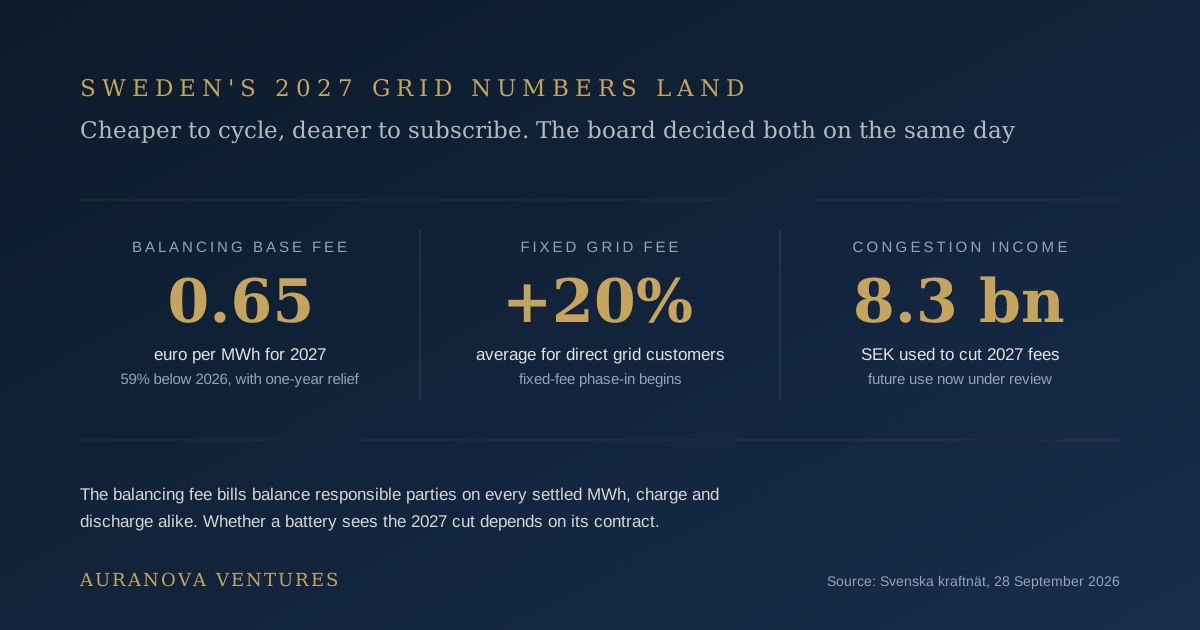
On 28 September Svenska kraftnät's board fixed the price lists we told readers to wait for. Three numbers matter for storage: the base fee every balance responsible party (the company answerable for keeping its customers' production and consumption in balance) pays falls to 0.65 euro per MWh for 2027, down 59 percent; the fixed fee for customers connected directly to the transmission grid rises about 20 percent on average; SEK 8.3 billion of congestion income, the operator's bottleneck earnings, softens the rest. The first reaches a battery only through its balance responsible party's contract; the second lands only on directly connected assets. One decision moved both.
The development
Svenska kraftnät, the Swedish transmission system operator, warned in September 2025 that its power fee would have to rise from 2027 and approved a rebuilt fee model in February 2026. On 28 September it set the 2027 numbers, in force from 1 January.
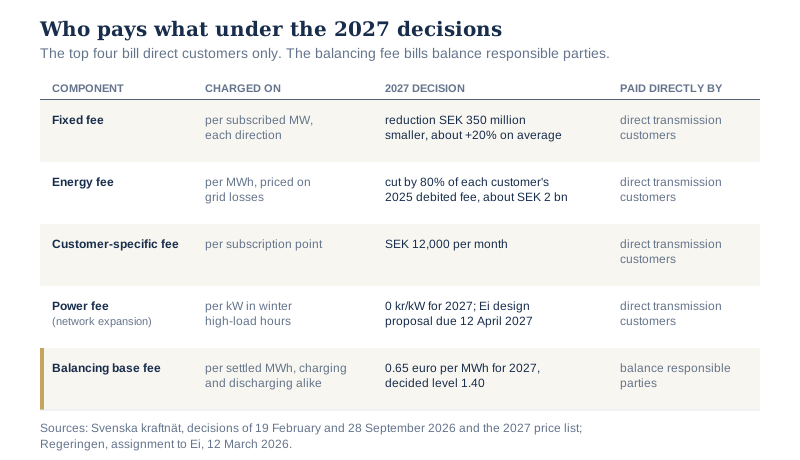
Two price lists were decided. The first prices use of the 400 kV and 220 kV transmission grid. Only directly connected customers (regional network companies, large producers and any battery connected directly to it) pay it; everyone else meets it second-hand through their network company. From January it has four components: a fixed fee per subscribed MW, an energy fee per MWh priced on grid losses, a customer-specific fee of SEK 12,000 per month per subscription point for metering and settlement and a network-expansion power fee on capacity in winter high-load hours. The congestion-funded reduction on the fixed fee shrinks by about SEK 350 million, a rise of about 20 percent on average for the customer collective, varying by location and by whether the subscription is for injection (feeding power in) or offtake (drawing power out). The energy fee is cut by an amount equal to 80 percent of each customer's energy fee debited for 2025, about SEK 2 billion in total. That power fee stays at 0 kr/kW at every connection point for 2027.
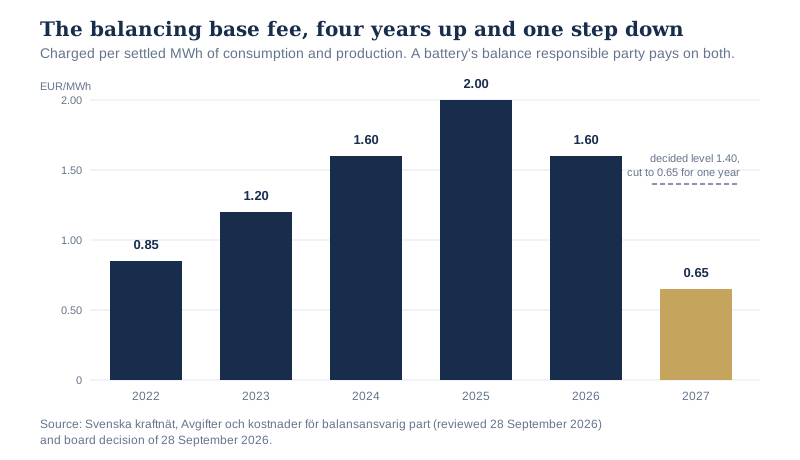
The second list is the fees for balance responsible parties. Every settled asset needs one, its own or contracted; batteries are no exception. The base fee, which funds the operator's balancing overheads, is cut 13 percent to 1.40 euro per MWh on lower forecast costs, then temporarily reduced a further 54 percent to 0.65 euro per MWh for 2027 because balancing costs in 2025 and 2026 came in below expectations. The imbalance fee stays at 1.15 euro per MWh and the weekly fee at 30 euro per week.
A companion notice totalled the softening: just over SEK 8.3 billion of congestion income (collected when prices differ between bidding zones) reduces 2027 charges for directly connected customers, just over 6.3 billion on the fixed fee and just over 2 billion on the energy fee.
What it actually means
The base fee is the quiet line in this decision and, for a battery outside the transmission grid, the only one of these lines that can reach it directly. It is charged on a balance responsible party's settled consumption and production volumes, the MWh attributed to it after delivery in the Nordic imbalance settlement. A battery is both: under the Nordic settlement rules Swedish storage charging and discharging are reported separately, not netted, so the fee falls on full throughput, twice over per cycle. In the revenue stacks we model (a battery's income and cost lines) it usually hides inside the balancing-service agreement; owners rarely see it itemised.
The arithmetic deserves daylight. Illustratively, a 100 MW two-hour battery cycling fully once a day, every day, settles about 146,000 MWh a year across both directions, treating charge and discharge as equal at the meter and ignoring losses and downtime. At the 2026 fee of 1.60 euro per MWh that is roughly 234,000 euro a year. At 0.65 it is roughly 95,000 euro. The step is worth about 139,000 euro a year to whoever captures it. That is the point: Svenska kraftnät charges the balance responsible party, not the battery, so the agreement decides whether the saving reaches the asset. The volumes are ours as a worked example; the fees are Svenska kraftnät's.
The history gives the step its scale: 0.85 euro per MWh in 2022, 2.00 by 2025, 1.60 for 2026, now 0.65. Svenska kraftnät attributes the cuts to a lower forecast cost level and balancing costs coming in under budget, nothing more specific. The operator does not say which costs fell and we do not guess. What is certain is narrower. The 0.65 lasts one year, the decided level is 1.40 and any 2028 fee is a fresh decision, not yet made.
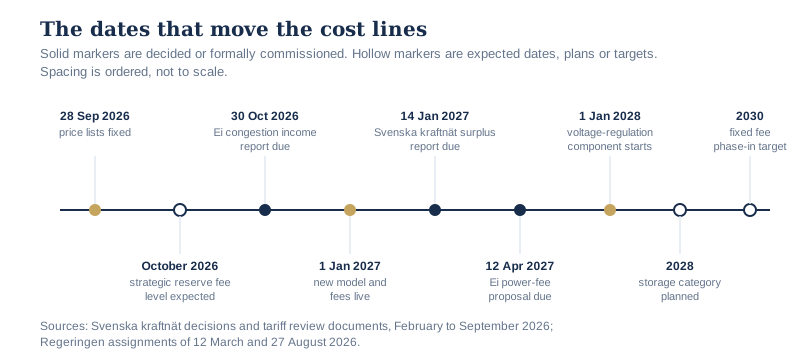
On the grid-fee side the direction was already public; now it has a size. The 20 percent average rise follows from how low congestion income holds today's fee: even a SEK 350 million smaller reduction moves the average that much. Svenska kraftnät says plainly that room for reductions will shrink as its investment programme runs and that the fixed fee will step back toward full cost coverage. The 2027 cushion is decided; its future is formally in play. The regulator Energimarknadsinspektionen reports on congestion income by 30 October 2026 and Svenska kraftnät must report expected surpluses for 2027 to 2031 and propose alternative uses by 14 January 2027. Neither report changes a fee by itself; both feed the decisions that will. So does the power fee: the zero holds for 2027 while Energimarknadsinspektionen owes the government a new power-fee design proposal by 12 April 2027. A proposal is not a price; our view is that the next price will be argued from it.
Who is affected and how differently
Developers should split the thesis by connection point. The cycling line falls as far as the balancing-service agreement passes it through. Only a transmission-connected asset faces the 20 percent average fixed-fee rise directly; it also books the new SEK 12,000 monthly point fee and the zero power fee. A battery on a regional or local network inherits whatever its network company passes on. Same decision, three different invoices.
Investors and lenders should read the 2027 fee lines as one-year decisions, not run rates. The 0.65 expires after one year, the power-fee zero has a design proposal due in April and the congestion cushion has two reports hanging over it. A debt case that extends 2027 operating costs forward is quietly optimistic on three lines at once.
Balance responsible parties and the utilities running them face a pass-through question: the cut is public and clients will ask for it. Separately, the strategic reserve surcharge (the fee funding Sweden's reserve of last-resort capacity) applies to weekday daytime winter consumption in bidding zones SE3 and SE4. Last winter it was 0.00 euro per MWh; the new level comes in October, pending a decision on a new reliability standard (how many hours a year supply may be expected to fall short of demand). Charging is settled consumption, so batteries cycling daytime in the south should watch that number.
Policymakers get a live experiment in what congestion income is for, with two report deadlines to shape it.
What to do about it
- Reopen the balancing-service agreement before January. The base fee falls 59 percent year on year; if the per-MWh pass-through does not move, the saving stays with the balance responsible party.
- Model 2027 as the cheap year on the fee lines. Stress 2028 on the underlying 1.40 euro per MWh (no 2028 fee exists yet), an undesigned power fee and a smaller cushion before credit committee asks.
- In SE3 or SE4, check charging patterns against the surcharge window (weekdays 06:00 to 22:00, 16 November to 15 March) when the October level lands.
- Transmission-connected owners: existing summaabonnemang (one subscription spanning several connection points) expire on 31 December and the annual subscription may not sit below contracted connection capacity, bar a staged-connection exception. Confirm each direction's subscribed MW now.
- Keep a line open for the storage customer category planned for 2028. Its design is being settled now and for transmission-connected assets it is the biggest open variable in the Swedish grid-fee stack.
The read that matters
In September we wrote that the open questions in Sweden's rebuilt grid fee were worth more than the settled ones. The board has now settled the prices and left the questions. The 2027 lists are kind to storage costs; the kindness rests on one-year decisions and a cushion under review. The figures are Svenska kraftnät's, the reading of what is temporary is ours. It is the kind of question we at Auranova Ventures work through with developers and investors across the Nordics, Baltics and wider Europe. If your Swedish model carries one grid-fee line through 2030, reply and we will help split it.
If the one-year reductions are not renewed, will your revenue stack notice before your lender does?
Sources
- Svenska kraftnät, Beslutad transmissionsnätsavgift och avgifter för balansansvariga parter 2027, 28 September 2026: https://www.svk.se/press-och-nyheter/nyheter/elmarknad-allmant/2026/beslutad-transmissionsnatsavgift-och-avgifter-for-balansansvariga-parter-2027/
- Svenska kraftnät, Svenska kraftnät använder flaskhalsinkomster för att minska avgifter med 8,3 miljarder kronor, 28 September 2026: https://www.svk.se/press-och-nyheter/nyheter/allmanna-nyheter/2026/svenska-kraftnat-anvander-flaskhalsinkomster-for-att-minska-avgifter-med-83-miljarder-kronor/
- Svenska kraftnät, Transmissionsnätsavgiften 2027, avgift och prislistor, overview page (customer-specific fee, energy-fee mechanism, power fee 0 kr): https://www.svk.se/aktorsportalen/anslut-till-transmissionsnatet/transmissionsnatsavgiften/avgift-prislistor-avtal-abonnemang/
- Svenska kraftnät, Nyttjandeavtalet 2027, bilaga 3 (subscription floor and staged-connection exception): https://www.svk.se/4a46cf/siteassets/2.utveckling-av-kraftsystemet/systemansvar-o-elmarknad/tariffoversyn/bilaga-3---nyttjandeavtalet-2027.pdf
- Svenska kraftnät, Avgifter och kostnader för balansansvarig part (fee levels 2022 to 2027 and strategic reserve surcharge), reviewed 28 September 2026: https://www.svk.se/aktorsportalen/balansansvarig-part/avgifter-och-kostnader/
- Svenska kraftnät, Ny modell för transmissionsnätstariffen, 3 March 2026: https://www.svk.se/press-och-nyheter/nyheter/allmanna-nyheter/2026/ny-modell-for-transmissionsnatstariffen/
- Svenska kraftnät, Översyn av transmissionsnätstariffen, final report Svk 2023/2237, 19 February 2026: https://www.svk.se/492b56/siteassets/2.utveckling-av-kraftsystemet/systemansvar-o-elmarknad/tariffoversyn/slutrapport_ny-tariffmodell_v0.pdf
- Svenska kraftnät, Beslutad transmissionsnätstariff och avgifter för balansansvariga parter 2026, 30 September 2025: https://www.svk.se/press-och-nyheter/nyheter/allmanna-nyheter/2025/beslutad-transmissionsnatstariff-och-avgifter-for-balansansvariga-parter-2026/
- Regeringen, Uppdrag till Affärsverket svenska kraftnät att redovisa årliga överskott av flaskhalsinkomster samt föreslå användningsområden för dessa, decided 27 August 2026, published 23 September 2026: https://www.regeringen.se/regeringsuppdrag/2026/09/uppdrag-till-affarsverket-svenska-kraftnat-att-redovisa-arliga-overskott-av-flaskhalsinkomster-samt-foresla-anvandningsomraden-for-dessa/
- Regeringen, Uppdrag till Ei att upphäva föreskrifter och lämna förslag om ny utformning av effektavgifterna, 12 March 2026: https://www.regeringen.se/contentassets/353c232c163b4b15922706f7ee385747/uppdrag-till-energimarknadsinspektionen-att-upphava-foreskrifter-och-lamna-forslag-om-en-ny-utformning-av-effektavgifterna.pdf
- eSett, Nordic Imbalance Settlement Handbook (settlement of consumption and production volumes): https://www.esett.com/handbook/
- Auranova Ventures, Sweden Rewired the Grid Fee. The Battery Line Is Still Being Written, 15 September 2026: https://www.auranova.io/insights/sweden-transmission-tariff-rebuild-2027