Romania's 150 Million Euro Storage Auction Turns on One Number
20 August 2026 · 9 min read · Auranova Ventures
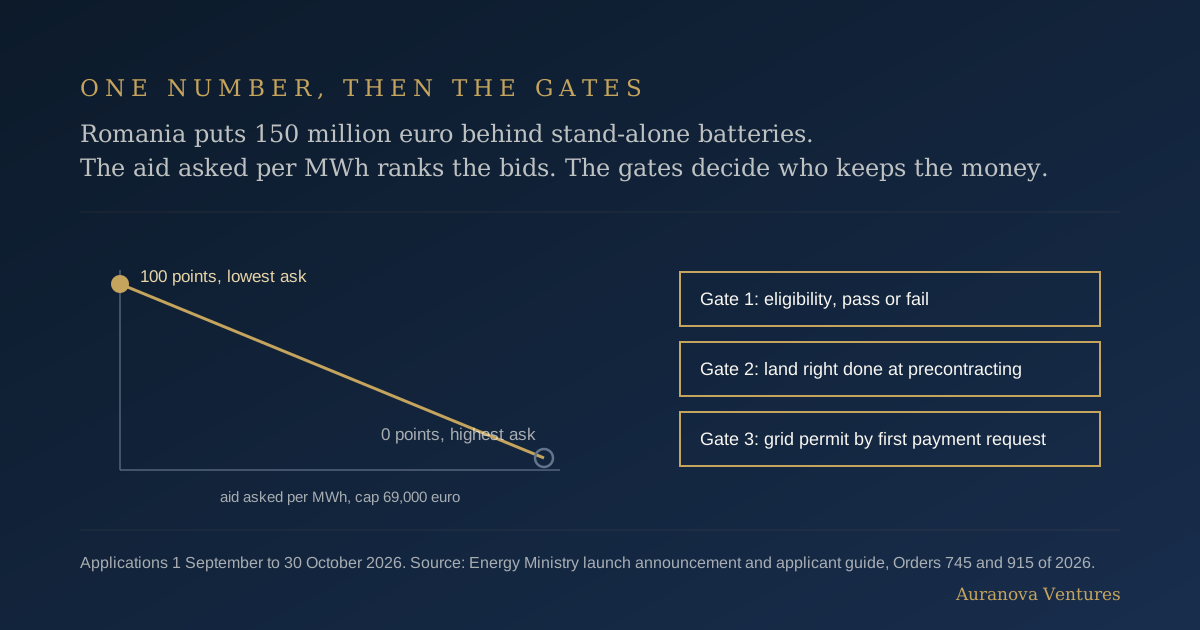
Romania's Energy Ministry approved the final rulebook for its 150 million euro stand-alone battery programme on 14 August. Applications open on 1 September at 12:00 and close on 30 October at 14:00. One number ranks them: the state aid requested per megawatt hour of storage installed, capped at 69,000 euro. The lowest asks top the list until the budget is spoken for. Pass or fail gates then decide who converts a place into money. The window is two months. The number takes longer to get right.
The development
The European Commission approved the scheme on 6 March 2026 under state aid case SA.121308, Romania's first under CISAF, the Clean Industrial Deal State Aid Framework the Commission adopted on 25 June 2025 for clean-energy state aid. The national aid scheme followed as Energy Ministry Order 745 of 16 July 2026, gazetted 27 July. The applicant guide, which sets the auction mechanics, was approved by Order 915 on 14 August and gazetted 17 August, the order in issue 680 and the guide itself in 680 bis.
The money is a grant: 150 million euro of non-repayable funds from the Modernisation Fund, the EU fund built on emissions trading revenues for 13 lower income member states. Eligible projects are new stand-alone battery installations: their own connection to the transmission or distribution grid at any voltage level, their own metering and no integration with a production or consumption site. The ministry's November 2024 Modernisation Fund call funded batteries bolted to existing renewable plants, required to absorb at least 75 per cent of their energy each year from the plant next door. This call funds the battery as its own grid asset.
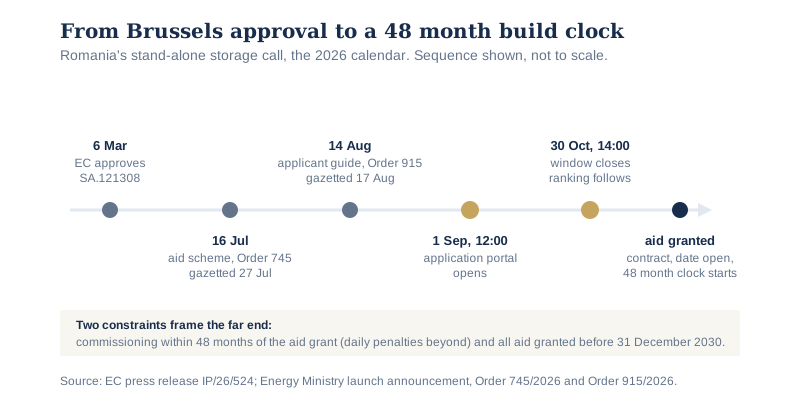
The formal entry thresholds sit low; the documentation behind them does not. Minimum 1 MW of installed power; in a project built from several aggregated units each installation must itself clear 1 MW. At least a 2:1 ratio of storage capacity to power, energy held in MWh against the MW it can charge or discharge at, equal to at least two hours of discharge at rated power. Any company size qualifies, down to newly founded vehicles with 100,000 lei of paid-in capital, provided the constitutive act covers electricity production and sale under CAEN division 35, Romania's power-sector activity class. Partnerships are excluded. The ceilings: 69,000 euro of aid per MWh installed, 15 million euro per enterprise and aid intensity, the share of eligible costs the grant may cover, of up to 100 per cent. Linked companies count as one economic unit, so the 15 million cannot be multiplied through sister vehicles. Winners must commission within 48 months of the aid being granted: 0.01 per cent daily penalties beyond that, full recovery of the aid with interest if the investment is never completed under the contract. Under CISAF all aid must be granted before 31 December 2030.
What it actually means
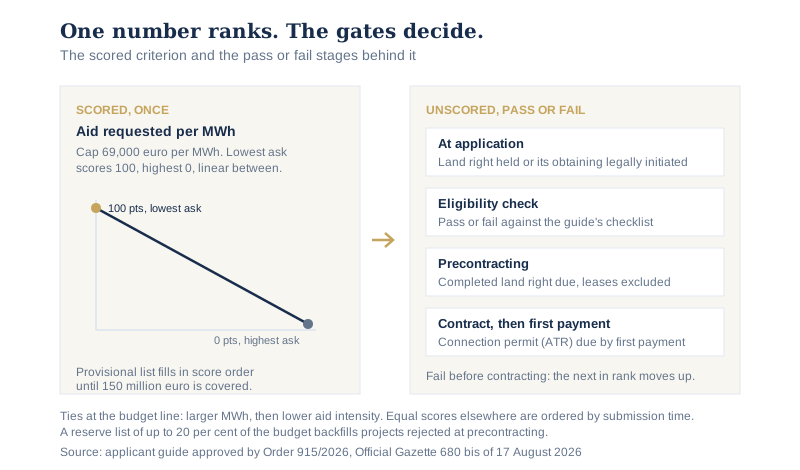
The scored part of this competition is a reverse auction with one bid variable. The evaluation grid gives 100 points to the lowest requested aid per MWh, zero to the highest and a straight line in between. Applications enter a provisional list in score order until the 150 million euro is covered. Ties at the budget line go to the larger project in MWh, then to the lower aid intensity; equal scores elsewhere are ordered by submission time.
The provisional list is exactly that. Behind it sit unscored pass or fail gates: administrative and eligibility checks, a precontracting stage with its own deadlines, then the financing contract. Fail before contracting and the next in rank moves up; the 20 per cent reserve list exists precisely for rejections at precontracting. Fail after contracting and the sanction is termination, with aid already paid recovered. One number ranks the list. The gates decide who keeps a place on it.
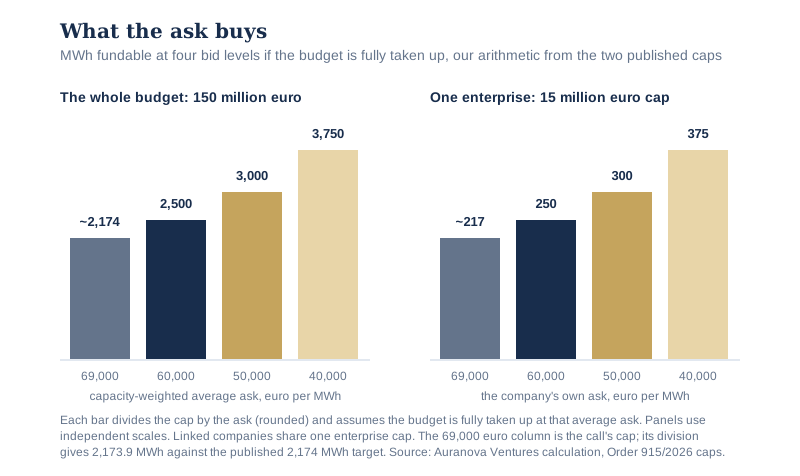
The arithmetic behind the headline target is simple. Divide the 150 million euro budget by the 69,000 euro cap and you land within a megawatt hour of the programme's stated minimum: 2,173.9 against a published target of 2,174 MWh. In effect, the target is what the budget buys at asks near the cap. If the budget is fully taken up at lower asks, the same money funds more storage: 3,000 MWh at a capacity-weighted average winning ask of 50,000 euro per MWh. The same division sets an enterprise's maximum fundable size, roughly 217 MWh at the cap but 300 MWh at 50,000 euro. Bidding lower raises more than your odds: it raises how much of your portfolio the grant can touch, at the price of a wider funding gap of your own. Two precisions. Compression is a scenario, not a certainty: if eligible demand is thin, budget goes unspent and the cap, not competition, sets the asks. And euro per MWh is a ranking ratio and a ceiling, not how money moves; aid is disbursed in lei, with an optional advance (prefinancing) of up to 20 per cent and payment or reimbursement requests against eligible costs.
Then there is the clause that shapes who shows up. The ATR, Romania's technical connection approval, the operator's written sign-off on a project's connection conditions, is not required at submission, nor at contracting. It is due by the first payment request, on pain of contract termination. Land is staged too: at application a project may file either a completed real right over the site (ownership, concession, administration or superficies, a right to build on another's land; leases never qualify) or proof that it has legally initiated obtaining one, with the completed right due at precontracting. So the bidder pool can include projects that hold neither finished land rights nor grid access. Our read cuts both ways: the wider field presses asks down and loads the list with projects that may never convert. We wrote in July about Romania's capacity auctions, which Transelectrica runs annually for generation and storage sites of 5 MW and above. Its procedure does not wait for this call: entry applications for the first round closed on 14 July and daily bidding starts on 30 October for projects already qualified. A grant applicant below 5 MW connects outside that regime; a larger one that missed July queues for the next annual round. You can win the money without the grid. You cannot collect it.
Who is affected and how differently
For developers with mature projects, land secured and a credible ATR path, the rules work in your favour. The ranking rewards exactly one thing you control: how little aid your business case needs.
For developers with early-stage sites, the open door is also a trap. A win without a completed land right at precontracting passes to the next in rank; a contract without an ATR by the first payment request ends in termination and clawback.
For investors, the read is portfolio-level. The programme target is 2,174 MWh of new capacity on a 48 month runway; lower asks would fund more, a thin field less. Selection is not commissioning. But the guide obliges winners to pursue balancing market qualification (the real-time market where the system operator buys flexibility), which on our read points the new fleet at the revenue pools existing assets trade in. When we model a Romanian revenue stack, the sum of a project's income streams across energy and system services, the grant is the easy line. The hard line is pricing the neighbours the grant creates.
For utilities and traders, the pipeline is the point. Stand-alone assets have no plant next door to trade through; each needs market access, in-house or contracted. Winners without a trading desk will be shopping for offtake (a committed buyer), tolling (renting out the battery's capacity) or optimisation partners inside those 48 months.
For policymakers, Romania is running the experiment Bulgaria just finished a round of. Bulgaria's ministry ranked 31 RESTORE 2 projects in December 2025; in our July analysis of that programme we traced how a build deadline just months out left selected, built and paid as three different numbers. Romania's 48 month window gives winners the time Bulgaria's second round never had.
What to do about it
- Derive the bid from the revenue stack, not from the cap. Model the project's internal rate of return across asks from 69,000 euro downwards and find where the grant stops repairing the case. That walk-away number should exist before September, not be improvised in MySMIS2021, the application platform, in late October.
- Size against the 15 million euro enterprise cap, remembering linked companies share it. Choose between maximum MWh at a lower ask or a smaller project with a fatter grant per MWh. The 2:1 ratio is a floor; more MWh means more total aid only until the enterprise cap binds.
- Map the grid route before bidding. Below 5 MW you connect outside the capacity-auction regime. At 5 MW and above capacity is auctioned annually; the first round's entry closed on 14 July, so a project not already in queues for the next round and its participation guarantee of about 20,000 euro per MW. A funding bid without a dated route to an ATR is a liability.
- Stage the land paperwork to the gates: the filed initiation of a real right can carry the application, but the completed right is due at precontracting and leases never count. Prepare the DNSH file early (do no significant harm, the EU's environmental screening test).
- If you land just below the line, stay engaged: the reserve list runs to 20 per cent of the budget and precontract rejections promote the next in rank.
Related insight
- Romania just made grid access an auction, our July piece on the Transelectrica capacity auctions this call now interlocks with.
- Bulgaria selected 13,700 MWh of batteries for grants, our piece on why selected, built and paid are three different numbers.
Where this lands in the model
A one-number ranking sounds simple and is anything but: the number compresses your capital cost curve, your revenue stack, your grid timeline and your exposure to the winner's curse, which in a subsidy auction means winning by asking for less support than the project turns out to need, into a single euro figure per MWh. This is the kind of question we at Auranova Ventures work through with developers and investors across the Nordics, Baltics and wider Europe. Romania's autumn calendar makes it a this-quarter question. If you are weighing a bid, reply and we will compare notes on how we are modelling the ask.
What number would your Romanian project bid and what does it assume about everyone else's? We read every reply.
Sources
- European Commission, press release IP/26/524, Commission approves 150 million euro Romanian State aid scheme for electricity storage, 6 March 2026: https://ec.europa.eu/commission/presscorner/detail/en/ip_26_524
- Romanian Ministry of Energy, call launch page with the state aid scheme (Order 745/16.07.2026, Official Gazette 610 of 27 July 2026), the launch announcement and the applicant guide (Order 915/14.08.2026, Official Gazette 680 bis of 17 August 2026): https://energie.gov.ro/lansare-apel-sprijinirea-investitiilor-in-dezvoltarea-instalatiilor-autonome-stand-alone-de-stocare-in-baterii-a-energiei-electrice-cu-finantare-din-fondul-pentru-modernizare-p/
- Romanian Ministry of Energy, launch announcement PDF with the call parameters: https://energie.gov.ro/wp-content/uploads/2026/08/Anunt-lansare-apel-proiecte-STOCARE-STAND-ALONE_final.pdf
- Applicant guide as published in Official Gazette 680 bis of 17 August 2026 (ranking grid, tie-breakers, reserve list, land-right staging, ATR timing, penalties, payment mechanics): https://energie.gov.ro/wp-content/uploads/2026/08/Anexa_OME_915_2026_Ghid-solicitant_stand-alone_publicat_M-Of_680-Bis.pdf
- Romanian Ministry of Energy, November 2024 call for co-located battery storage (the 75 per cent absorption rule): https://energie.gov.ro/ministerul-energiei-anunta-lansarea-unui-nou-apel-de-150-de-milioane-de-euro-pentru-investitii-in-stocare-in-baterii/
- Transelectrica, grid capacity allocation procedure, June 2026 update (daily bidding sessions from 30 October 2026): https://www.transelectrica.ro/documents/10179/22805497/Procedur%C4%83%20privind%2Balocarea%2Bcapacit%C4%83%C5%A3ii%2Bre%C5%A3elei%2Belectrice%2Bactualizat%C4%83_iunie%2B2026.pdf/a169cf30-2534-4d75-80dd-cc52d86dc9e3
- European Commission, Modernisation Fund overview (financing and beneficiary member states): https://climate.ec.europa.eu/areas-action/eu-funding-climate-action/modernisation-fund_en
- Bulgarian Ministry of Energy, RESTORE 2 award notice, 31 projects selected, 17 December 2025: https://www.me.government.bg/news/31-proekta-na-stoinost-blizo-229-mln-lv-shte-badat-finansirani-po-procedurata-restore-2-3741.html