Kraftlyftet Can Co-Fund Your Battery. Read the 75 Per Cent Rule Before You Count On It.
28 July 2026 · 8 min read · Auranova Ventures
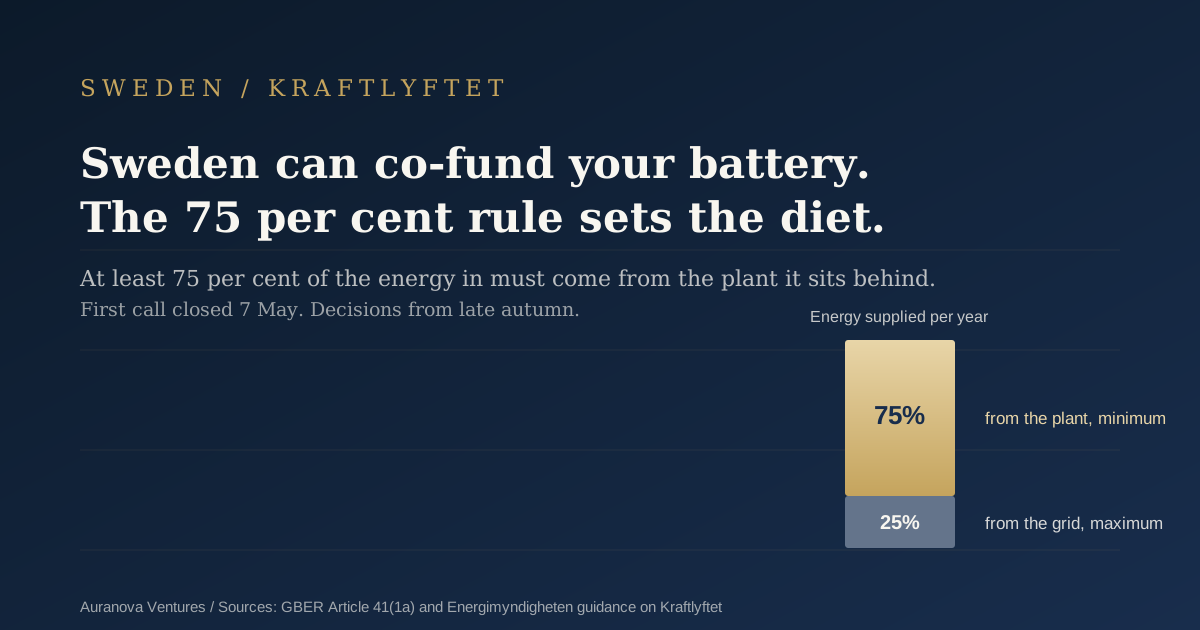
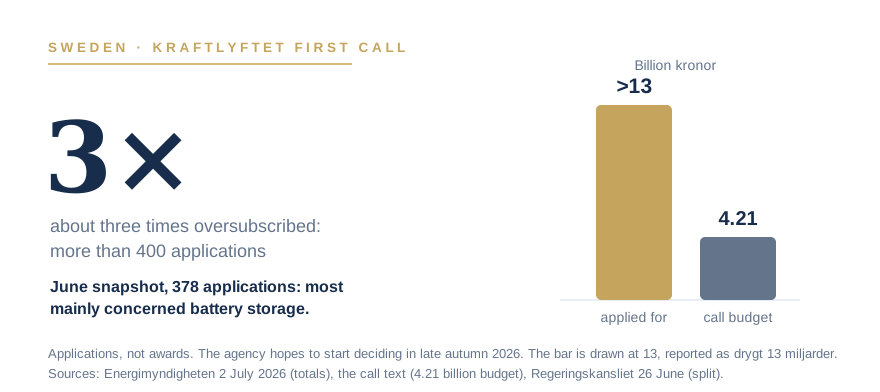
Sweden's first Kraftlyftet call closed with more than 400 applications seeking just over 13 billion kronor, about three times the 4.21 billion on offer. In the government's June snapshot most applications were mainly new battery storage. The agency hopes to start deciding in late autumn. Before then every applicant should reread one clause. The battery must sit inside a renewable plant's own connection and at least 75 per cent of the energy it takes in each year must come from that plant. That diet is the first thing to model.
The development
Kraftlyftet is Förordning (2025:1487), Sweden's investment support for security of supply in the electricity system, in force since 13 January 2026. The Swedish Energy Agency runs it. Electricity storage is on the eligible list under one storage-specific condition: "om lagringsanläggningen är direkt ansluten till en anläggning för produktion av förnybar el". Only if the storage facility is directly connected to a facility producing renewable electricity.
The first call opened on 26 February 2026 with 4.21 billion kronor. Storage and most other categories closed on 7 May, while the bioenergy combined heat and power categories had until 1 July. The agency reported the result on 2 July: "fler än 400 ansökningar" seeking "drygt 13 miljarder kronor". The government's June snapshot said around a third of the 378 applications concerned new production capacity while the rest were mainly new battery storage. This piece describes that call's rules; whether a later one comes, on what budget and under which rules, is not settled. At the 2 July report awards had not been made. On timing: "vår förhoppning är att vi kan börja fatta beslut under sen höst 2026", a hope to start deciding in late autumn.
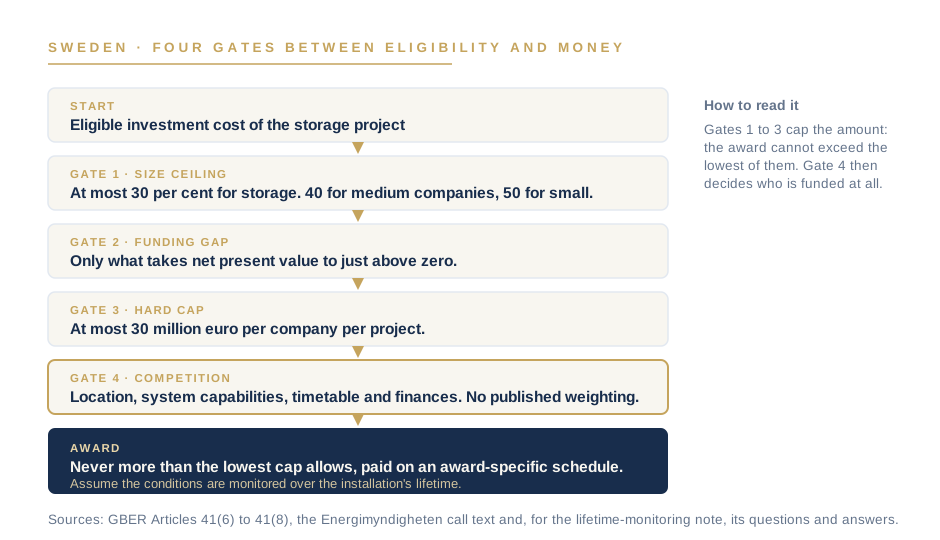
Eligibility is not entitlement. The call text caps aid twice: a size-dependent ceiling (30 per cent of eligible cost for storage, rising to 40 or 50 for medium and small companies) and never more than the gap that takes the project's net present value to just above zero. Net present value is the project's lifetime cash flows valued in present-day money. Which operating case goes into that calculation, diet-constrained or free, is not spelled out. Ask before you assume. Applications then compete on assessment criteria without a published weighting: strategic location, with the southern price areas flagged, contribution to system capabilities such as the reserve markets (standing balancing capability the operator buys), a credible timetable and the applicant's finances. A company can get at most 30 million euro per project.
Where the 75 per cent rule comes from
Kraftlyftet runs on the EU's General Block Exemption Regulation (GBER), the rulebook that lets a government grant state aid without negotiating approval from the European Commission first. The price of that speed is that the scheme must stay inside GBER's conditions, with Sweden's award tests on top.
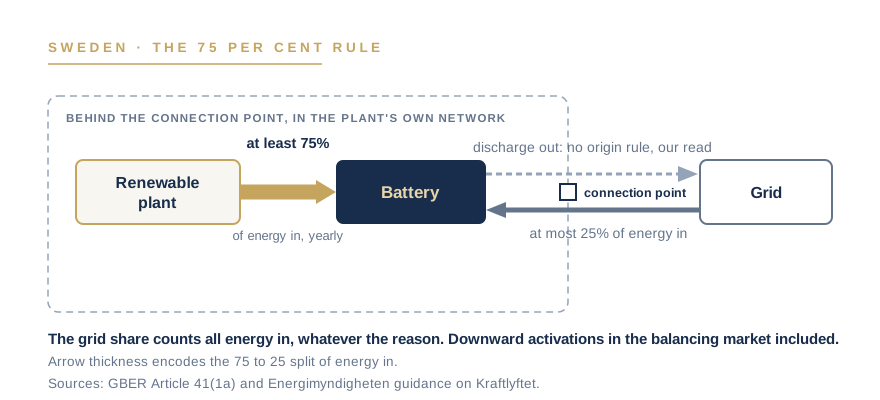
For batteries the operative text is Article 41(1a). Aid for electricity storage is exempt only for "combined renewable and storage projects (behind-the-meter)", either built together as a single investment or where storage is added to an existing renewable plant. Behind the meter means on the plant's side of the grid connection point, inside the plant's own internal network. Then the sentence that matters most: "The storage component shall absorb at least 75 % of its energy from directly connected renewable energy generation installation, on an annual basis."
The Swedish Energy Agency's guidance turns that into operating instructions. At most 25 per cent of the energy supplied to the battery may come from the grid in a year. The test counts energy supplied, so grid power counts whatever the commercial reason. The agency confirms this includes charging drawn from the grid during downward activations in the balancing market, where the system operator buys rapid adjustments. The guidance adds that batteries should be at least 1 MW, though smaller projects can argue their case. The size-dependent ceilings trace to GBER: 20 extra points for small companies, 10 for medium-sized.
What it actually means
A merchant revenue model, one built on market income alone, assumes freedom of diet: the asset charges wherever power is cheapest, from the grid at negative prices or from its own plant when generation is strong. Cheap grid hours are the raw material of arbitrage, the trade of buying power cheap to sell it dear. The 75 per cent rule caps that raw material at a quarter of the battery's annual intake.
The cap binds energy in, not revenue lines directly. Payments for standing ready in the reserve markets are capacity payments, calculated for accepted bids "independent of any energy activation" in Svenska kraftnät's words. The regulation is silent on discharge; our read is that no origin test applies going out. What it squeezes is what fills the battery from the grid: bargain-hour charging and downward activations share the 25 per cent allowance. Managing the charge level under the cap can also change how capacity is offered.
As an illustration: a 10 MW two-hour battery cycling once a day takes in roughly 7 GWh a year. Under the rule at most about 1.8 GWh may come from the grid. Losses, usable capacity and availability move both numbers. Whether the allowance is generous or tight depends on the battery's job. A reserve-led battery cycling little may barely notice the cap. A high-throughput trading battery feels it first. The call is open about intent: it supports storage with characteristics, extended endurance its example, that do not arise for market reasons. The site-by-site question, how much margin the constrained dispatch (the hour-by-hour plan for charging and discharging) gives up against the aid, is what we model. The figures are the scheme's and the market's; the reading of them is ours.
The aid is not a lump sum either. The call text sets ceilings, with each award fixing its own plan: at most 20 per cent in advance, at most 30 per cent during the build and the rest payable annually for up to seven years. The diet is the longer commitment: the agency has not decided how long it will monitor the conditions and tells applicants to assume the installation's lifetime.
The rule is not Swedish, which is why it travels: any member state building battery investment aid on GBER Article 41, as that article stands today, inherits the same behind-the-meter and 75 per cent conditions.
Who is affected and how differently
Owners of operating wind and solar plants hold the best opening hand: Article 41(1a) explicitly covers storage added to an existing plant, so a retrofit battery on a site they control can qualify. Whether the hand wins depends on spare capacity in the connection, how the site is wired and plant-to-battery sizing.
Developers of standalone grid-connected batteries are outside this scheme. Kraftlyftet changes their competitive landscape rather than their financing: part of the battery build will gravitate toward generation sites while merchant projects keep the full revenue stack and full exposure.
Investors should treat a supported battery as a different asset from a merchant one. The aid is bounded by the funding gap, staged over years and conditioned on a diet the agency says to assume is monitored for the installation's life. Our read from diligence, not a statistic: a merchant revenue model applied to a 75-per-cent-constrained battery is where this scheme will disappoint first.
What to do about it
Re-run dispatch before relying on an application. Impose the 25 per cent grid-intake cap across a full year of the plant's generation profile and prices, then compare the result plus the aid against your merchant case.
Count the balancing market inside the cap: downward activations compete with cheap-hour charging for the same allowance, while availability payments sit outside it.
Check the meter, not the map: confirm how the connection is wired with your grid company before assuming a nearby site qualifies.
Read the assessment criteria as a competitor would: location, system capabilities, timetable and finances, with new production capacity to be valued highly.
Where we come in
We at Auranova Ventures build exactly this comparison for developers and investors: the constrained battery with the aid against the free battery without it, on the site's own generation profile and the current Swedish price series. If you applied in the first call or want to know what a retrofit would look like should a second call come, reply and we will give you a second read on which side of the line your site falls.
Would your battery still make its numbers if three quarters of its energy had to come from the plant behind the meter? We read every reply.
Sources
- Förordning (2025:1487) om statligt stöd för att förbättra leveranssäkerheten i elsystemet, issued 11 December 2025, in force 13 January 2026 (electricity storage eligible only if directly connected to renewable electricity production): https://www.riksdagen.se/sv/dokument-och-lagar/dokument/svensk-forfattningssamling/forordning-20251487-om-statligt-stod-for-att_sfs-2025-1487/
- Energimyndigheten, great interest in Kraftlyftet support, 2 July 2026 (more than 400 applications for just over 13 billion kronor, hope to start deciding in late autumn 2026): https://www.energimyndigheten.se/nyhetsarkiv/2026/stort-intresse-for-stod-inom-kraftlyftet/
- Energimyndigheten, full call text for Kraftlyftet production and storage (call budget of 4.210 billion kronor, aid up to the point where net present value passes just above zero, storage supported for characteristics that do not arise for market reasons, capped at 30 per cent for storage and 45 for renewable production, assessment criteria including strategic location and system capabilities, new production capacity valued highly, at most 30 million euro per company per project, payment staged with at most 20 per cent in advance and the remainder over up to seven years): https://www.energimyndigheten.se/492e00/globalassets/utlysningar/kraftlyftet/fullstandig-utlysningstext-kraftlyftet---produktion-och-lagring.pdf
- Energimyndigheten, questions and answers on Kraftlyftet (directly connected means behind the meter within the same internal network, at most 25 per cent of energy supplied from the grid, the test counts energy supplied regardless of purpose including balancing-market charging, batteries should be at least 1 MW): https://www.energimyndigheten.se/energisystem-och-analys/energisystem-och-analys/kraftlyftet/stod-for-produktion-och-lagring/fragor-och-svar-om-kraftlyftet-stod-for-produktion-och-lagring/
- Commission Regulation (EU) No 651/2014 (General Block Exemption Regulation), consolidated text, Article 41(1a) (behind-the-meter combined projects, 75 per cent annual absorption from the directly connected renewable installation), Article 41(7) (aid intensity not exceeding 45 per cent for renewable production or 30 per cent for other investments including storage) and Article 41(8) (20 percentage points extra for small companies, 10 for medium-sized): https://eur-lex.europa.eu/legal-content/EN/TXT/HTML/?uri=CELEX:02014R0651-20230701
- Svenska kraftnät, provision of ancillary services (capacity remuneration received for accepted bids independent of any energy activation, energy remuneration paid on activated energy): https://www.svk.se/en/stakeholders-portal/electricity-market/provision-of-ancillary-services/
- Regeringskansliet, the government broadens Kraftlyftet, 26 June 2026 (interim snapshot: 378 applications, around a third for new production capacity, the rest mainly new battery storage): https://www.regeringen.se/pressmeddelanden/2026/06/regeringen-breddar-investeringsstodet-kraftlyftet/