The Nordics Cap Static FCR-D in September. Check Which Side of the Line Your Megawatts Sit On.
6 August 2026 · 8 min read · Auranova Ventures
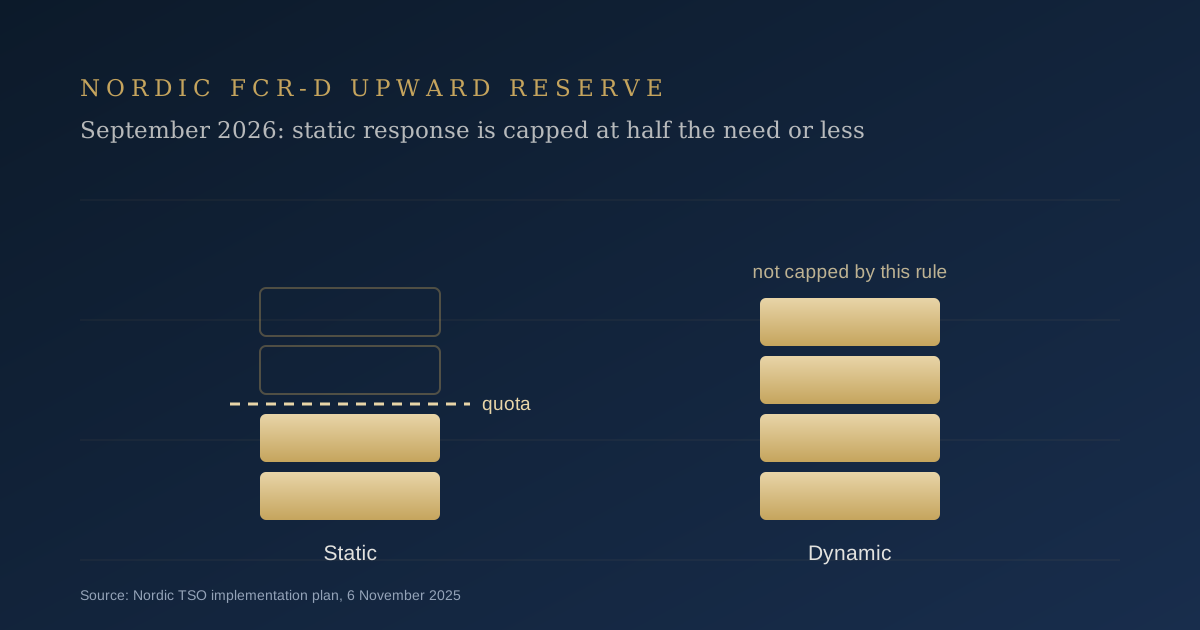
From September 2026 the four Nordic transmission system operators (TSOs) will cap how much of their upward disturbance reserve may come from the product class with the lighter technical tests. Announced in March 2024 with the implementation plan set in November 2025, it goes live in weeks. The product splits into an exempt class and a rationed class. The line between them is a prequalification file, not a technology category.
The development
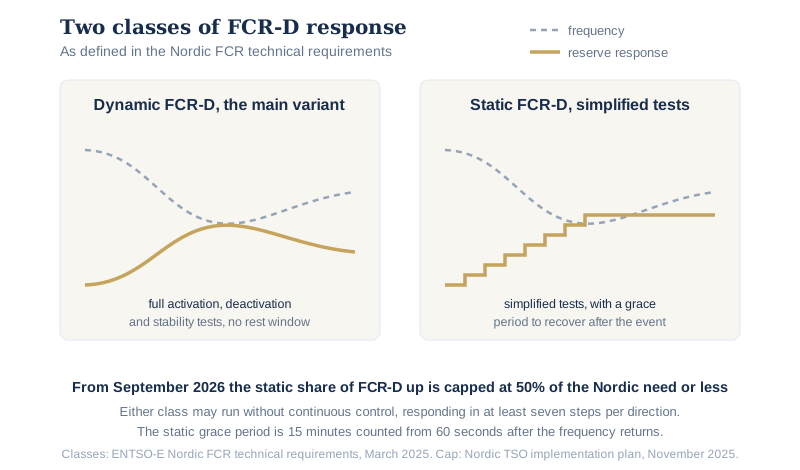
FCR-D, frequency containment reserve for disturbances, is the fast reserve that arrests a frequency fall outside the normal band. The upward product activates below 49.9 Hz, reaches full output by 49.5 Hz, delivers at least 86 per cent of its power within 7.5 seconds and stays on for as long as the deviation persists. Prequalification, the technical testing that admits a resource to a reserve product, splits FCR-D into two classes. Dynamic FCR-D, the main variant, passes the full activation, deactivation and stability tests. Static FCR-D is the simplified variant for resources that struggle with those tests, relay-activated consumption being the TSOs' own example. The binding technical requirements let either class run without continuous control; such a resource must approximate the response in at least seven steps per direction. What static capacity uniquely gets is a grace period: once the frequency has been back in its band for 60 seconds, it has 15 minutes to stand down and be ready again. Inertia is the rotational energy stored in the grid's spinning machines. The playing field is the Nordic synchronous area: Sweden, Finland, Norway and eastern Denmark (DK2).
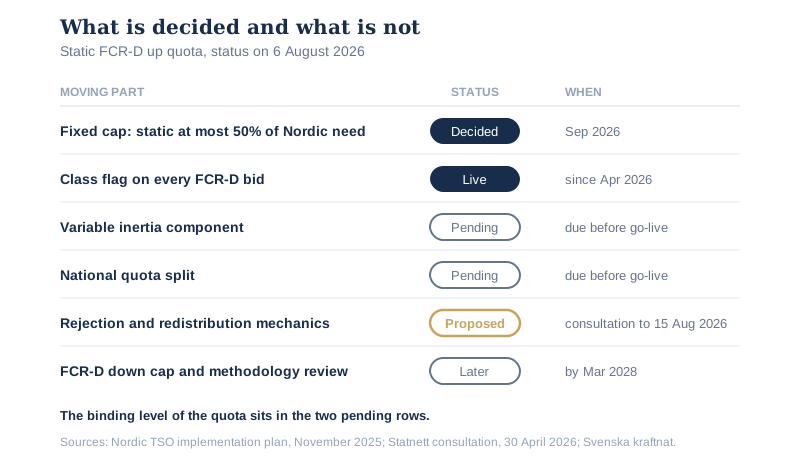
Within that field, Energinet, Fingrid, Statnett and Svenska kraftnät will introduce a volume limitation on static FCR-D up in September 2026, per the implementation plan published on 6 November 2025. A fixed component caps the static share at 50 per cent of the total Nordic demand for the product. A variable component tightens the cap when inertia is low, so the ceiling sits at or below half the Nordic need at all times. The TSOs have promised details of the variable component and the split into national quotas before go-live. The downward product follows later, undated; the methodology is due for amendment by March 2028.
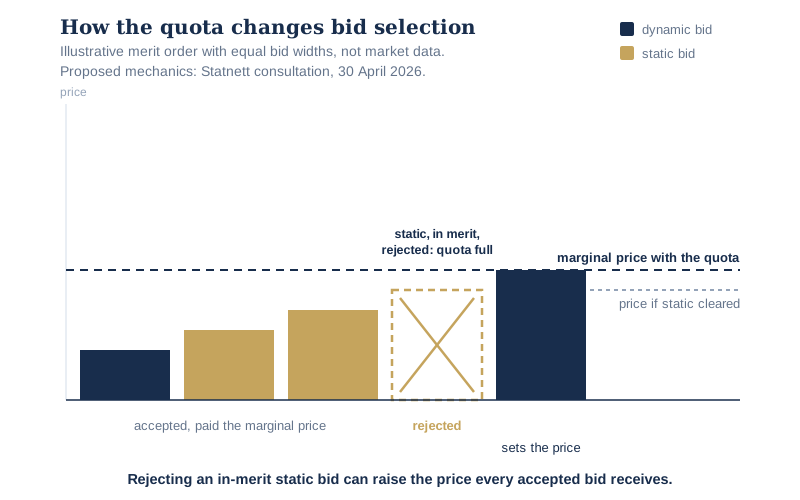
In the auctions, static bids are treated like dynamic bids while the quota fills and accepted static bids receive their auction's marginal price, the clearing price paid to every accepted bid. Statnett's consultation of 30 April 2026, a proposal open for comments to 15 August and then submitted to the regulator, spells out the intended mechanics: once a national quota is full, further static bids are rejected even when priced below the clearing price and unused national quota can be redistributed between the TSOs. The cap is decided; that layer of the rulebook is not yet approved.
What it actually means
The cap is an inertia rule wearing procurement clothes. The TSOs' stated purpose is a sufficient share of dynamic FCR-D through the operating hour. Our read: the Nordic reserve markets are starting to sort bids by how megawatts respond as well as by how many there are. September writes that sorting into the volume rules of an existing product.
The arithmetic frames the stakes. The FCR-D up requirement is sized against the largest credible single failure, 1,450 MW when Oskarshamn 3 runs at full output, so at the maximum requirement the fixed cap works out to 725 MW Nordic-wide, our arithmetic on the TSOs' figures. Within it, Svenska kraftnät's procurement decision for 2026 sets Sweden's maximum at 547 MW and Fingrid's published 2026 obligation is 309 MW. The variable component tightens exactly when inertia is low, so if the quota binds, it will bind hardest in low-inertia hours.
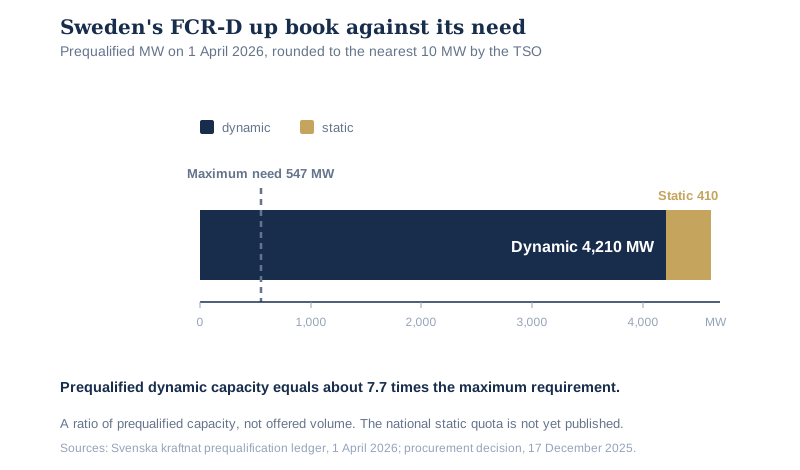
Sweden's ledger shows why the national quotas matter. On 1 April 2026 Sweden had about 4,620 MW of FCR-D up prequalified, rounded to the nearest 10 MW by the TSO: roughly 4,210 MW dynamic and 410 MW static. The dynamic book equals about 7.7 times the maximum requirement, a ratio of prequalified paper, not of offered volume. The live question is static headroom, which no published number settles. If Sweden's quota were simply half of its own maximum need, an illustration and not a rule, the ceiling would be about 274 MW against a 410 MW static book. Where the line lands depends on the unpublished allocation key and on how much static volume bids in the tight hours.
The quota also has a price edge. Statnett's consultation notes that once the quota is filled, a static bid can be rejected even though its price sits below the marginal price, which can push marginal prices and FCR-D costs up. Any such firming accrues to every accepted bid, static capacity inside the quota included. We would not underwrite an uplift for anyone; the rejection risk is what lands only on the static class.
The plumbing is already in place. Every FCR-D bid on Nordic MMS, the TSOs' shared market platform, has carried its class as a bid attribute since the auctions moved there in April 2026. The flag September's rule needs is on every bid today.
Who is affected and how differently
Owners of static resources carry the direct risk. Neither the product nor the settlement rule changes. From September, acceptance can: in the hours the quota binds, a static bid can be rejected while in merit, priced below the level the market clears at.
For batteries the honest reading is narrower than the headline. The most exposed class is relay-based demand response, the TSOs' own example of static provision. A battery's stake is the file. The TSOs' battery leaflet counts 608.3 MW of battery capacity prequalified for FCR-D up in Sweden and 119 MW in Finland at the start of 2025 without splitting it by class, so no published number says how much battery capacity sits in the static book. A fleet qualified years ago behind a coarse control scheme could; the file decides. And dynamic prequalification exempts a battery from the quota, it does not protect revenue: a dynamic bid still competes on price with every other dynamic megawatt in its zone.
Aggregators with mixed fleets must decide which static assets merit a controls retrofit and a new prequalification and which should carry a lower expected acceptance rate. For investors the change is a diligence column: in the models that cross our desk the FCR-D line is still one number; from September it should be two, with the volume risk sitting on one. Utilities running relay-tripped demand programmes should read the consultation line by line.
What to do about it
None of this requires believing the quota will bind hard. The checks are cheap; an October surprise is not.
First, pull the prequalification files and confirm the class of every FCR-D megawatt you own or underwrite. Terms built around a grace period are the tell of the static book.
Second, be realistic about requalification timing. Under the Nordic process the TSO has up to 8 weeks to confirm an application is complete, the provider has 4 weeks to supply anything requested and the decision follows within 3 months, with testing before any of it. A material change such as a new controller can trigger a full prequalification. Started today, that clock does not promise a September landing. Start it anyway where the case is clear.
Third, map static exposure to hours with an acceptance-rate scenario for low-inertia periods; a flat annual haircut misprices both the risky hours and the rest.
Fourth, calendar two dates: the TSOs' pre-launch publication of the variable component and national split, then 15 August, when Statnett's consultation closes. The binding level of the quota lives in those documents, not in the 50 per cent headline.
Fifth, split the FCR-D line in the revenue stack, the layered income mix a battery sells across products, by class and rerun it when the quotas publish. Price a static portfolio's retrofit against expected lost acceptances. For a dynamic battery, book no uplift; run a price sensitivity instead, since the selection rule can move the marginal bid.
The question under the question
This is the kind of question we at Auranova Ventures work through with developers and investors across the Nordics, Baltics and wider Europe. When we model a revenue stack, the prequalification class of each megawatt is now an input; September turns it from paperwork into a revenue variable. The market figures above are the TSOs' own, the acceptance-risk framing around them is ours. If your FCR-D line still reads as one number, reply to this piece and we will talk through how we would split it.
Could you say today, without opening a single filing cabinet, how many of your FCR-D megawatts are prequalified static?
Sources
- Implementation plan for the volume limitation on static FCR-D upward regulation, Fingrid, 6 November 2025
- Implementation plan for the volume limitation on static FCR-D upward regulation, Svenska kraftnät, 6 November 2025
- Volume limitation on static FCR-D in the Nordic synchronous area, Statnett, 25 March 2024
- Technical Requirements for Frequency Containment Reserve Provision in the Nordic Synchronous Area, version 1.1, ENTSO-E Nordic TSOs, 28 March 2025
- Consultation document on updated system operation guidelines with the static FCR-D quota provisions, Statnett, published 30 April 2026, open for comments to 15 August 2026
- Decision on FCR procurement volumes for 2026, Svenska kraftnät, 17 December 2025
- FCR-D upp product page with the dimensioning fault, Svenska kraftnät
- Prequalified reserve volumes as of 1 April 2026, Svenska kraftnät
- FCR market moved to the Nordic MMS platform, Svenska kraftnät, 15 April 2026
- Power system reserves with 2026 national reserve obligations, Fingrid
- Batteries in the Nordic reserve markets, Energinet, Fingrid, Statnett and Svenska kraftnät, April 2025