No Date, Only a Window: The Nordic Link to Europe's mFRR Market Slips Toward Autumn 2027
3 September 2026 · 8 min read · Auranova Ventures
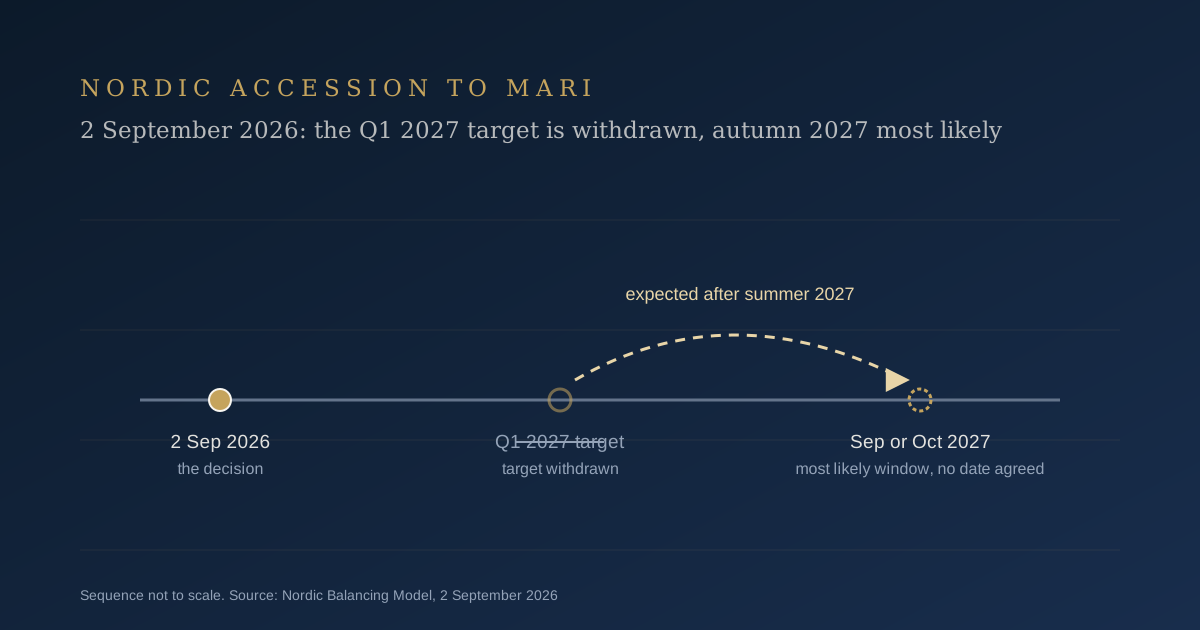
On 2 September the four Nordic transmission system operators (TSOs) withdrew the first quarter of 2027 as the target for connecting the Nordic balancing market to MARI, the European platform for manual frequency restoration reserve. No new go-live date is agreed. The TSOs call September or October 2027 the most likely window. Two months earlier, on 3 July, the same TSOs had reconfirmed Q1 2027. If your 2027 revenue model has European competition reaching Nordic mFRR in the first quarter, that line just lost its target quarter.
The development
mFRR, manual frequency restoration reserve, is the workhorse balancing product: reserves the system operator calls on in scheduled 15-minute blocks, plus direct activations for incidents, to restore the frequency and relieve the faster reserves. Providers can earn on two sides: capacity markets pay those who commit to stand ready and activated energy settles at the marginal price, the price of the last accepted bid; energy-only participation is allowed. MARI, the Manually Activated Reserves Initiative, is the European platform where TSOs pool the energy bids, so the cheapest available bid can serve a need across borders when transmission capacity allows. Capacity payments stay national or Nordic. The platform has been live since October 2022. By April 2026, per Svenska kraftnät's balancing market outlook, 16 TSOs across 13 countries were connected.
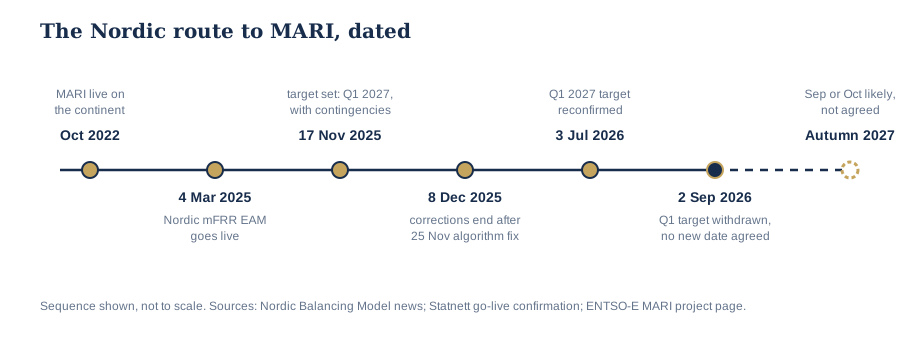
The Nordics staged the approach. The Nordic mFRR energy activation market (mFRR EAM) went live on 4 March 2025, replacing 60-minute manual balancing with automated 15-minute clearing of Nordic bids against Nordic needs. In November 2025 the TSOs set the MARI connection for Q1 2027, flagged as contingent from day one. In July 2026 they reconfirmed it. On 2 September they withdrew it, with "September or October 2027 currently considered the most likely timeframe" and a firm date to follow only once the fix inside MARI has a confirmed schedule.
That fix is the story. The Nordic TSOs have filed change requests to MARI's clearing algorithm, the first proposed algorithm changes since the platform went live, to prevent what they call undesired price spread: balancing prices leaking into areas they should not reach. The request is separate from the Nordic market's own 2025 repair; it asks MARI to build the equivalent protection before the Nordics arrive. They now judge the implementation timeline for that fix incompatible with a Q1 2027 accession and will not start go-live activities until it is in place.
What it actually means
Undesired price spread is not an abstraction; the Nordics have lived through it. After the Nordic mFRR EAM went live, indivisible bids (bids that must be accepted in full or not at all) sitting at the price margin caused bidding zones (the price areas the market splits into) to share clearing prices they should not have. High prices spread wider than intended and some divisible bids priced better than the clearing price were rejected. By the TSOs' own account, mFRR prices and imbalance prices (the prices balance responsible parties settle their errors at) did not always reflect the market situation. Bid selection stayed correct throughout; the flaw sat in price formation. The TSOs corrected prices manually for months, deployed an updated algorithm on 25 November 2025 and stopped those spread corrections on 8 December. The September decision is that memory applied at continental scale.
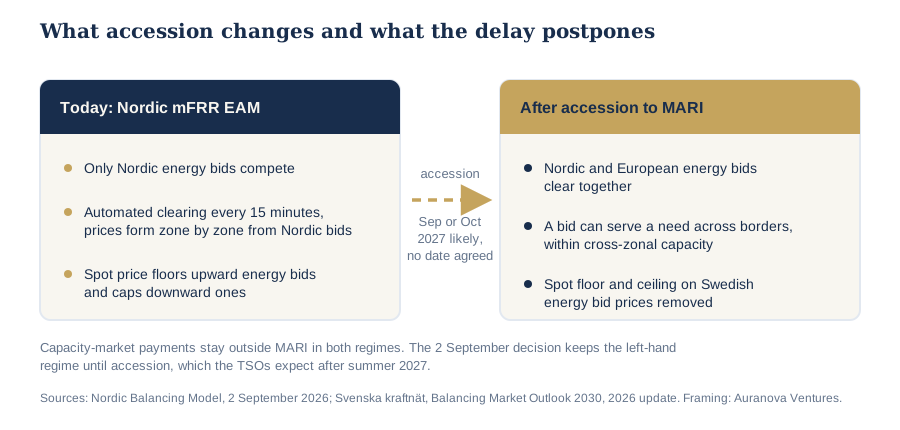
For asset owners, two changes on connection day matter most for revenue. First, the energy bid pools join: European balancing energy bids can be activated for Nordic needs and Nordic bids for continental needs, within the cross-zonal transmission capacity (the room left on the borders) still available in the balancing timeframe. Second, a pricing fence inside the bids falls: per Svenska kraftnät's outlook, the day-ahead spot price stops being the floor for upward regulation energy bid prices and the ceiling for downward ones, widening the bidding space in each quarter-hour.
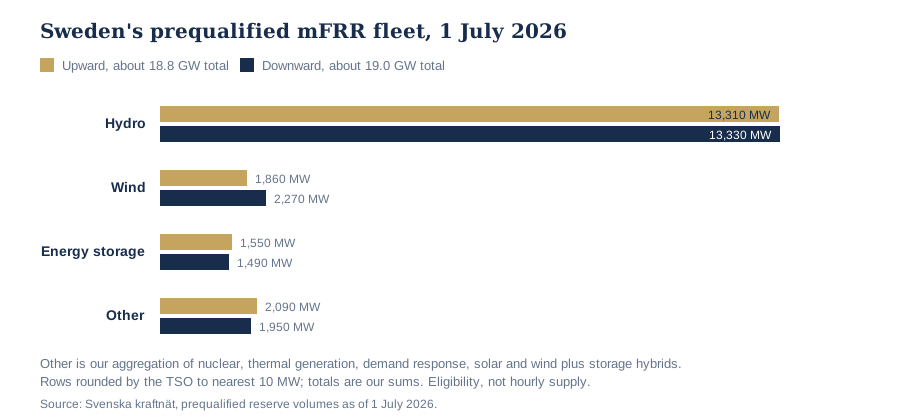
Until then, Nordic mFRR energy prices form from Nordic bids alone. Prequalification, the technical testing that admits a resource to a product, sets who can bid at all. In Sweden that eligible pool is hydro-heavy: of about 18,800 MW prequalified for upward mFRR on 1 July 2026 (our sum of rows the TSO rounds to the nearest 10 MW), hydro holds 13,310 MW, energy storage 1,550 MW and wind 1,860 MW. Svenska kraftnät's caveat applies: prequalified volume is theoretical; the bids actually in the market in any quarter-hour are fewer. The Swedish mFRR capacity market, which stays outside MARI, procures up to 1,300 MW upward and 1,155 MW downward per the June outlook.
Which way accession moves prices is genuinely two-sided. A deeper continental bid pool can undercut Nordic bids in calm quarter-hours; continental scarcity can pull Nordic flexibility into export and lift tight ones. The sharpest counterargument: little cross-zonal capacity may be left for balancing energy in exactly the quarter-hours that matter. That argues for scenario weights, not for ignoring the calendar. When we model this for a specific battery, the answer turns on that border headroom and the shape of the two bid pools in the hours the asset clears, so we carry accession as scenarios, not a step change. Svenska kraftnät notes MARI activity was initially low with few TSOs connected. What the delay does is simpler: on the TSOs' stated expectation, winter, spring and summer 2027 clear Nordic-only, where the old plan had European competition arriving in the first quarter. An illustration, ours: a model that had continental competition trimming Swedish mFRR energy prices from January 2027 applied that trim to four quarters of 2027. Re-dated to the autumn window, the same assumption touches one quarter, two at most.
Who is affected and how differently
Developers with merchant Nordic batteries in financing feel this first. Any revenue curve with a regime change dated Q1 2027, in either direction, is mis-dated: the TSOs expect the new date after next summer and have committed to nothing. Debt sizing now has three periods: a Nordic-only run the TSOs expect to last through summer 2027, a transition window and a European regime with slip risk.
Investors should treat platform timing as a named diligence risk, not background. Q1 2027 was contingent from the day it was set; a well-built model already held timing scenarios. What changed on 2 September is that the target quarter is gone with nothing firm behind it, the second revision in ten months. When a seller's forecast shows a 2027 inflection in mFRR or imbalance revenue, the first question is which platform calendar produced it.
Utilities running hydro portfolios read the delay from the other side. Hydro holds about 71 per cent of Sweden's prequalified upward pool, a technology share, not an ownership measure. Every quarter the fence stands, the mFRR energy price forms from Nordic bids alone.
Policymakers should read the decision as governance, not setback: the TSOs chose algorithm quality over an integration date, informed by 2025, when price formation errors could reach imbalance prices in some intervals until the November fix. The price is a longer wait for cross-border efficiency gains.
What to do about it
First, re-date the assumption. Move any European-coupling effect on Nordic mFRR energy prices to autumn 2027 and carry a scenario where it slips again.
Second, re-run 2027 sensitivities with a Nordic-only bid pool through the summer of 2027. If your base case had continental competition compressing prices from January, the extra months are upside worth quantifying; the reverse if you counted on export demand.
Third, in any acquisition, tag every revenue curve with the platform calendar behind it; two curves for the same asset can quietly differ on nothing more than an assumed accession date.
The calendar is a model input
This is the kind of question we at Auranova Ventures work through with developers and investors across the Nordics, Baltics and wider Europe. The dates and component volumes above are the TSOs' published figures; the aggregates, the three-period framing and the risk reading are ours. In our revenue-stack and forecasting work the platform calendar sits beside price and volume as an input in its own right. If your 2027 Nordic battery case still turns on a January accession, reply and we will walk through how we would re-cut it.
When the go-live date finally lands, will your model already hold a scenario for it or will it be rebuilt around it?
Sources
- Changes in the target timeline for the Nordic accession to the MARI platform, Nordic Balancing Model, 2 September 2026
- Reconfirmation of the target timeline for the Nordic accession to the MARI platform, Nordic Balancing Model, 3 July 2026
- Update to the timeline for the Nordic accession to the MARI platform, Nordic Balancing Model, 17 November 2025
- New implementation fixes undesired price spread issue in Nordic mFRR EAM, Nordic Balancing Model, 8 December 2025
- Ny fase i automatisert balansering, Statnett, 7 March 2025, confirming the 4 March mFRR EAM go-live
- Confirmation of mFRR EAM go-live 4 March 2025, Statnett, February 2025
- MARI, the European mFRR platform, ENTSO-E project page
- Balancing Market Outlook 2030, 2026 update, Svenska kraftnät, June 2026
- Prequalified reserve volumes as of 1 July 2026, Svenska kraftnät