Batteries Pay to Use the Grid Twice. Europe Is Unwinding That in 2026
14 July 2026 · 7 min read · Auranova Ventures
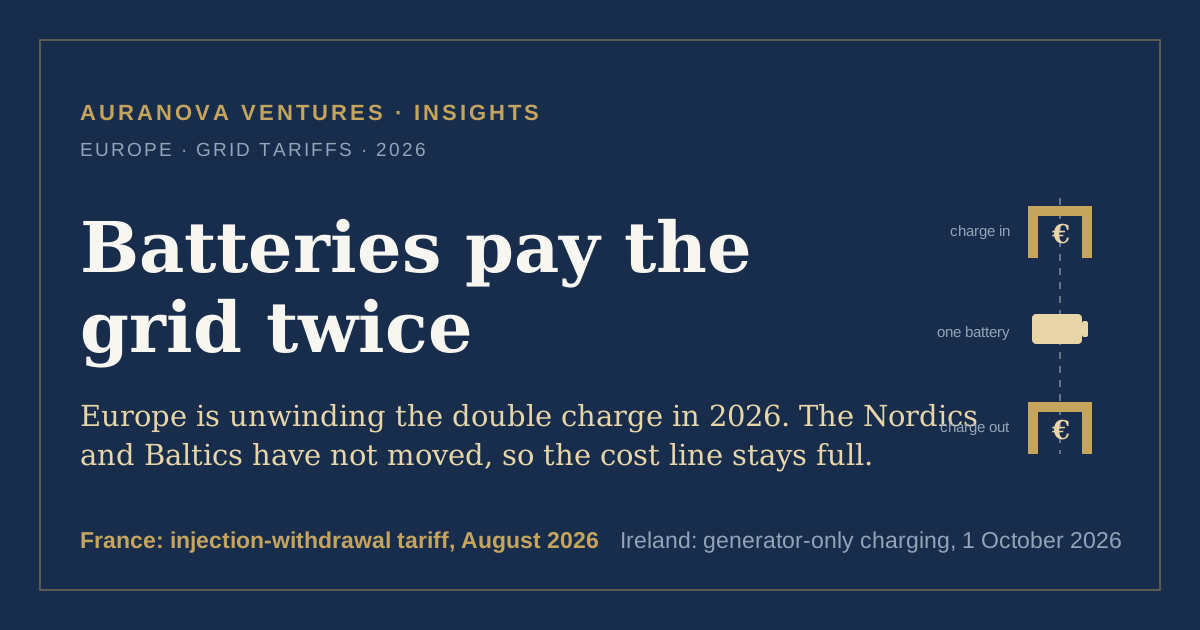
Next month a battery in France can stop paying to use the grid twice. From August 2026 French storage can opt into a new injection-withdrawal grid tariff. On 1 October 2026 Ireland starts charging every storage asset as a generator rather than as a consumer. Both fix the same quiet drag on the business case, the double charge that treats a battery like a factory when it draws power to charge. The Nordics and Baltics have not moved. That gap is now a number in the model.
A short glossary first
This lives in the least glamorous corner of the revenue stack, so a few plain definitions before the argument.
A grid or network tariff is what the system operator charges a connected asset to use the wires. It usually has a capacity part priced per kilowatt of subscribed connection and an energy part tied to what flows.
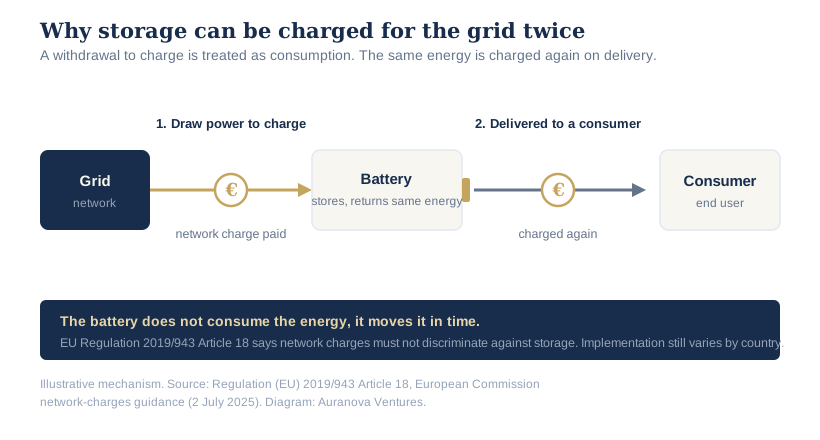
Double charging is when a battery pays that network charge on the way in when it draws power to charge, then the same electricity is charged again when it is finally delivered to a consumer. The battery does not consume the energy. It moves it in time. Charging it as final consumption bills the grid for the same megawatt-hour twice.
Generator use of system versus demand use of system is the split most transmission charges make, by whether you are seen as feeding the grid or drawing from it. Storage sits awkwardly across that line.
The injection-withdrawal tariff, in France part of the TURPE7 framework set by the regulator CRE, is an optional structure that prices when a battery charges and discharges rather than treating every withdrawal as consumption.
The development
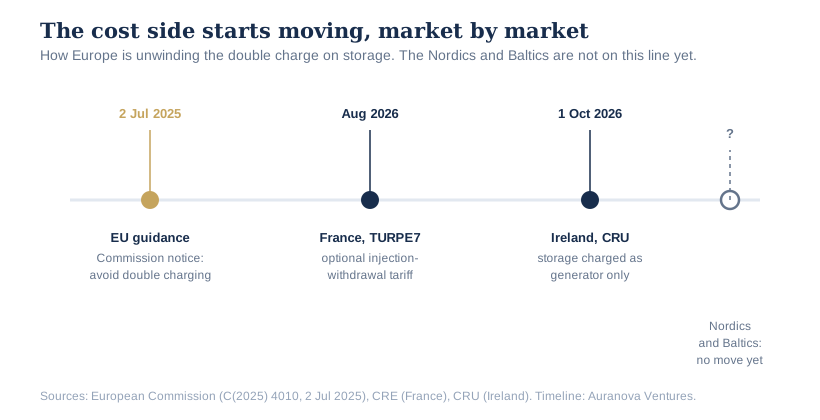
The principle is already European law. Article 18 of Regulation (EU) 2019/943 says network charges "shall not discriminate either positively or negatively against energy storage" and shall not be distance related. On 2 July 2025 the European Commission went further with a notice on future-proof network charges that names double charging as an obstacle to storage and asks member states to design it out. The principle is settled. The implementation is where markets diverge.
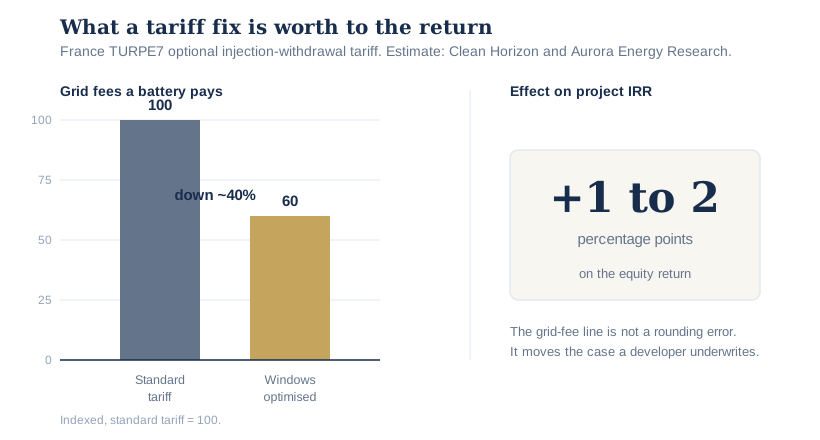
France moved first with a concrete tariff. Its regulator CRE approved the TURPE7 framework in October 2025. From August 2026 a battery can choose an injection-withdrawal tariff that rewards charging and discharging in the windows the grid needs, roughly the winter morning and evening peaks for discharge and summer midday for charging. Analysis by Clean Horizon and Aurora Energy Research puts the prize at a grid-fee reduction of around 40 percent for an asset that optimises around those windows, worth one to two percentage points on project IRR.
Ireland took a cleaner route. From 1 October 2026, the 2026/2027 tariff year, its regulator the CRU will charge every energy storage unit under generator transmission tariffs only, with no demand charge. Until now Irish storage has paid a demand charge of up to 30 euro per megawatt-hour every time it imports power to charge, treated as a large consumer rather than a flexibility asset. The new step removes that charge and puts storage on the same generator basis as wind and solar.
What it actually means
This is the cost side of the stack. It has been the least examined line in it. The reserve markets and the energy spread get the modelling attention because that is where the revenue is. The grid tariff sits on the other side of the ledger, fixed and dull. It is often carried into a model as a flat assumption lifted from a neighbouring project. When the tariff itself is being redesigned, that flat assumption is the risk.
When we run a bankability case, the grid-fee line rarely swings the headline the way an FCR-D price does. FCR-D is the fast frequency reserve Nordic batteries have lived on. Its price moves loudly year to year. The grid tariff does something quieter and more durable. It sits in every operating year for the life of the asset, it is close to fixed and it is senior to the merchant upside. A forty percent cut to that line (or its absence) does not just change one year. It resets the floor under the whole model. The figures above are third-party estimates for the French case. The point that a near-fixed cost line moving is worth more than it looks is ours. It holds in any market.
Who is affected and how differently
For a developer building in France or Ireland now, this is a design input, not a footnote. The asset should be sized and its dispatch strategy set with the new tariff in view, because the windows that minimise grid fees are not always the ones that maximise energy arbitrage. The two objectives have to be modelled together.
For a developer in the Nordics or the Baltics, the story is the reverse. There is no injection-withdrawal option and no storage-specific exemption to plan around. Svenska kraftnät, to take the clearest case, charges connected assets a capacity fee per subscribed kilowatt plus an energy loss charge. Its published national tariff makes no distinction for storage. The grid-fee line stays full. Our read is that this is now a live diligence question rather than a settled input, because the European direction of travel is set and national regulators have been asked to follow it.
For an investor, the double charge is a sensitivity that has been hiding in plain sight. A model that assumed a flat grid cost for ten years in a market that later adopts an injection-withdrawal tariff has understated the return. One that assumed a French-style exemption in a Nordic market that keeps charging in full has overstated it. Neither is wrong to hold a number. Both are wrong to treat it as fixed.
For a policymaker or a regulator in the region, the competitive signal is plain. Storage is mobile capital. France and Ireland have made their grid treatment a selling point. A market that leaves the double charge in place is quietly less bankable than one that removes it, at the same reserve prices.
What to do about it
A few concrete moves for this quarter.
Pull the grid-fee line out of the fixed-costs block and model it explicitly, per market, with its capacity and energy parts separated. A blended number hides exactly the risk that is now moving.
In France and Ireland, model the injection-withdrawal or generator-only treatment directly and check whether your dispatch strategy still holds once grid-fee minimisation is one of the objectives. The cheapest charging window and the most profitable one may not coincide.
In the Nordics and Baltics, run the case both ways, with the current full tariff and with a France-style exemption. Treat the gap between them as a policy sensitivity. If the equity case only clears under an exemption that does not exist yet, that is worth knowing before financial close.
For investors, add a grid-tariff sensitivity to diligence alongside the reserve-saturation one. Ask which tariff regime the model assumes and what the return does if it changes.
Watch the national regulators, not just the Commission. The binding principle is already in Article 18. The money is in how Svenska kraftnät, Fingrid, Energinet and the Baltic operators choose to implement it.
Where we come in
We at Auranova Ventures spend a good part of our week pulling lines like this one out of the fixed-cost block and pricing them properly, per market and per asset, in the revenue-stack and bankability models we run for developers and investors across the Nordics, Baltics and wider Europe. The grid tariff is the line most models still carry as a flat assumption. It is the one now moving under everyone's feet. If you are underwriting a project and want a second read on how the tariff question hits its floor, reply or start a conversation. We are also building a tool that models these stacks across markets, grid fees included, so tell us if you would like early access when it opens.
Is the grid-fee line in your current model a real number or a placeholder? We read every reply.
Sources
- Regulation (EU) 2019/943, Article 18 on charges and non-discrimination against storage: https://eur-lex.europa.eu/eli/reg/2019/943/oj/eng
- European Commission, guidance on future-proof network charges (2 July 2025): https://energy.ec.europa.eu/news/commission-continues-action-lower-energy-bills-new-guidance-renewables-grids-infrastructure-and-2025-07-02_en
- Energy-Storage.news, France introduces grid tariff reforms for energy storage (TURPE7 injection-withdrawal, August 2026): https://www.energy-storage.news/france-introduces-grid-tariff-reforms-for-energy-storage/
- Energy-Storage.news (ess-news), Irish regulator plans to reduce grid fees for energy storage (CRU generator-only charging from 1 October 2026, demand charge up to 30 euro per MWh): https://www.ess-news.com/2026/04/30/irish-regulator-plans-to-reduce-grid-fees-for-energy-storage/
- Energy Storage Ireland, CRU confirms decision to scrap grid demand charges on battery storage from October 2026: https://www.energystorageireland.com/2026/06/press-release-cru-confirms-historic-decision-to-scrap-unfair-grid-charges-on-battery-storage-from-october/
- Svenska kraftnät, transmission tariff and charges: https://www.svk.se/en/stakeholders-portal/electricity-market/connecting-to-the-grid/tariffcharges/
- Paul Hastings, Unlocking Energy Storage in the EU and France (double-charging analysis): https://www.paulhastings.com/insights/client-alerts/unlocking-energy-storage-in-the-eu-and-france-regulatory-and-contractual-pathways